



The ninth annual Silicon Catalyst Semiconductor Industry Forum was held last week at the Computer History Museum in Mountain View, CA. This event has a rich history of probing the key challenges of the day with a world-class speaking panel. The focus is always on “What’s Next”. The event last week lived up to the Forum’s reputation with an excellent presentation from GlobalFoundries and a far-reaching and thought-provoking panel discussion from a group of industry luminaries.
What follows are the highlights of the event for those who missed it. For future Forum events, you should register to attend if you can. You won’t be disappointed. With that, let’s look at some of the key points from the Silicon Catalyst 2026 Semiconductor Industry Forum – What’s Next for AI, Quantum, and Space.
Setting the Stage
Richard Curtin, Managing Partner at Silicon Catalyst kicked off the meeting with the question, AI Is transforming engineering, but who is preparing engineers for the future?
He explained that artificial intelligence is rapidly re-writing the rules of semiconductor engineering. But while the technology is advancing at extraordinary speed, the engineers expected to harness it may be getting left behind. And as AI systems become increasingly autonomous, an even more fundamental question emerges: Who will ultimately remain in control?
These questions set the tone for the Forum, where the discussion extended beyond technological innovation to explore the implications of AI for engineering talent, workforce development, and society. This discussion reinforced the Forum’s founding philosophy of the triple bottom line—balancing financial performance, environmental responsibility, and societal well-being.
Three years after launching the 2023 Forum, “Welcome to our AI Wonderland” theme, this year’s Forum is confronting a critical question: As AI becomes more intelligent and autonomous, will humans remain firmly in the loop—or gradually surrender control?
The discussions that followed explored this rapidly evolving landscape and what it means for the future of semiconductor innovation.
The View from Manufacturing
Next, Pete Rodrigruez, CEO of Silicon Catalyst Introduced Tim Breen, CEO of GlobalFoundries. Pete pointed out that GlobalFoundries was the first company to become a Silicon Catalyst Strategic Partner, an In-Kind Partner and limited partner of the Silicon Catalyst Ventures investment group.
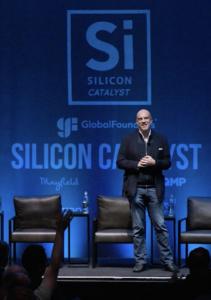
In his keynote presentation, “AI everywhere to quantum at scale: Building the semiconductor foundation for the next era of technology”, Breen delivered a clear message: the semiconductor industry’s most exciting chapter is still ahead.
His keynote highlighted three fundamental developments:
- AI is only beginning to realize its potential
- Semiconductor manufacturing is becoming increasingly strategic
- Quantum computing is approaching an important inflection point.
He explained that for decades, semiconductors operated largely behind the scenes, delivering revolutionary technologies while receiving relatively little public attention. Today, that has changed dramatically. Artificial intelligence, massive data center investments, autonomous systems, and emerging quantum technologies have propelled semiconductor innovation to the center of the global economy.
The extraordinary expansion of AI data centers represents one of the largest infrastructure investments in modern history. Yet according to Breen, the industry’s current focus on GPUs and computing capacity captures only part of the opportunity.
As data centers expand toward gigawatt-scale power consumption and racks approach megawatt-scale requirements, bottlenecks are moving beyond computation into memory, power delivery, and connectivity.
These challenges are fundamentally changing the semiconductor technologies needed to support AI infrastructure. Energy efficiency increasingly depends on metrics such as picojoules per bit, while advanced power delivery requires unprecedented current densities. Meanwhile, silicon photonics and optical communication are becoming essential for moving enormous quantities of data efficiently.
For GlobalFoundries, which has invested in silicon photonics for more than a decade, the rapid emergence of optical connectivity represents an important validation of its technology strategy.
Breen concluded with the observation that although advanced process nodes remain important, future innovation will increasingly involve specialized materials, heterogeneous integration, power management, sensing, connectivity, and application-specific architectures. For semiconductor companies, the opportunity extends far beyond delivering more computational performance.
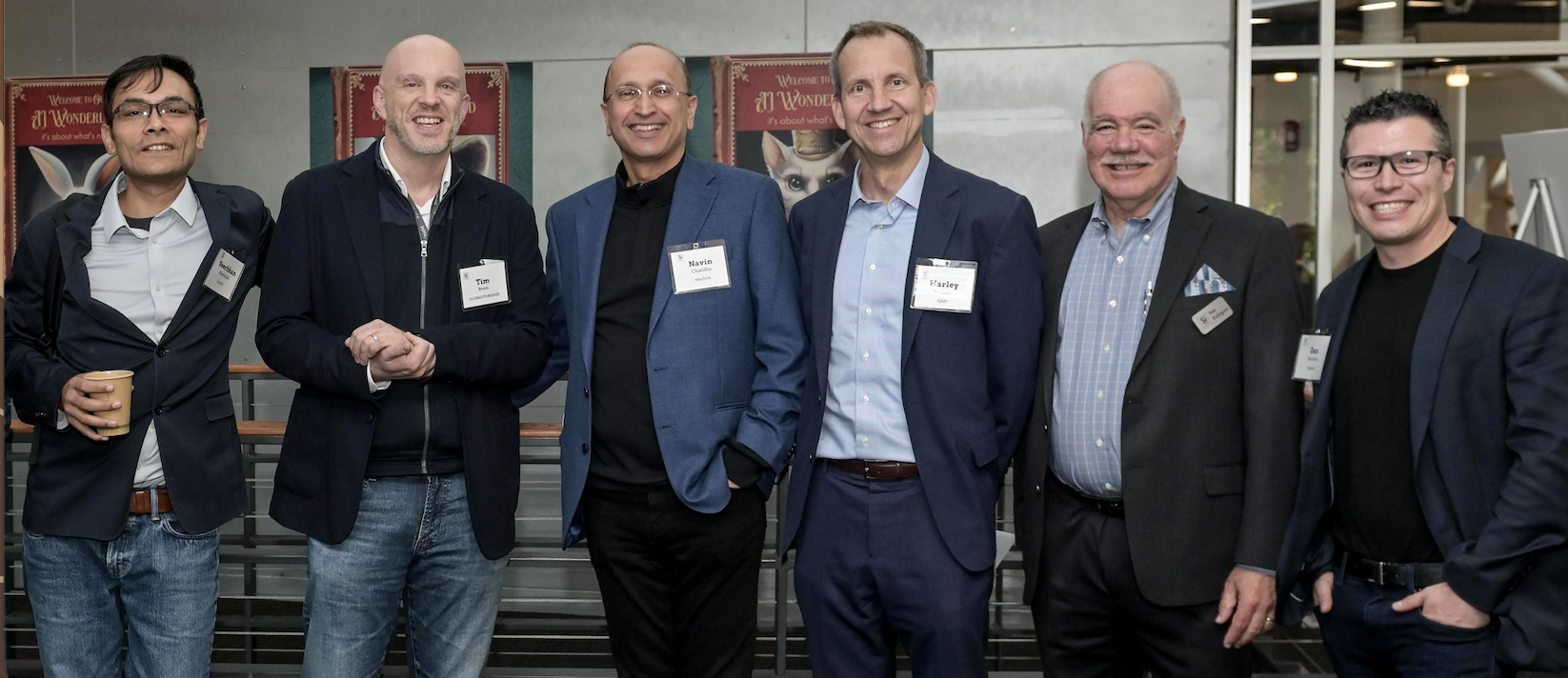
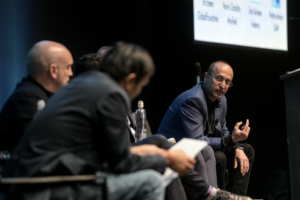
Next, the event moved to a spirited panel discussion. The participants are shown above. From left to right:
- Veerbhan Kheterpal, Co-founder & CEO, Quadric (Panel moderator)
- Tim Breen, CEO, GlobalFoundries (Keynote speaker and panelist)
- Navin Chaddha, Managing Partner, Mayfield Fund (Panelist)
- Harley Johnson, CEO, Illinois Quantum and Microelectronics Park (Panelist)
- Pete Rodriguez, CEO of Silicon Catalyst
- Dan Dechene, Head of Foundry Business, Anderon (Panelist)
Beyond AI: Why Semiconductors, Quantum Computing, and New Business Models Will Define the Next Decade
As artificial intelligence reshapes the technology industry, a panel of leaders in venture capital, semiconductor manufacturing, and quantum computing explored where the next wave of innovation—and economic value—will emerge.
The semiconductor industry is entering a new era in which hardware is becoming more valuable, AI is transforming business models, and quantum computing is approaching a potential commercial breakthrough. But unlocking these opportunities will require more than technological innovation. It will demand new approaches to manufacturing, investment, and collaboration.
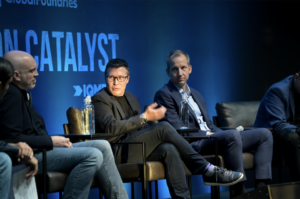 That was the central message of a wide-ranging panel discussion featuring Navin Chaddha, Managing Partner at Mayfield; Harley Johnson, CEO of the Illinois Quantum and Microelectronics Park; Dan Dechene of Anderon, a quantum technology company spun out of IBM; and Tim Breen, CEO of GlobalFoundries representing the semiconductor manufacturing perspective.
The discussion examined where value will accumulate across the technology stack, how quantum computing can move from research to commercialization, and why entrepreneurs should focus on solving real problems rather than chasing extraordinary valuations.
From Software as a Service to Work as a Service – “WaaS”
One of the panel’s most provocative predictions came from Chaddha, who argued that the next major technology transition will move businesses beyond selling software to selling work and measurable outcomes. He called this emerging model Work as a Service (WaaS).
Rather than purchasing software tools that employees operate, organizations will increasingly purchase completed work delivered by AI-powered digital workers and physical robots. Chaddha estimated that approximately $30 trillion is spent annually on digital labor and another $30 trillion on physical labor. If AI captures just 20% of those expenditures, it could create a $12 trillion market opportunity.
This transformation will not eliminate the importance of software platforms, AI models, or semiconductors. Instead, those technologies will become essential infrastructure supporting thousands of companies delivering AI-powered services.
The implication is significant: the next generation of technology leaders may compete on the economic value of work performed rather than the software products they sell.
Hardware Moves Back to the Center of Value Creation
For decades, semiconductor innovation focused on reducing costs to make computing accessible to larger markets. According to Breen, that economic model is changing.
AI-driven computing is increasingly valued not simply for its cost efficiency but for the work it enables. As applications become more complex, manufacturing capabilities, advanced materials, and specialized semiconductor technologies become increasingly valuable. The ability to manufacture advanced devices reliably at scale represents a competitive advantage that cannot be replicated quickly.
Johnson reinforced that perspective, particularly for AI-assisted materials discovery. While AI can dramatically accelerate the identification and understanding of new materials, converting those discoveries into manufacturable products remains extraordinarily difficult.
The panel’s consensus was that AI may accelerate invention, but manufacturing expertise will remain a critical source of competitive differentiation and economic value.
Quantum Computing: From Scientific Promise to Commercial Reality
Quantum computing occupied much of the discussion, with panelists expressing growing confidence that meaningful commercial breakthroughs are approaching. Deshane described quantum computing as being at the “beginning of the beginning,” contrasting its maturity with today’s AI industry.
 Both Deshane and Johnson pointed toward 2028–2029 as a potentially important period for advances in fault-tolerant quantum computing. Such systems could enable more sophisticated algorithms and applications that are difficult to execute reliably on today’s noisy quantum hardware.
However, Johnson cautioned that quantum computing’s equivalent of the ChatGPT moment might not arrive as a single dramatic event. Instead, commercial momentum could build through demonstrations of compelling applications that reveal quantum computing’s unique capabilities.
Chaddha offered an important counterpoint: quantum computing does not need a revolutionary consumer application to become commercially successful. It needs credible, economically valuable use cases. Rather than pursuing trillion-dollar companies immediately, entrepreneurs should identify narrow markets, solve specific problems, establish commercial traction, and expand.
Small, demonstrable successes could provide the confidence needed to attract substantially greater venture investment.
The Semiconductor Foundry Model Could Accelerate Quantum
A central obstacle facing quantum computing is manufacturing scale. Today’s quantum ecosystem resembles the semiconductor industry decades ago, when individual companies and research laboratories developed highly customized technologies using specialized production facilities.
Deshane argued that quantum computing must increasingly leverage the established semiconductor manufacturing ecosystem. That includes wafer fabrication, testing, packaging, system integration, and manufacturing infrastructure.
Quantum devices present unique challenges. For example, testing superconducting qubits can require cryogenic environments and lengthy measurement procedures. Nevertheless, the panel emphasized that quantum companies should avoid unnecessarily duplicating manufacturing capabilities that already exist.
Breen highlighted the importance of designing for scalability from the beginning, leveraging established semiconductor processes wherever possible. The emerging quantum industry could therefore adopt a fabless-foundry model much earlier in its development than conventional semiconductors did.
Funding Innovation Without Chasing Unicorns
Financing quantum computing represents another major challenge. Chaddha observed that venture capital is currently heavily concentrated in AI, potentially limiting investment in emerging technologies.
He also expressed concern about extraordinarily high private-company valuations unsupported by proven business performance. His recommendation was straightforward: build sustainable businesses that solve identifiable customer problems.
Quantum computing will require collaboration among venture investors, government agencies, universities, research institutions, and semiconductor manufacturers. Panelists pointed to public investment, shared infrastructure, and government-supported benchmarking programs as important mechanisms for accelerating commercial development.
These partnerships can reduce the burden on individual startups while helping establish technical credibility and attract private capital.
A Call to Build the Future Responsibly
The discussion concluded with a broader question about whether society can adapt quickly enough to accelerating technological progress. Rather than predicting technological utopia or catastrophe, Breen encouraged the audience to focus on its responsibility to shape the future. Engineers, entrepreneurs, and investors have unprecedented tools and resources to address difficult problems. Their challenge is to use those capabilities constructively.
The panel also ended with a spontaneous proposal from Chaddha to establish a quantum-focused addition to Silicon Catalyst, offering Mayfield’s participation to jump-start a new initiative for the quantum startup community. That proposal captured the discussion’s underlying theme: technological progress depends on ecosystems willing to accelerate ambitious ideas into transformative and sustainable businesses.
The Next Decade Belongs to the Builders
Three themes emerged from the conversation.
First, AI is shifting economic value toward delivered work and outcomes. Second, semiconductor manufacturing and materials expertise will become increasingly important as computing complexity grows. Third, quantum computing’s future depends on scalable infrastructure and commercially meaningful applications, not simply scientific milestones.
The most important insight may be that transformative industries rarely emerge fully formed. They advance through focused innovation, early customer successes, sustained investment, and partnerships.
The next decade’s winners may not be the companies making the boldest technological predictions, but those that successfully turn difficult engineering problems into scalable, valuable solutions.
Conclusion
These are some of the important takeaways from the Silicon Catalyst event. You can get another perspective on the event from this SemiWiki post. And don’t forget, January 11, 2027, is the application deadline for the next Silicon Catalyst Accelerator screening cycle. You can submit your application here. And that’s a summary of the Silicon Catalyst 2026 Semiconductor Industry Forum – What’s Next for AI, Quantum, and Space.
Also Read:
Sir Arthur C. Clarke Deserves a Nobel Prize
CEO Interview with Paul Butler of VeriQuantix
Building a Faster Path from Semiconductor Idea to Commercial Silicon
Share this post via:


Comments
There are no comments yet.
You must register or log in to view/post comments.