





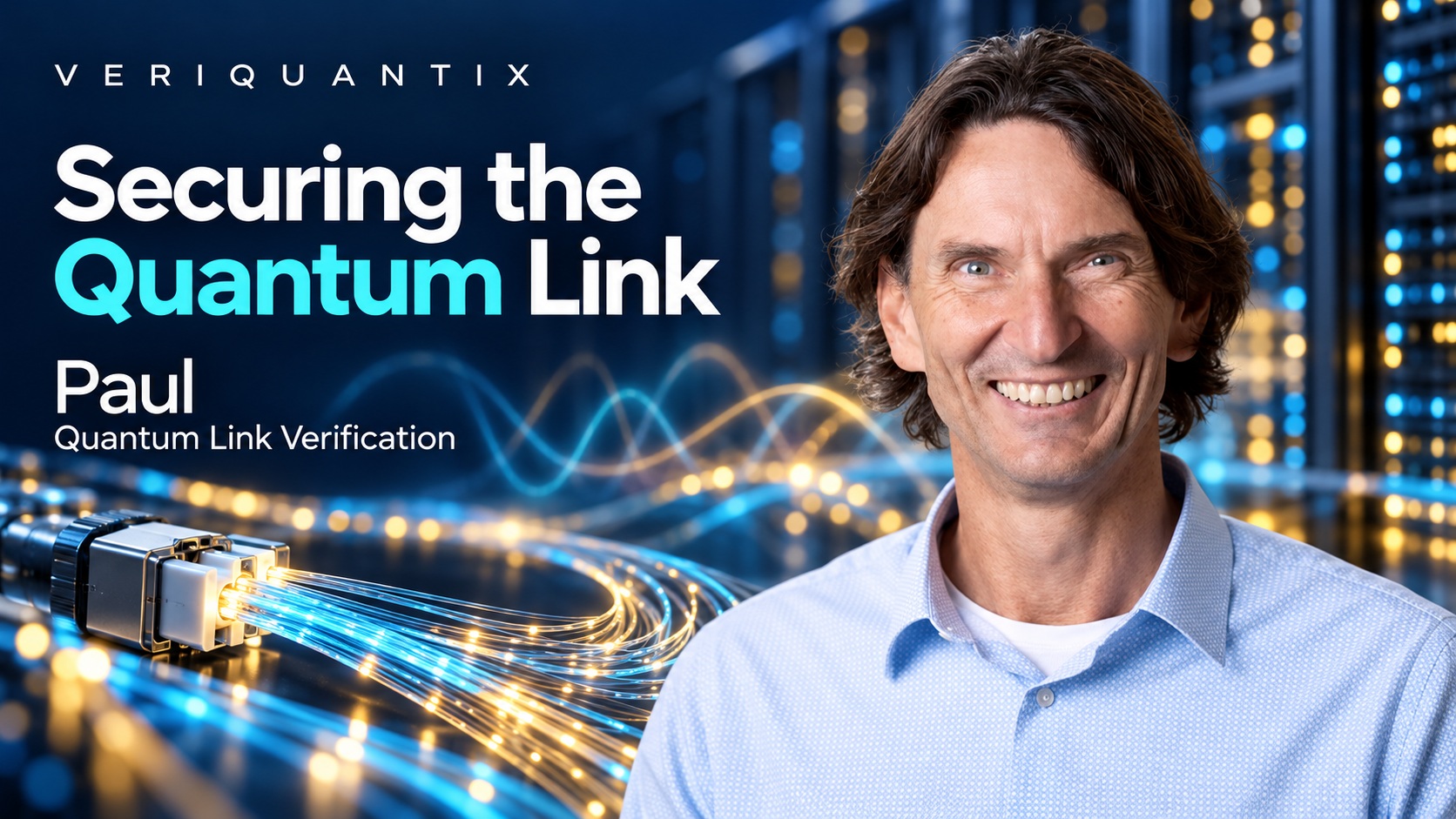
Paul is an experienced CEO/General Manager/Investment Manager who has led and developed teams in a technology domain across the communications, medical and mining industries. With qualifications in Electrical Engineering and a Bachelor of Economics Paul has been able to develop and bring new products to global markets.
Tell us about VeriQuantix. What problem are you solving?
“We’re generating and storing more data than ever, and almost none of it stays put. Every cloud backup, financial transaction, AI request or video stream depends on data constantly travelling between devices, data centres and networks over optical fibre. We’ve become very good at protecting that data with encryption, but we’ve spent far less effort asking a simple question: can we trust the physical path it’s travelling on?
That’s what VeriQuantix exists to do. We’re developing a new layer of cybersecurity for the quantum era. While most security technologies focus on protecting the data, we’re protecting the communication link itself. Our Quantum Link Verification (QLV) technology uses quantum physics to continuously monitor optical fibre networks for physical tampering that conventional systems can miss. It complements post-quantum cryptography: one secures what’s being sent, the other confirms the connection it’s sent over hasn’t been interfered with.
Think of it this way: encryption protects what’s inside the envelope. QLV tells you whether someone has opened the envelope along the way. Almost nobody can answer that second question with confidence today.”
“Harvest now, decrypt later” sounds almost theoretical until you put a $100 trillion number next to it — how did you land on link verification as the answer to that threat?
“The quantum threat isn’t just about breaking encryption. It’s also the fact that stolen data has a long shelf life. Adversaries can capture encrypted traffic today and simply wait for quantum computers to become powerful enough to break it. That changes the economics of the threat completely: it’s no longer a future problem, it’s a data-collection problem happening right now.
We realised that even with quantum-safe encryption deployed everywhere, you still need to know whether someone has physically compromised your fibre network in the first place. Encryption alone doesn’t tell you a link has been tapped, spliced, or diverted. QLV addresses that blind spot by monitoring the optical link itself, rather than assuming the fibre is safe simply because no alarm has gone off. The route your data takes should be just as trustworthy as the encryption protecting it.”
You’ve said the last mile of fibre is the most vulnerable point, and that eavesdropping hardware is a few hundred dollars on eBay — how big a gap is that in what data centres think they’re protected against today?
“Data centers are very good at protecting the data: firewalls, encryption and access control are all layered inside a well-defended perimeter. What they’re much less equipped to do is know whether someone has physically tapped the fibre carrying that data once it leaves the building.
The last mile is often outside the secure perimeter, running through shared conduits, street cabinets, and junction boxes that aren’t under the operator’s direct control. And fibre tapping equipment is commercially available and relatively inexpensive, which means the barrier to physical eavesdropping is far lower than most security teams assume. An attacker doesn’t have to break today’s encryption immediately. They can intercept encrypted traffic moving across the fibre and store it for future decryption.
That’s the gap QLV addresses. It continuously verifies the integrity of the optical link, giving early warning if the communication path has been physically compromised instead of finding out after the fact.”
Your technology sends a photon out and keeps its twin at home, using quantum interference to tell if the link’s been touched — what was the hardest part of engineering that into something that works on real infrastructure, not just in a lab?
“The science of quantum interference has been known for years. The challenge was engineering it into something that works outside a laboratory. In a lab, you have vibration-isolated tables, temperature-controlled rooms, and nobody rerouting your fibre for other traffic. Live telecom infrastructure gives you none of that.
We had to make an extremely sensitive quantum measurement operate reliably over kilometres of deployed fibre, dealing with thermal drift, polarization changes, and the everyday noise of a live network. One of our biggest breakthroughs was replacing the need to store a photon for the fibre’s round-trip time with a locally generated reference. Photon storage is elegant on paper and impractical in the field; it demands specialised hardware and tight timing tolerances. Generating the reference locally instead made the system practical to deploy while keeping the same security guarantees, and it’s a big part of why we’re now talking about pilots on carrier networks rather than lab demonstrations.”
NIST’s post-quantum algorithms get most of the attention — how does QLV fit alongside that rather than compete with it?
“Post-quantum cryptography protects the message. QLV protects the path the message travels on. They’re solving different problems, and together they provide much stronger security than either could alone.
We see QLV as complementary infrastructure, not a competing standard. Enterprises and carriers are already investing heavily in migrating to NIST’s post-quantum algorithms, and rightly so — that work needs to happen regardless. QLV doesn’t ask anyone to choose between the two; it sits at the physical layer, underneath the cryptography, and adds a capability that no algorithm can provide on its own: continuous assurance that the fibre itself hasn’t been touched.”
What do you imagine this to be in 5 years’ time?
“In five years, we would like QLV to be something people don’t think about because it’s a simple element of the network. Today we are working to prove the technology; our next step is turning it into a compact, commercial product, easy to integrate into existing telecommunications infrastructure.
Our goal isn’t just smaller hardware. It’s making quantum link verification a standard layer of network security. Just as organisations today expect encryption to be built into every communication system, we would like to expect continuous verification that the physical communication link itself is also safe. If we are successful in making that shift, we will have moved a sophisticated piece of quantum science out of the lab, turning it into an everyday critical infrastructure.
Why did you join Silicon Catalyst ChipStart AU, and what do you expect to gain from their 12-month program?
The challenge for us is not only to prove the science, but also to turn it into a scalable commercial product. The ChipStart AU program opens up access to expertise to help with this transition.
Over the next 12 months, we want to accelerate QLV development from a lab prototype into a viable, manufacturable product. Having access to mentors and partners who have successfully built deep-tech companies is invaluable because scaling a technology requires a very different set of skills from inventing it.
Success isn’t just building a better prototype. It’s about having a clear pathway to market, strong industry partnerships, and a product that customers can deploy with confidence.
________________________________________________
Website: veriquantix.com
Contact: p.butler@veriquantix.com
Also Read:
CEO Interview with Vivek Raghuraman of Mixx Technologies
CEO Interview with Dr. Stefan Pastine of Thintronics
CEO Interview With Nick Kurayev of ScienceSoft
Share this post via:



Comments
There are no comments yet.
You must register or log in to view/post comments.