







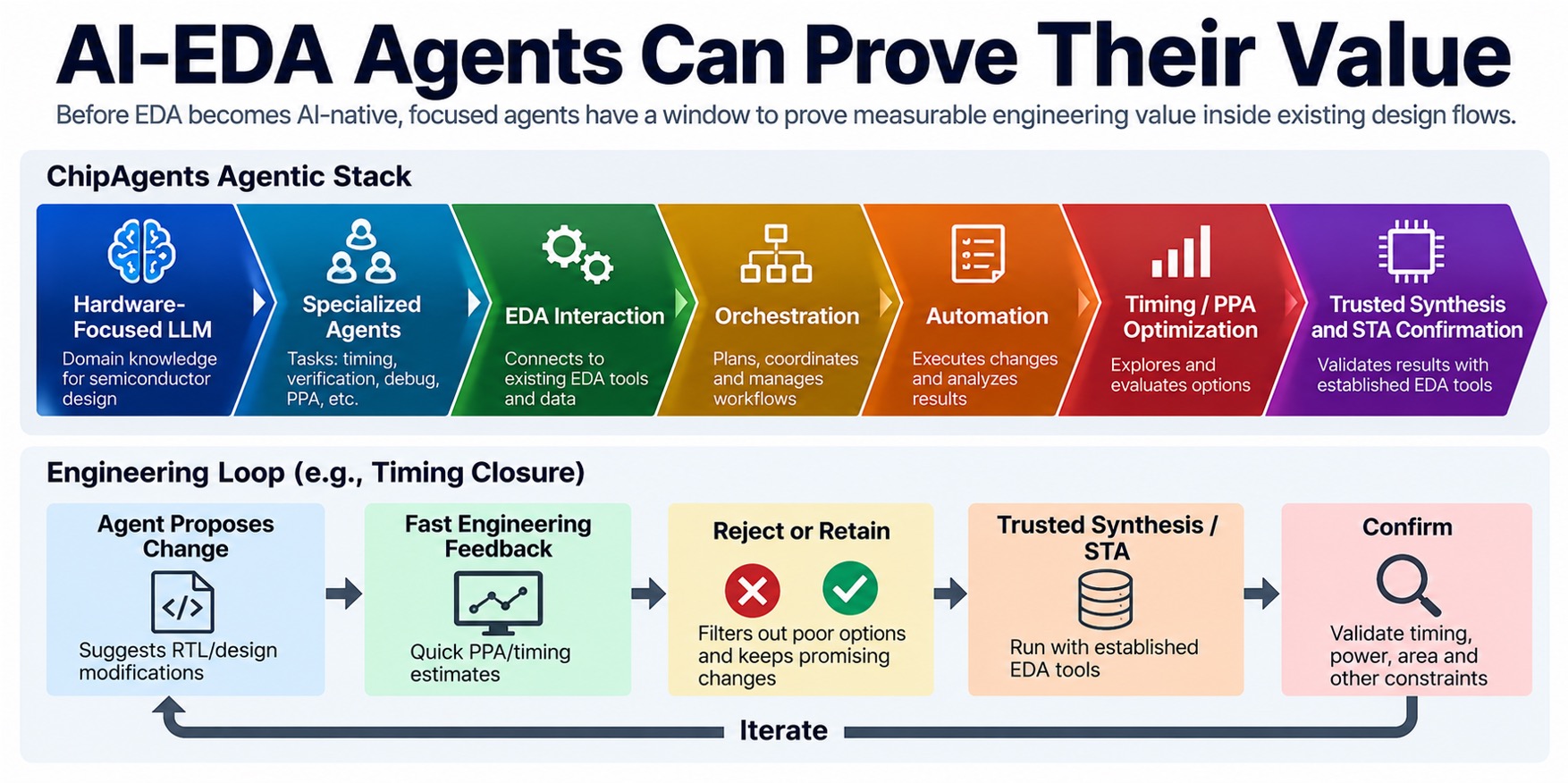
Before EDA becomes AI-native, focused agents have a window to prove measurable engineering value inside existing design flows.
AI is entering semiconductor engineering from several directions at once.
Some companies are building broad agentic design environments. Others are attacking specific bottlenecks: timing closure, verification, debug, root-cause analysis, PPA optimization, and physical implementation.
That focused approach may be especially important.
A startup does not need to replace the EDA stack to create value. It can enter one expensive engineering loop, shorten that loop, and work around the tools engineers already trust.
ChipAgents offers a useful example.
Its recent timing-closure work focuses on a familiar problem: the design change itself may be quick, but discovering the real impact through synthesis, STA, and PPA analysis can take much longer. The opportunity for AI is therefore not simply to make another design change. It is to reduce the cost of the feedback loop around that change.
From Agent to Engineering Loop
For timing closure, the practical loop can be expressed simply:
agent proposes change
→ fast engineering feedback
→ reject or retain
→ trusted synthesis / STA
→ confirm
→ iterate
That is a very practical use of AI.
The agent does not have to replace synthesis.
It does not have to replace STA.
It does not have to become the sign-off authority.
It has to help the engineering team make better decisions before every expensive full-tool iteration.
ChipAgents places that loop inside a broader agentic stack that can be viewed as:
hardware-focused LLM
→ specialized agents
→ EDA interaction
→ orchestration
→ automation
→ timing / PPA optimization
→ trusted synthesis and STA confirmation
The important point is not how many layers exist.
It is whether those layers actually shorten the engineering loop while remaining correlated with the trusted tools underneath.
Start With the Bottleneck, Not the Entire Flow
Semiconductor design contains many expensive feedback loops.
Timing closure is one.
Verification triage is another.
Debug is another.
Coverage closure, root-cause analysis, PPA optimization, and implementation refinement all contain repeated cycles of:
analyze → decide → modify → rerun → inspect → repeat
That is where focused AI agents may first create commercial value.
Instead of asking whether an AI system can design an entire chip autonomously, a customer can ask much simpler questions:
Did it reduce iterations?
Did it find the root cause faster?
Did it improve timing?
Did it preserve power and area?
Did the result survive trusted analysis?
Did engineering time decrease?
Those are much easier to measure.
And that may be how agentic EDA enters production:
one expensive engineering loop at a time.
Fast Feedback Changes the Economics of Iteration
The value of fast feedback is not necessarily that AI discovers something a human engineer could never discover.
It may be that the agent can evaluate more possibilities before invoking the expensive outer loop.
That changes the economics.
If the agent can reject poor choices early, keep promising ones, and reduce the number of full synthesis or STA runs, the engineering team gains time.
That time matters.
In advanced semiconductor development, the cost of a design decision is often not the edit itself.
The cost is the delay required to discover whether the edit was actually useful.
Focused AI can attack that delay directly.
The Hard Question Is Repeatability
A successful demonstration proves capability.
It does not prove a scalable product.
The harder questions begin when the workflow moves beyond one selected example.
How many different designs have been evaluated?
How many starting points?
How many architectures?
How many process technologies and libraries?
How stable is the correlation between the fast estimate and the trusted EDA result?
Does the flow still converge when timing, power, and area conflict?
How often does the engineer need to intervene?
That is the real challenge.
The test is not whether one agent improves one design. The test is whether the method produces repeatable convergence across different designs and conditions.
That distinction is critical.
A startup can show an impressive demo very quickly.
Building an engineering method that behaves consistently across real products is much harder.
Correlation Matters More Than Activity
Agentic systems can generate a lot of activity.
More iterations.
More analyses.
More suggestions.
More automation.
But activity is not the same as engineering value.
If a fast timing or PPA estimate says a change is good, the next question is whether trusted synthesis and STA agree.
That creates a very important measure:
How closely does the fast AI feedback predict the downstream engineering result?
If the correlation is strong and stable, the agent becomes increasingly useful.
If the correlation changes sharply by design, block, corner, or starting point, then the workflow becomes harder to trust.
This is where AI-EDA begins to move from demonstration toward engineering infrastructure.
The Large EDA Companies Have a Structural Advantage
The startup opportunity is real.
But so is the incumbent advantage.
The large EDA companies already own major parts of the engineering environment:
implementation
verification
simulation
timing analysis
physical design
sign-off
IP
design databases
customer workflows
They also have long-standing foundry relationships and deep customer integration.
As AI becomes more deeply embedded in semiconductor design, that position matters.
An incumbent can eventually place AI directly beside the underlying engines that generate the engineering data.
That means a standalone startup has to answer a difficult strategic question:
Why should an engineering team add another platform if similar intelligence becomes native to the tools it already uses?
This is why the timing of the market matters.
The Startup Window Exists Before EDA Becomes AI-Native
Focused AI-EDA startups have a window.
They can move faster.
They can attack narrow pain points.
They can experiment aggressively.
They can build workflows around specific bottlenecks without waiting for an entire EDA platform to change.
That gives them an opportunity to establish measurable value before the same capabilities become standard features of larger platforms.
The startup window therefore exists here:
prove meaningful engineering value before EDA itself becomes AI-native.
That value has to be visible.
Not just more automation.
Not just more agents.
Not just a better demo.
It has to show up as:
fewer expensive iterations
faster convergence
better root-cause identification
stronger PPA tradeoffs
lower engineering effort
repeatable results
trusted-tool agreement
If a startup can prove those things, it becomes harder to dismiss.
Startups Have Speed. Incumbents Have Infrastructure.
That creates an interesting competitive dynamic.
Startups have:
speed
focus
specialization
freedom to experiment
Large EDA companies have:
installed workflows
trusted sign-off
customer relationships
design data
foundry integration
platform scale
Neither advantage is trivial.
The startup does not need to beat the incumbent everywhere.
It only needs to become important enough in one or more workflows that the capability becomes strategic.
That can lead to several outcomes.
The startup may become a broader platform.
It may remain an independent specialized layer.
It may become a partner.
Or it may become strategically attractive to a larger EDA company.
Integration May Matter More Than Autonomy
The companies that create the most value may not necessarily be the ones claiming the highest degree of autonomy.
They may be the ones that integrate most naturally with existing engineering flows.
That is an important distinction.
The first commercial objective may not be:
replace the EDA stack.
It may be:
make the EDA stack dramatically easier, faster, and more intelligent to use.
That is a much more practical path to adoption.
It also lowers the trust barrier because established tools can remain the final engineering reference.
The AI becomes an acceleration layer.
The trusted EDA environment remains the arbiter.
What Should Customers Measure?
The evaluation of a focused AI-EDA agent should go beyond a demonstration.
I would want to understand:
Accuracy
Does the fast AI estimate agree with the trusted result?
Repeatability
Does the workflow behave consistently across repeated runs?
Convergence
Does it reliably move toward the engineering objective?
Breadth
Does it work across different designs and conditions?
Tradeoff control
Can it improve one objective without silently damaging another?
Human intervention
When does the engineer need to step in?
Integration
How naturally does it fit into the existing flow?
Productivity
Does it reduce engineering time or expensive tool iterations?
Those questions matter more than simply asking how many agents are in the system.
The Real Competitive Test
The AI-EDA market may therefore develop in two phases.
First, specialized startups prove value inside narrow engineering loops.
Then larger platforms absorb, reproduce, partner with, or acquire the capabilities that prove important.
Competition between those two forces is healthy.
The startups push the industry faster.
The incumbents can eventually scale the capability across much larger engineering environments.
The strategic question is therefore not whether AI will enter EDA.
That is already happening.
The more interesting question is:
Can focused AI-EDA agents prove enough repeatable engineering value to become indispensable before that intelligence becomes native to the established EDA stack?
That may determine which companies remain standalone platforms, which become strategic partners, and which become part of the larger EDA ecosystems.
Also Read:
Agentic AI Can Reach GDS. What Must It Prove Before Engineers Trust It for Tapeout?
The Future of CPO May Be a Glass Integration Platform
Semiconductor Engineering Has a State-Continuity Problem
Share this post via:



SEMICON West’s Autonomous Fab Vision Needs a Decision-Escalation Design