





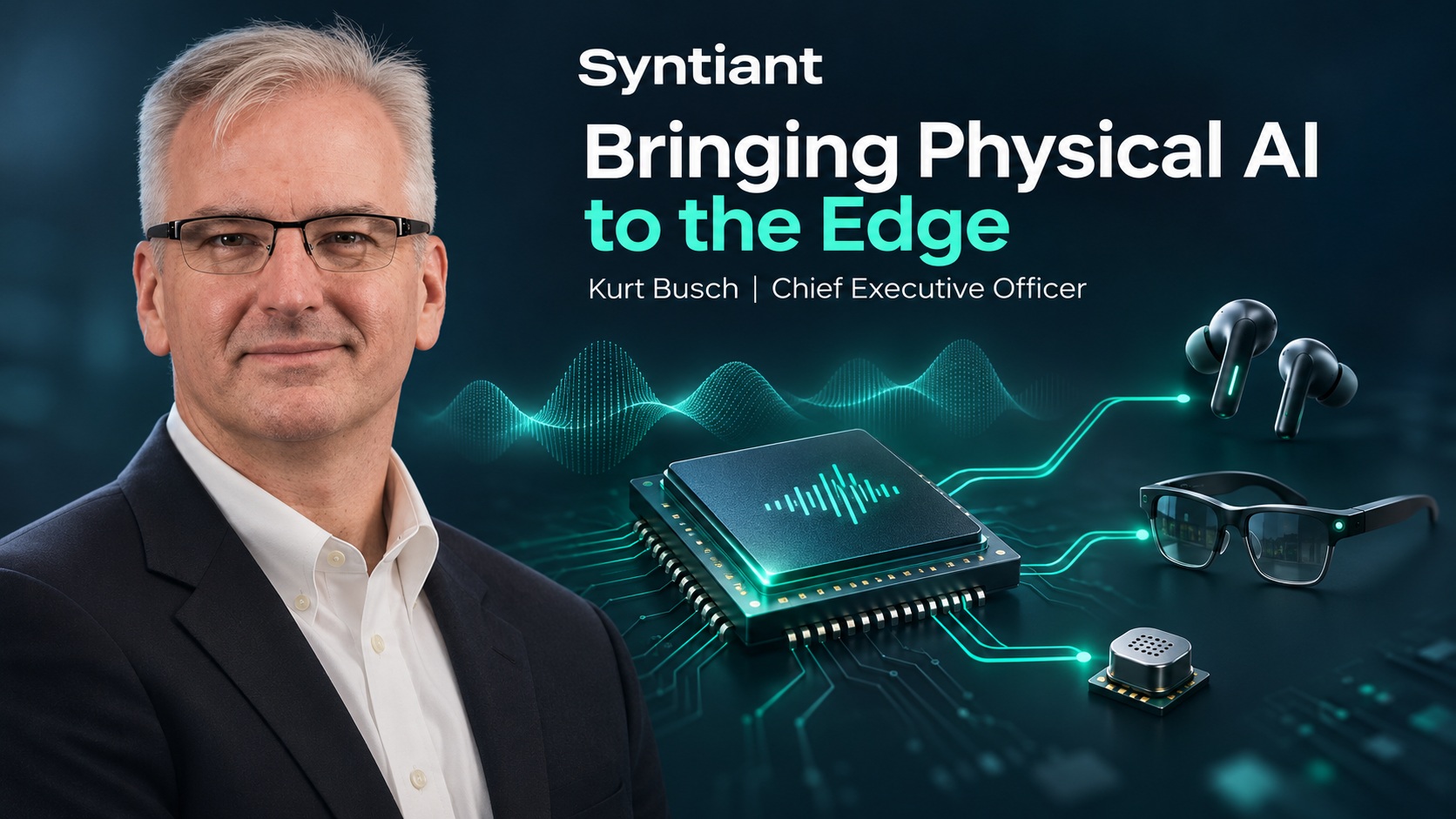
Kurt Busch is the chief executive officer of Syntiant Corp. He has extensive experience in product development, having driven the successful launch of new products, ranging from SaaS and semiconductors for telecom and broadcast video to consumer electronics and data center systems. Prior to Syntiant, he was president, chief executive officer and a member of the board of directors at Lantronix (NASDAQ: LTRX), a global provider of secure data access and management solutions for Internet of Things (IoT) and information technology (IT).
Tell us about your company?
Syntiant was founded in 2017 around a simple idea: AI shouldn’t live only in the cloud. Intelligence needs to exist in the physical world, close to the sensors where data is created. Since our last update with SemiWiki, we have scaled significantly. The Knowles Consumer MEMS Microphone acquisition in late 2024 was transformational for us. It gave Syntiant the ability to combine the sensor (Knowles’ SiSonic™ MEMS microphones), the AI processor (our Neural Decision Processors™) and the models into one platform. That lets us start where the data is created and decide what needs to be processed locally and what should go upstream.
What’s new for Syntiant right now?
We recently completed the acquisitions of Orosound and AudioSourceRE, significantly advancing our capabilities in real-world audio processing. Orosound brings leading technology in voice enhancement and noise suppression, while AudioSourceRE adds sophisticated sound separation, enabling devices to isolate voices and distinguish audio sources in complex environments. Together, these technologies strengthen our ability to deliver high-quality audio capture and interpretation directly on-device, enabling more accurate, private and responsive user experiences even in challenging acoustic environments with background noise, multiple speakers and changing conditions.
We’re also unveiling our new NDP130 Neural Decision Processor at CES 2027, a new class of processor designed specifically for always-on audio intelligence. Built on our Core 3 neural architecture, the NDP130 combines neural inference, advanced audio DSP and ultra-low-latency programmable processing in a single device. This enables next-generation products such as earbuds, headphones and glasses to deliver more sophisticated audio experiences while maintaining ultra-low-power operation. We believe the NDP130 represents an important step forward for Physical AI by bringing more intelligence directly to the sensor and closer to where real-world interactions occur.
What makes the NDP130 different from other edge AI processors?
The NDP130 is really three specialized processors working together, rather than one processor being asked to do everything. Most architectures force neural processing, audio signal processing and latency-sensitive functions to compete for shared resources. The NDP130 gives each its own domain: Syntiant neural processing, a Cadence Tensilica HiFi 5s DSP and a dedicated ultra-low-latency programmable processing subsystem. That lets AI inference, audio processing and applications such as adaptive ANC or speech enhancement to run simultaneously and efficiently at the power levels battery-operated devices require. We see the NDP130 as a foundational building block for the next generation of physical AI products, devices that continuously understand and respond to the world around them without relying on constant cloud connectivity.
Syntiant talks a lot about “Physical AI.” What does that mean?
Physical AI is what happens when AI can hear, see, sense and respond to the real world. It is the expansion of AI beyond the data center into billions of physical devices. It combines sensors, compute and AI models so a device can perceive what is happening around it and act on it in real time. That means embedding intelligence directly into industrial equipment, wearables, automobiles and smart home products, where latency, privacy, power efficiency and reliability matter most.
Is Physical AI real today, or still theoretical?
Physical AI isn’t theoretical for us. Syntiant technology is currently deployed in tens of millions of devices worldwide, spanning applications that use intelligent sensing to recognize sounds, process voice and respond to real-world conditions.
What problems are you solving?
The fundamental problem is that the physical world has very different constraints than the cloud. You can’t put a GPU and a big battery into an earbud, a sensor or most embedded devices. You have milliwatts of power, limited memory, tight cost constraints and often intermittent connectivity. We built Syntiant around solving AI within those constraints, combining purpose-built Neural Decision Processors, low-power sensors, optimized models and software tools so customers can bring differentiated products to market faster.
AI models continue to grow rapidly. Can edge devices keep up?
We see a hybrid future. The edge will handle the tasks where immediacy, privacy and power matter, while the cloud will provide larger-scale compute, broader context and model updates. Models and algorithms will keep evolving, so the underlying architecture has to be resilient enough to support what comes next. By distributing workloads across specialized processing domains, our platform can accommodate new models without a fundamental hardware redesign. The goal is to bet on the architecture, not any single model.
What excites you most about the next five years?
The semiconductor industry is entering a new phase where intelligence is moving beyond the data center and into embedded systems. Over the next five years, intelligent sensing will become ubiquitous, with microphones, cameras and other sensors acting as intelligent front ends that process data locally before sending it onward. Success won’t come from faster processors alone, but from an architecture that orchestrates up and down the entire stack, from sensors and signal processing to accelerators, models and software, to maximize performance per watt. We believe this architectural shift represents one of the largest opportunities the semiconductor industry has seen since the smartphone revolution.
Also Read:
Share this post via:


Jensen Huang and the Cost of Unchecked Influence