



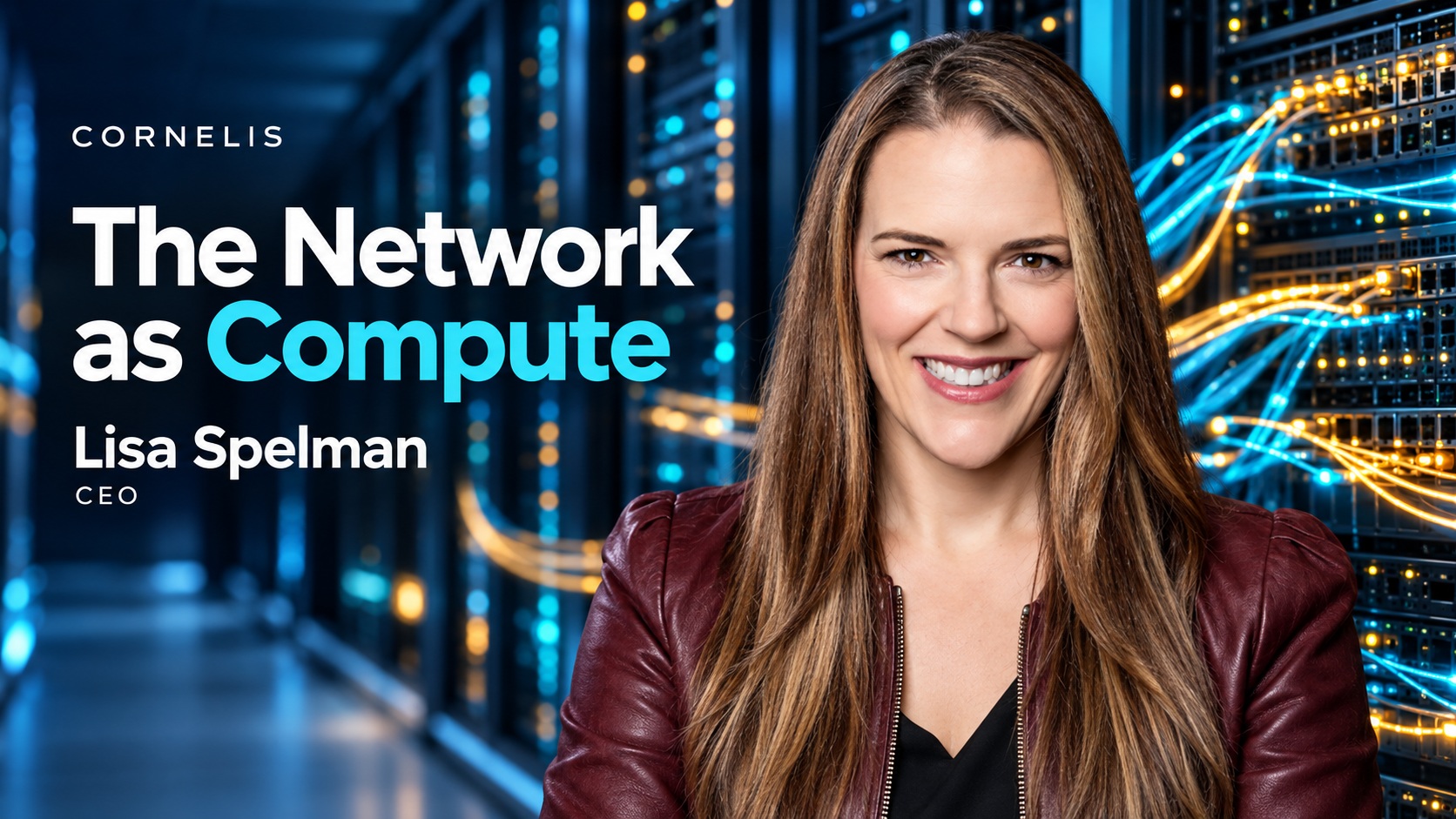
Lisa Spelman is CEO of Cornelis, where she leads the company’s efforts to advance high-performance networking for AI and HPC infrastructure. She brings more than 20 years of experience across AI, cloud, enterprise infrastructure, data center operations, product strategy, and go-to-market leadership.
Before joining Cornelis, Spelman served as Corporate Vice President at Intel, where she led the Xeon Products and Solutions business within the Data Center & AI Group. Over the course of her career, she has also held leadership roles spanning infrastructure engineering, IT operations, enterprise sales, finance, and product strategy.
At Cornelis, Spelman is focused on helping organizations build more scalable and efficient AI infrastructure by improving system utilization, reducing networking bottlenecks, and enabling greater performance at scale.
Can you tell us about Cornelis and its mission?
Cornelis exists to make the network the reason AI and HPC infrastructure overperforms.
Over the last decade, compute, storage, and memory all got smarter about the workload. The network is the last passive layer. It got faster, but it still forwards packets without knowing what’s running on it. As compute accelerates, the largest training, inference, and simulation jobs spend more time waiting on data, leaving expensive compute idle.
Our mission is to turn the network into an active participant in the workload. We design our own networking silicon and systems, SuperNICs and switches purpose-built for AI and HPC, to cut latency and keep compute productive.
We’re working on the third generation of our high-performance networking platform, with more than 50 OEM and ODM design wins. Our open approach gives customers real choice, supporting a wide range of CPUs, GPUs, and accelerators without changes to their applications.
What problems are you solving for AI and HPC operators?
Fundamentally, we’re solving an economics problem: maximizing productive compute at the best performance per watt.
In the network, that challenge shows up as congestion and latency. AI and HPC workloads generate bursts of small messages across thousands of endpoints, and the job often can’t move forward until all of them arrive. Conventional networks may drop and retransmit packets under congestion, adding latency and forcing the job to run at the speed of its slowest exchange.
We designed our network to manage congestion proactively using credit-based flow control, telemetry-driven adaptive routing, and per-packet path selection. We focus on keeping expensive compute productive, completing jobs predictably, and getting more value from every watt and dollar invested in the system.
Which workloads and application areas are the strongest fit for Cornelis today?
Communication-intensive work, where network behavior directly affects application results. This includes both traditional HPC and AI.
On the AI side, that includes large-scale training, disaggregated inference, mixture-of-experts (MoE) models, and other distributed inference pipelines. In HPC, we see strong adoption across scientific computing, engineering simulation, weather and climate modeling, and national research environments. We’re deployed in over 500 datacenters including new large-scale deployments at Lawrence Livermore National Lab and the Texas Advanced Computing Center.
What are your customers’ biggest networking challenges today?
AI infrastructure and the software that runs on it are evolving faster than many networks were designed to support. Distributed training, expert routing, and agentic AI generate huge volumes of small, latency-sensitive messages, where even small delays can compound across the job.
There’s also an economic challenge. Operators investing heavily in compute and power need the network to help use those resources efficiently.
And then there’s choice. Mixed CPUs, GPUs, and workload-specialized accelerators are becoming the norm. Organizations need an interoperable network that fits their workloads without locking them into one vendor’s architecture.
What does the competitive landscape look like, and how does Cornelis differentiate itself?
We differentiate in how we think about the role of the network. InfiniBand and Ethernet keep getting faster, and both were built to move data between endpoints. DPUs and SmartNICs brought intelligence to the edge and did a good job with offload. The fabric in between stayed passive, and in-network processing today is typically fixed-function.
We start from a different assumption. At AI scale, the network should take part in the work. That’s the idea behind the Active Compute Fabric™ we announced this month. It builds on a high-performance scale-up and scale-out fabric and adds programmable RISC-V cores at every hop, across every NIC and switch. Those cores accelerate collectives, KV cache, and MoE routing while the accelerators keep doing math, and customers can tune them to their workloads instead of working within fixed functions. The result is better application performance and more productive work from every accelerator.
The other difference is independence. That fabric is built on open standards, with UALink and ESUN for scale-up and Ultra Ethernet for scale-out. It supports a mix of CPUs, GPUs, and accelerators, so customers can optimize for their workloads without tying their network strategy to a single compute vendor’s roadmap.
AI infrastructure is evolving rapidly. What do you think organizations are getting wrong about networking for AI?
Many still plan the network last, size it by bandwidth, and assume its job is to carry bytes and stay out of the way. At AI factory scale, that assumption breaks. The network acts as the central nervous system, determining how efficiently thousands of processors and accelerators work as a single machine. That makes it part of the compute path.
Organizations getting this right design compute and network together and validate the combination before deployment. Buying accelerators first and solving the network later produces a cluster that looks impressive on paper and underdelivers in production.
What technologies or innovations are you most excited about over the next year?
I’m particularly excited about our move into scale-up networking. As open standards take shape, the playing field gets much wider, and that creates room for real innovation in model FLOPs utilization. Every scale-up domain eventually becomes a scale-out problem, which is why we’re building for both.
That matters because new compute challengers are designing at the rack level instead of the individual chip. Open scale-up gives them a high-performance path to complete rack-scale systems without adopting a single vendor’s stack. As those systems become more heterogeneous, there’s an opportunity to rethink how compute and networking work together.
How do customers normally engage with Cornelis?
Most customers engage with us through our OEM partners. Our technology is already qualified across a broad range of systems and available through major OEMs around the world. Customers can deploy Cornelis through vendors and systems they already know and trust.
That distribution and qualification reflects the maturity of our software and our commitment to an open ecosystem. We’ve spent years building the software, integrations, and OEM relationships to make our technology broadly deployable.
From there, the technical engagement is workload-driven. We work with customers and partners to understand what the application is doing on the wire, where it is stalling, and what the operator wants to improve. Customers can also benchmark their own applications on our fabric before they commit, which we encourage.
Also Read:
Share this post via:


Comments
There are no comments yet.
You must register or log in to view/post comments.