





As semiconductor complexity accelerates across AI, automotive, and edge computing markets, SoC architecture has become a critical determinant of commercial success. Modern silicon programs must simultaneously achieve aggressive performance-per-watt targets, support evolving workloads, and maintain manageable development risk. The emergence of RISC-V as an open and extensible instruction set architecture (ISA) is reshaping how design teams approach these challenges.
Traditional SoC development often treated architecture as an early planning stage before RTL implementation. Today, that approach is no longer sufficient. Advanced process nodes dramatically increase tape-out costs, making architectural mistakes extraordinarily expensive. According to Aion Silicon’s recent white paper on RISC-V system design, even a prototype tape-out on advanced nodes can approach the cost of full production masks, meaning a single re-spin may result in multi-million-dollar losses and missed market windows.
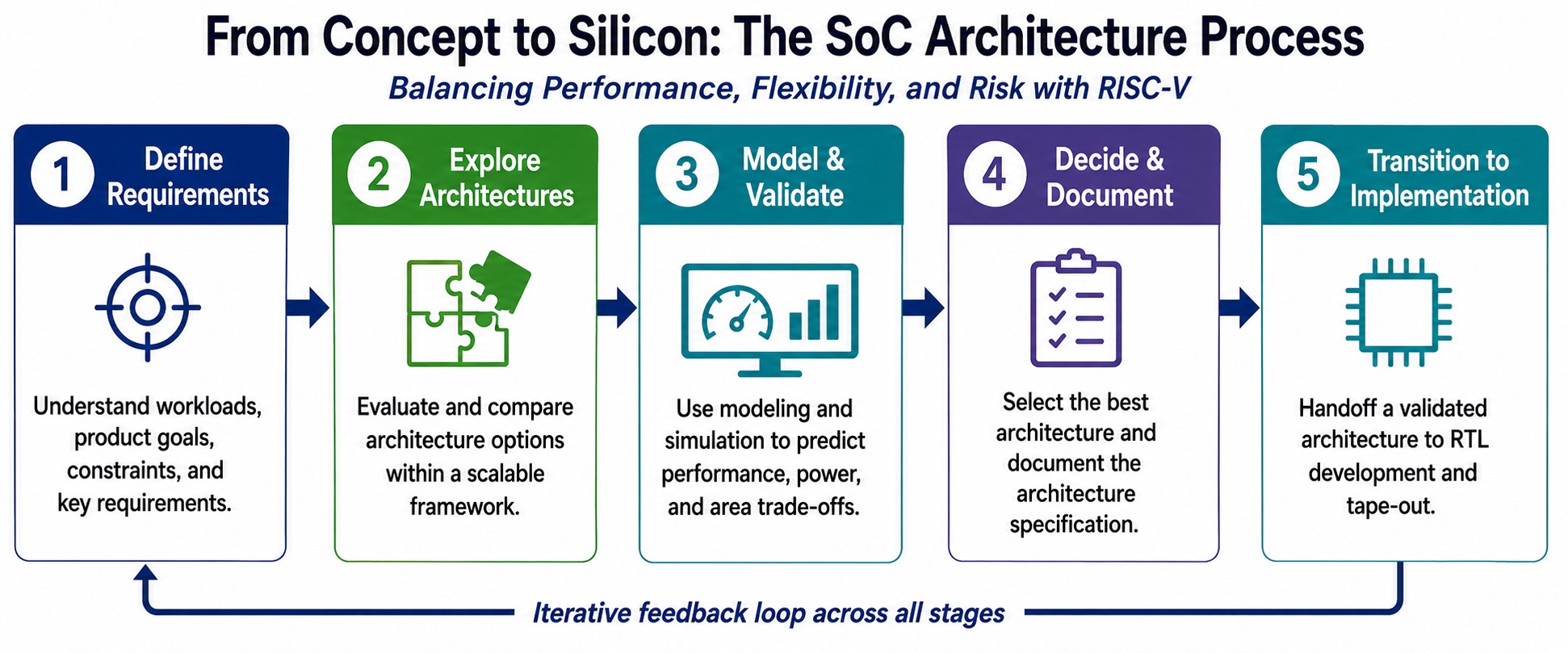
Effective SoC architecture begins with rigorous requirement analysis. Teams must define measurable KPIs covering throughput, latency, power consumption, safety compliance, software ecosystem compatibility, and interface bandwidths before selecting compute resources. These constraints directly influence architectural feasibility and downstream verification complexity.
Modern heterogeneous SoCs increasingly combine multiple compute engines optimized for different workloads. Scalar CPUs continue to provide operating system control and sequential execution, while DSPs handle low-latency streaming workloads such as radar and sensor fusion. Vector processors accelerate SIMD operations common in image processing and AI inference, and GPUs provide massively parallel throughput for machine learning and graphics applications.
The challenge is not simply integrating these compute engines, but balancing them efficiently within a scalable architecture framework. Aion Silicon describes a layered architecture model consisting of compute subsystems, fabric and chassis infrastructure, custom accelerators, and dedicated safety/security subsystems. This modular approach allows engineering teams to optimize performance without unnecessarily increasing verification complexity or power consumption.
Memory architecture and interconnect design have become equally important. AI and edge inference workloads are increasingly constrained by memory bandwidth and data movement efficiency rather than raw compute capability. Cache hierarchy sizing, arbitration policies, and on-chip memory allocation significantly influence achievable throughput and energy efficiency. Small architectural decisions in these areas often create large downstream consequences in thermal performance and silicon area utilization.
To reduce risk, advanced SoC programs now rely heavily on cycle-accurate modeling prior to RTL development. SystemC-based architectural simulation enables engineers to evaluate realistic workload traffic, identify contention bottlenecks, and validate performance assumptions while changes remain inexpensive. This modeling phase transforms architecture from a theoretical exercise into a measurable engineering discipline.
For AI workloads, the modeling process becomes even more critical. Neural network execution generates highly dynamic memory traffic patterns that are difficult to predict using spreadsheets or static analysis alone. Aion Silicon’s methodology models full DNN graphs directly in SystemC, generating traffic profiles, node reordering recommendations, and fusion analysis before implementation begins. This enables architects to quantify the impact of design changes on KPIs such as latency, throughput, and power efficiency before committing to RTL.
RISC-V introduces additional opportunities and challenges within this environment. Its open ISA allows designers to create application-specific extensions tailored to unique workloads. Properly implemented, custom instructions can significantly improve workload efficiency while reducing power and silicon area. However, uncontrolled customization can also increase software complexity, verification overhead, and ecosystem fragmentation.
Disciplined customization is therefore essential. Successful RISC-V programs align processor extensions with clearly defined workload requirements and validate them through simulation and modeling early in the architecture phase. Even relatively modest changes, such as selecting 32-bit floating-point precision instead of 64-bit implementations, can deliver substantial reductions in area and energy consumption when analyzed systematically.
Collaboration across the semiconductor ecosystem has also become increasingly important. Successful SoC programs depend not only on architecture quality, but also on alignment between IP vendors, EDA providers, foundries, software toolchains, and verification teams. Early engagement with processor IP suppliers and modeling partners helps reduce integration delays and prevents late-stage schedule disruptions.
Bottom line: The transition toward heterogeneous compute and customizable architectures is transforming SoC development into a highly data-driven discipline. Architecture is no longer simply a specification document; it is an iterative optimization process grounded in workload analysis, simulation, and ecosystem coordination. Organizations that model early, validate continuously, and customize with purpose will be best positioned to achieve right-first-silicon success in increasingly competitive semiconductor markets.
Also Read:
RISC-V: From Niche Architecture to Strategic Foundation
NoC Matters: Designing the Backbone of Next-Gen AI SoCs
The 10 Practical Steps to Model and Design a Complex SoC: Insights from Aion Silicon
Share this post via:



Comments
There are no comments yet.
You must register or log in to view/post comments.