







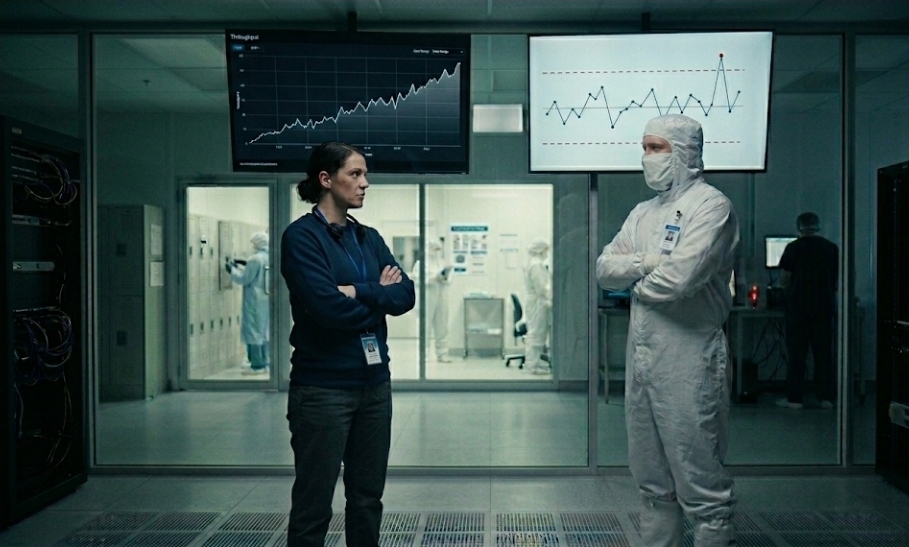
A deposition chamber drops out of production at 2 a.m. Forty minutes later it is back, the dashboard flips from red to green, and two people want opposite things. The operations-center operator has a step starving downstream and wants the tool dispatched now. The module’s shift group leader wants test wafers run and confirmed on target before a single product lot goes near it. Both are right. Someone has to choose in the next few minutes, on partial data, with a clock running.
That small standoff is the real work of high-volume manufacturing, and it repeats across a fab every shift. It turns on a distinction the dashboard hides. Available is the door being open. In control is whether it is safe to walk through: whether you can trust the tool to do to the next thousand wafers what it did to the last, stable and predictable, within a risk you have actually accepted rather than merely hoped for. A green board is a hypothesis, not a guarantee.
Every fab runs on two clocks. One counts output now: availability, utilization, throughput, the commit for the shift. It is carried by ROC operators, shift supervisors, shift managers, and the manufacturing engineers keeping product moving. The other counts consequences later: process stability, equipment health, quality. That clock belongs to the module and process engineering teams, the shift group leaders, the engineering group leaders, who know that a tool released too soon, or a PM deferred to make a number, can send a quiet excursion downstream, one you do not catch until two hundred wafers have already passed through it.
Neither clock is wrong. That is the point. The tension is not dysfunction; it is the system working as designed. Output and control are meant to compete, because a fab that served only one of them would quickly fail at the other.
It helps to be precise about what the green light actually claims. SEMI E10 gives the industry a shared vocabulary for equipment states: productive, standby, engineering, scheduled and unscheduled downtime, non-scheduled time, and from those states the metrics every fab lives by: availability, utilization, mean time between failures, mean time to repair. The vocabulary is exact, and that exactness is what exposes the gap. A tool counted as available may be genuinely productive or merely idle in standby. A tool pushed toward higher utilization buys throughput today at the cost of cycle time and flexibility tomorrow, because a line run too close to saturation amplifies its own variability. The states tell you what a tool is doing and how often it does it. They do not tell you whether to trust it with your next lot right now, and they do not tell you whether the number you are optimizing is the one that matters tonight.
That is why the same standoff takes so many shapes. A PM comes due, and taking the tool down costs output today while deferring it risks a bigger failure tomorrow. A chamber runs at the edge of spec under a green light, and the supervisor who owns tonight’s number is not the engineer who will own the excursion. A tool comes back at partial capability, and someone has to decide whether half a tool now beats a whole tool in three hours. None of these has a clean answer in a procedure. Each is a bet placed with incomplete information, and the standard that names the states cannot place the bet for you.
That call lives in people: the engineer who knows this chamber’s tells, the operator who has seen this signature before, the group leader who decides which risk the shift will carry. It is built from pattern memory and hard-won feel as much as from data, and much of it is invisible. No one is credited for the excursion they prevented or the downtime they avoided by holding a tool one hour longer. The save never shows up on the wall of screens, which means the people best at this are often the hardest to see, and the easiest to lose when they leave.
This is also the part that does not automate away. We can predict tool health, optimize dispatch, and model utilization better every year, and we should; the floor needs every bit of that signal. But software can recommend; it cannot own the consequence. The decision still belongs to people, and it is rarely one person’s to make alone: the operator, the supervisor, the group leader, and the engineer each hold a piece of the picture, and a good call is usually the one they reach together. So the real edge is not a sharper metric or a smarter system. It is people who can weigh availability, quality, equipment health, and risk in a single judgment, made in cooperation rather than in defense of their own number. Output and control were never meant to be enemies; they are two halves of the same call. The fabs that win the next decade will be the ones whose people can hold that balance.
Boris Shteinberg has spent over a decade in high-volume semiconductor manufacturing, across equipment integration, floor operations, and real-time production decisions.
Also Read:
The Yield Partnership: Intel and PDF Solutions Tackle Advanced Nodes
The Memory Sector Is Becoming One of the Main Beneficiaries of the AI Boom
Share this post via:



ChipAgent Raises $134Million and Why it Matters