




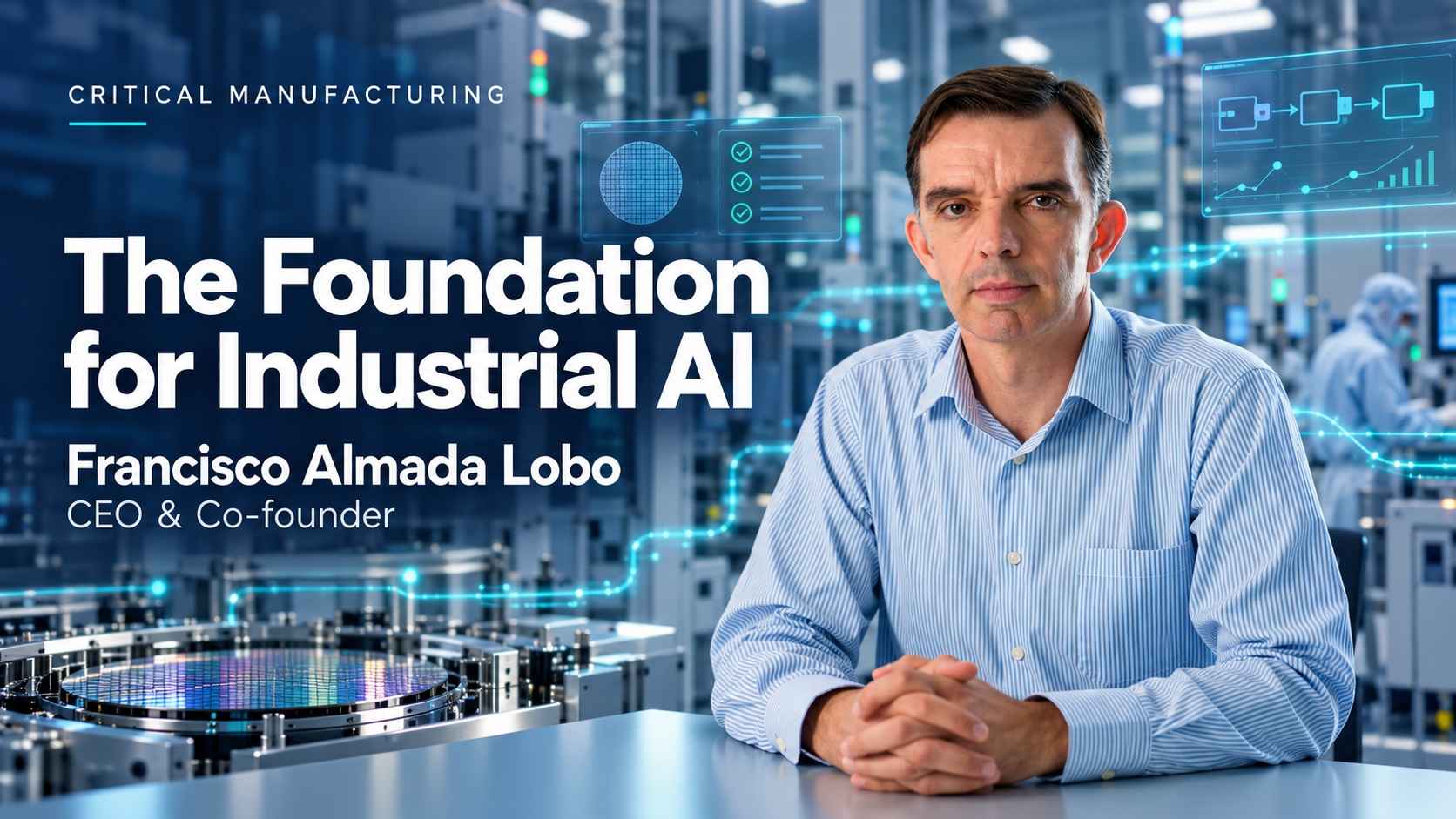


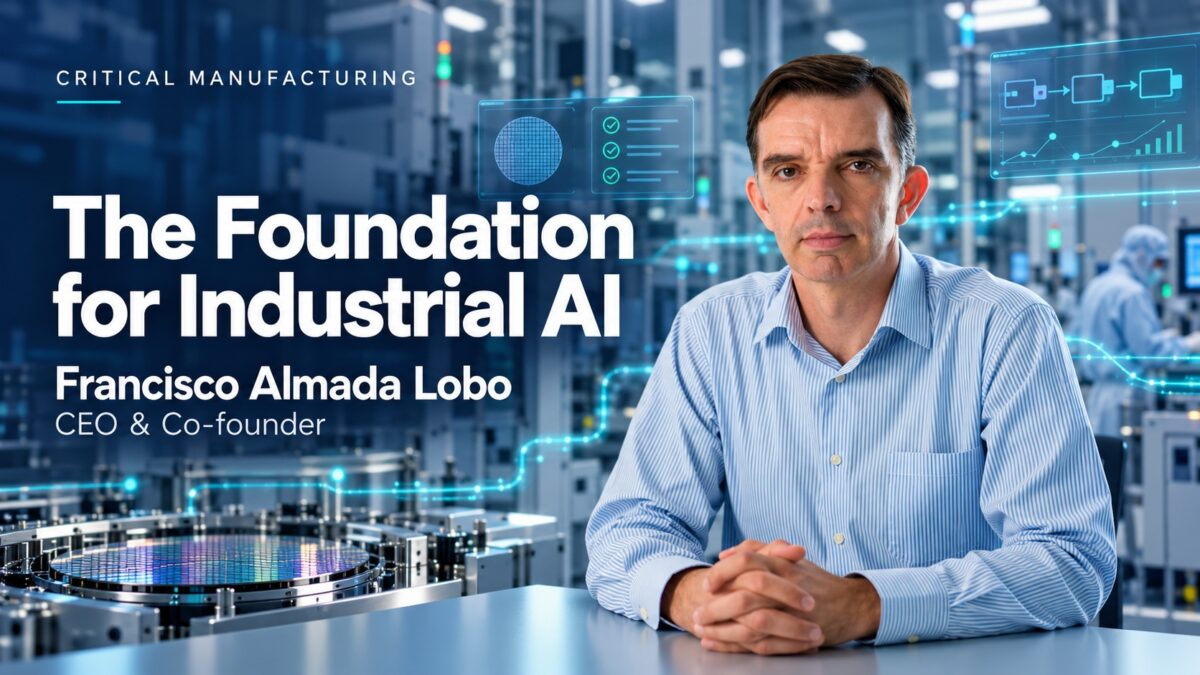
Francisco Almada Lobo is CEO and co-founder of Critical Manufacturing. He began his career at a CIM research institute and joined Siemens Semiconductors in 1997. In 2004 he led the migration of an MES in a running high-volume facility, and from 2005 to 2009 he managed the Porto Development Center for Infineon and Qimonda, responsible for automation projects across the group’s plants worldwide. He co-founded Critical Manufacturing in 2009. He serves on the SEMI Smart Manufacturing Technology Executive Committee and the Forbes Technology Council and writes regularly on industrial AI and manufacturing execution. He holds a degree in Electrical Engineering from the University of Porto and an MBA from Porto Business School.
Tell us about your company.
Critical Manufacturing builds an Industrial Operations Platform for high-tech manufacturing, with a manufacturing execution system (MES) at its core. Around the MES we bring together equipment connectivity, automation, an enterprise data platform, analytics and AI, so that production, quality and engineering teams work from one operational model of the factory.
We were founded in Porto, Portugal, in 2009, and semiconductor manufacturing is where we started. Several of us had spent years running MES and automation programs in Siemens Semiconductors, Infineon and Qimonda fabs. Since 2018 we have been part of ASMPT, one of the main suppliers of semiconductor assembly and packaging equipment. Today we serve semiconductor front-end and back-end, electronics, medical device and industrial equipment manufacturers from offices in Europe, the Americas and Asia. Gartner named us a Leader in its Magic Quadrant for MES in 2021, 2022 and 2023, and IDC placed us in the Leaders category of its 2024-2025 MES MarketScape.
What problems are you solving?
Semiconductor manufacturing is getting harder to execute. Advanced packaging moves front-end complexity into the back-end: wafer-level and panel-level processes, hybrid bonding, die from different nodes and suppliers in one package, and traceability that has to follow each die through its full genealogy. Many factories still run MES platforms designed for either front-end or back-end, with a layer of custom integration bridging the two.
We solve the execution problem: modeling the process at the right granularity, enforcing it on the floor, integrating the equipment, and recording what actually happened with its full context. That record is also what makes AI useful. Most manufacturers already have plenty of data. What they lack is data that carries its operational context, such as which lot, which recipe version, which exception and which decision. That context has to be captured at execution time. Reconstructing it afterwards from historians and logs is expensive and unreliable.
What application areas are your strongest?
Semiconductor back-end and advanced packaging is our strongest area and the one where demand is growing most. Our relationship with ASMPT gives us a depth in assembly and packaging equipment and processes that is unusual for a software company. We are also strong in greenfield facilities, both fabs and assembly and test sites, where the MES has to be live before the first lot moves and much of the team is still being hired. In the front-end we work with specialty, compound semiconductor, MEMS and R&D fabs, where experiment management, recipe control and frequent process change matter as much as throughput. Outside semiconductors, electronics assembly and medical devices share the same need for traceability and process enforcement.
What keeps your customers up at night?
Three concerns come up in most conversations. The first is ramp speed. New capacity is being built in the US, Europe, India and Southeast Asia, often where there is no deep pool of experienced semiconductor operators and engineers. The systems have to carry more of the process knowledge while the people are still learning it.
The second is the cost of quality in advanced packaging. When one package combines several high-value die, a single defect scraps all of them. Customers need to know quickly, and with certainty, which units share an exposure and why.
The third is AI. Boards expect results, and many pilots stall when they meet factory data. I describe this as the Industrial AI Cliff: AI maturity on the factory floor is capped by execution maturity. A factory that cannot say precisely what happened to each unit cannot train a model on that history, or trust what the model tells it.
What does the competitive landscape look like and how do you differentiate?
The market has three groups. There are established MES suppliers, many with a long history in either front-end or back-end. There are broad enterprise and automation vendors for whom MES is one module in a larger portfolio. And there are newer data-first platforms that collect and contextualize data but do not enforce how the process runs.
We differentiate in four ways. One platform covers front-end, back-end, advanced packaging and electronics assembly, so a multi-site customer runs a single operational model. The product is model-driven and configured rather than custom-coded, on a containerized architecture that runs on premises or in the cloud. The MES enforces the process and builds a canonical data model at execution time, which is the foundation external analytics and AI workloads need. And through ASMPT we understand the equipment side of packaging from the inside.
What new features and technology are you working on, and where does AI fit?
Our focus is making the MES the operational foundation for AI. We have embedded AI copilots in the platform, so engineers and supervisors can query manufacturing data in natural language and generate charts and dashboards without writing queries. Our enterprise data platform structures data from equipment, systems and sites into a canonical model that our own applications and our customers’ AI and agentic workloads can consume with the context intact.
We are also extending the platform for advanced packaging, including panel-level processing and die-level genealogy across sites and suppliers, and preparing a SaaS offering for smaller and pre-volume fabs that need a full MES without a large IT organization behind it.
How do customers normally engage with your company?
We sell directly and deliver together with system integrator partners who ramp up on real projects alongside our own teams. A typical engagement starts with one site and a clearly scoped first phase, which then becomes a template rolled out across the network. On greenfield projects we prefer to join early, during facility design, because MES and automation decisions affect layout, equipment specifications and staffing. Many relationships begin with a conversation at an event such as SEMICON West about a specific ramp or a specific traceability problem.
Also Read:
CEO Interview with Paul Butler of VeriQuantix
CEO Interview with Joel Jorgensen of FlowAccel
CEO Interview with Vivek Raghuraman of Mixx Technologies
Share this post via:



Maskless EUV Lithography: An Alternative to E-Beam