


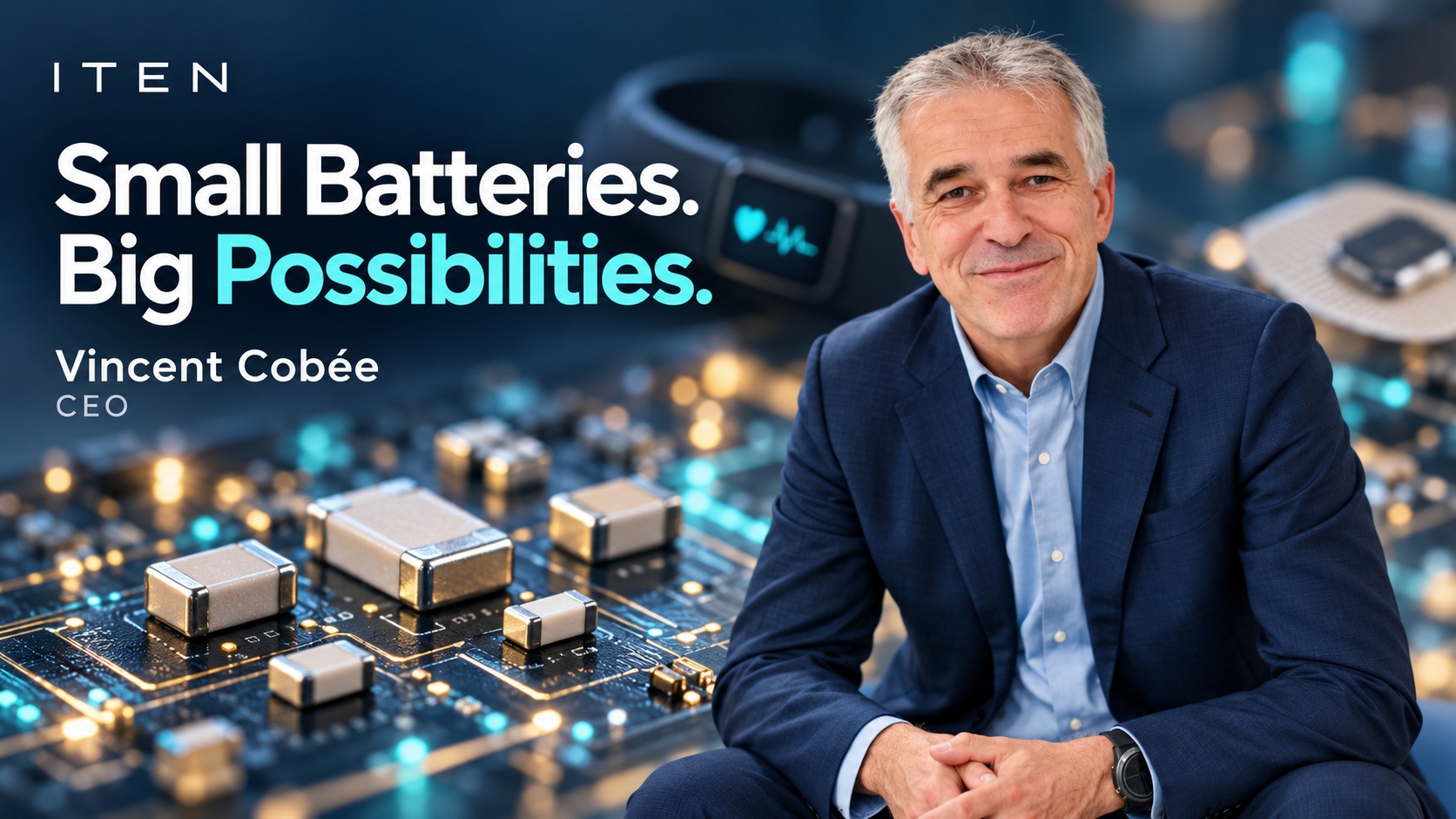



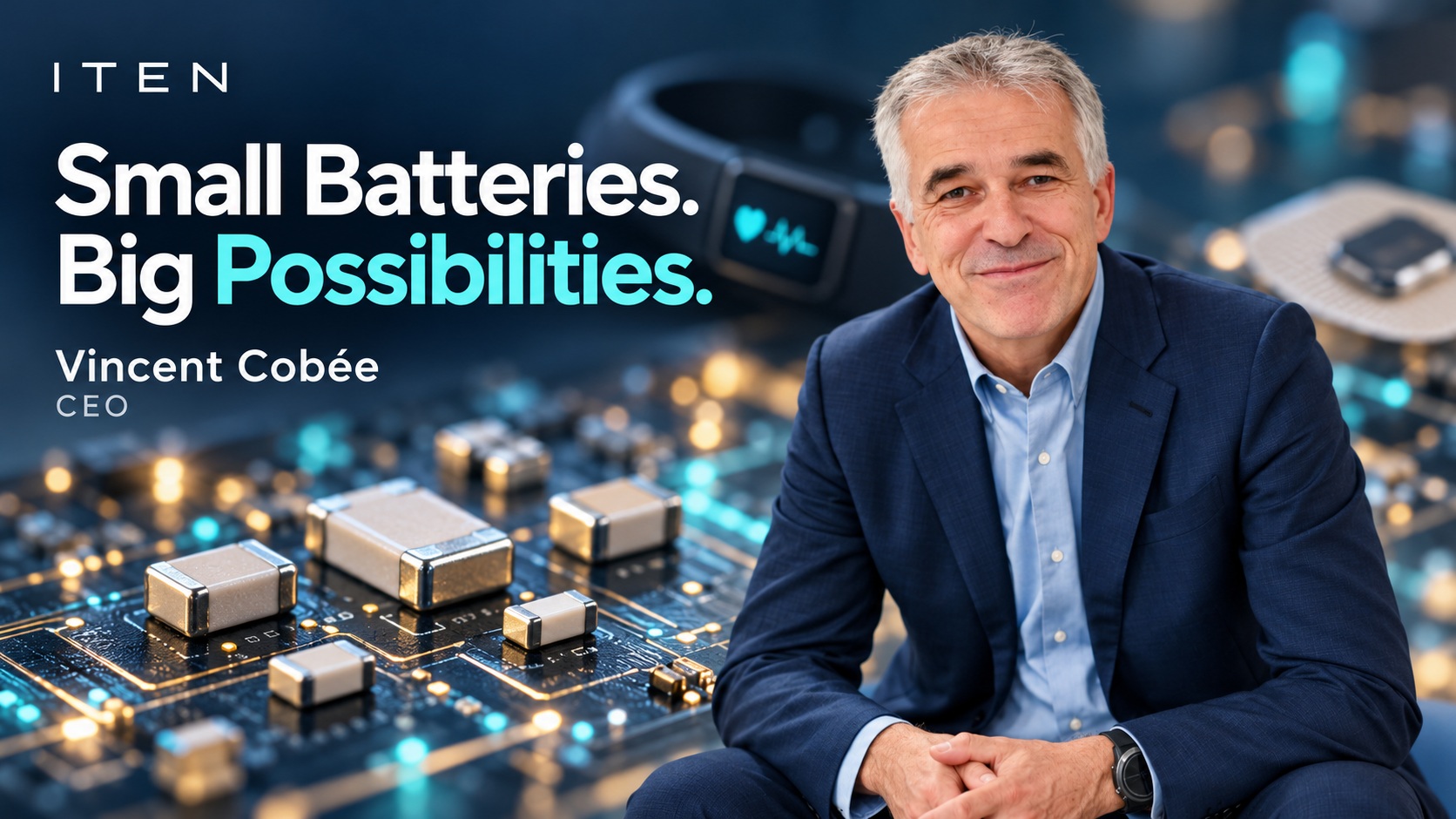
Vincent Cobée is a global industrial executive with more than 30 years of leadership experience, most of it spent in the highly demanding automotive industry, where he built a successful track record leading large-scale international organizations, driving business transformation, and bringing innovative technologies to market. Since December 2023, Vincent has served as Chief Executive Officer of ITEN, where he is leading the company’s industrialization and commercial expansion as it scales its breakthrough solid-state battery technology for next-generation electronic and medical devices.
Before joining ITEN, Vincent held senior executive positions within the Renault-Nissan-Mitsubishi Alliance, Mitsubishi Motors and Stellantis, and most recently CEO of Citroën and member of Stellantis’ Global Executive Committee. Throughout his career, he has led global operations, product strategy, electrification initiatives and industrial transformation across Europe and Asia, helping some of the world’s largest automotive manufacturers navigate profound technological change.
Tell us about your company?
ITEN is a French deep-tech company founded at the end of 2011 and based in France near Lyon. The company specializes in the design and industrial production of solid-state ceramic batteries.
We began supporting technology development with an early-stage pilot line in 2018. Our full-scale manufacturing line became fully operational at the end of 2025. We have secured more than €110 million in funding since its creation, including an €80 million round in 2022.
As an integrated device manufacturer, ITEN controls the full value chain, from materials and cell design through packaging, testing, and production. The company holds 48 families of patents around solid-state energy-storage technologies and manufacturing.
ITEN’s rechargeable batteries are designed for applications where conventional batteries can be too large, insufficiently safe, or unable to deliver the required power bursts. Target markets include IoT devices, connected sensors, smart cards, wearables, healthcare products, and advanced electronic systems.
The company’s technology is based on a solid-state architecture without liquid electrolyte. ITEN focuses on combining miniaturization, high power density, fast charging, and safety.
The company currently has two product families. Powency™ focuses on high power density for low-capacity batteries, up to a few tens of mAh, and has been in mass production since mid-2025, with three product references currently in volume production. Flowency™ is focused on higher energy density and fast recharge, targeting capacities from a few tens of mAh up to a few Ah.
ITEN’s focus is the electronics industry rather than mobility.
What problems are you solving?
The electronics industry continues to develop smaller and thinner end products, creating new challenges in energy storage form factor and integration. ITEN addresses this trend with ultra-small solid-state devices that can be soldered directly onto a PCB.
Another requirement is the ability to deliver very high peak currents from very small devices. This is particularly relevant for ultra-low-power wireless systems that periodically require short bursts of energy.
We are also focused on supporting energy-harvesting architectures. By combining rechargeable solid-state batteries with energy harvesting, systems can reduce their dependence on primary batteries, thereby avoiding their frequent replacement and improve their sustainability, particularly in IoT applications. The solid-state architecture is also intended to address safety requirements for applications such as MedTech.
There are also practical requirements around transportation and safety. Powency™ devices fall under the classification of electronic passive devices for air transportation.
Finally, customers often have stringent requirements around packaging, capacity, and form factor. Wen can customize these aspects to match the requirements of the end-product.
Which application areas are strongest?
IoT, Ambient IoT and Healthcare are key application areas. The technology can support systems using a wide range of connectivity standards, particularly where very low energy consumption is combined with periodic high-power requirements.
Energy harvesting is another important area of expertise for ITEN, including wireless energy harvesting, solar panels, and thermoelectric generators (TEGs). More broadly, Powency™ is designed for ultra-low-energy systems.
Miniaturized tracking applications are another example of the type of system targeted by this product where low weight, very small size, and sufficient power for wireless connectivity are important requirements.
Flowency™ remains under development, with a particular focus on wearables and MedTech applications where higher capacity, high energy density, fast recharge, and safety are required.
What keeps your customers up at night?
For IoT customers, one of the key concerns is durability and maintenance. Many connected devices are designed to operate for long periods but still rely on primary batteries that need to be frequently replaced. We are therefore promoting the combination of energy harvesting and rechargeable energy storage to address sustainability and primary battery replacement and recycling challenges.
In MedTech, one of the challenges is accessing ultra-miniaturized energy-storage devices that can be integrated into or placed on the body, while meeting demanding requirements for safety, reliability and operating life.
Our collaboration with XPANCEO is a good example. Together, we developed a proof of concept integrating an ITEN solid-state energy storage device into a smart contact lens. The application puts particularly stringent constraints on the energy-storage technology because the battery must fit within an ultra-thin, curved device that operates directly on the eye. The battery needs to support functions such as wireless connectivity and higher-power applications such as AR, while remaining compatible with the lens architecture and its safety requirements.
We are also addressing these challenges in other areas of MedTech through SOLIMED, a collaborative development project within the European IPCEI Tech4Cure initiative, focused on Class III implantable medical devices. The initial application is implantable cardiac pumps, where the battery needs to combine high energy density, fast charging, safety, reliability and long operating life within a very limited volume. The program is also exploring wireless recharging and new approaches to battery packaging and biocompatible encapsulation.
Finally, customers are looking for ways to differentiate new products through their form factor. Flowency™ is being developed with the capability to produce highly customized battery shapes, supporting new product form factors for AI wearable devices, possibly integrated within the end-product material or case.
What does the competitive landscape look like and how do you differentiate?
The competitive landscape varies depending on the application. Competition from other solid-state battery suppliers remains limited in the electronics industry with ITEN positioning its technology around both performance and manufacturing maturity.
For Powency™, supercapacitors are an important alternative, with numerous suppliers in the market. Primary batteries, including coin cells, can also be considered a competing solution, in front of which ITEN promotes energy harvesting to enable more durable and sustainable wireless sensors. The direct competition here comes from conventional lithium-ion (Li-ion) and lithium-polymer (LiPo) battery manufacturers.
Our differentiation comes from several aspects of the technology. Powency™ combines versatility and miniaturization: the devices can either deliver high bursts of energy or continuously power ultra-low-power systems, while occupying a very small footprint compared with bulky supercapacitors. This becomes particularly relevant when the application has tight area or volume constraints.
Another advantage is manufacturing integration. Powency™ devices can be soldered directly onto PCBs, which can reduce manufacturing costs compared with supercapacitors that are manually placed on PCBs.
Safety is also an important differentiator. Our batteries contain no liquid electrolyte or organic components, avoiding swelling and thermal runaway mechanisms. Their hazard-free architecture also enables recycling in a similar way to passive electronic devices.
Finally, our post-processing capabilities are an important part of the technology. The batteries can withstand high-temperature treatments, enabling the integration or co-integration of packaged or unpackaged batteries into a wide range of materials. This creates possibilities for integrating energy-storage structures into mechatronic systems.
What new features/technology are you working on?
ITEN is continuing to expand the Powency™ product family, including higher-capacity batteries and batteries operating at higher voltage. These products are planned for launch in 2027. The Flowency™ platform is under development, with a focus on high energy density, fast recharge, and full safety. The goal is to create a breakthrough in solid-state technologies for wearables and MedTech from 2028 onwards.
We are also developing post-processing capabilities to further demonstrate its ability to build SiP (System-in-Package) and Embedded Die integration.
Another area of development is new manufacturing technology capable of producing custom-shape batteries for new AI wearable devices.
Reparability is also a key focus, with batteries packaged in a way that allows them to be more easily replaced.
How do customers normally engage with your company?
Customer engagement starts with technical discussions to understand the system’s power requirements, constraints, and operating environment. Even though our solid-state ceramic batteries are designed to be user-friendly, we want to ensure that customers have a full understanding of the products’ performance and how to get the best out of them.
We can also take over full custom product development for customers requiring specific battery attributes. In these cases, a dedicated team is assigned to the new product development. The company can also support part of the end-customer system design and co-design electronic boards to validate power-management architectures around Powency™ devices.
Finally, ITEN builds reference designs to help customers evaluate its solutions in typical applications.
Also Read:
Share this post via:


Why America’s Semiconductor Manufacturing Capacity Matters