SiC WebAd SemiWiki Forum2026 800x100 Static
WP_Term Object
(
    [term_id] => 16126
    [name] => Lithography
    [slug] => lithography
    [term_group] => 0
    [term_taxonomy_id] => 16126
    [taxonomy] => category
    [description] => 
    [parent] => 0
    [count] => 205
    [filter] => raw
    [cat_ID] => 16126
    [category_count] => 205
    [category_description] => 
    [cat_name] => Lithography
    [category_nicename] => lithography
    [category_parent] => 0
    [is_post] => 
)

VLSI Symposium 2020 – Imec Buried Power Rail

VLSI Symposium 2020 – Imec Buried Power Rail
by Scotten Jones on 07-26-2020 at 10:00 am

thl61591895083576 Page 04

The 2020 VLSI Technology Symposium was held as a virtual conference from June 14th through June 19th. At the symposium Imec gave an interesting paper on Buried Power Rails (BPR) and I had a chance to interview one of the authors, Anshul Gupta.

As logic devices continue to scale down metal pitch is reaching a limit. Imec defines a pitch… Read More

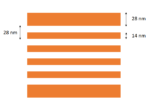
Application-Specific Lithography: a 28 nm Pitch DRAM Active Area

Application-Specific Lithography: a 28 nm Pitch DRAM Active Area
by Fred Chen on 07-19-2020 at 2:00 pm

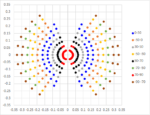
Application Specific Lithography 28 nm Pitch DRAM Active Area

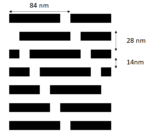
In the recent DRAM jargon, “1X”, “1Y”, “1Z”, etc. have been used to express all the sub-20 nm process generations. It is almost possible now to match them to real numbers which are roughly the half-pitch of the DRAM active area, such as 1X=18, 1Y ~ 17, etc. At this rate, 14 nm is somewhere around

… Read More

ASML More Covid Concerns and Impact

ASML More Covid Concerns and Impact
by Robert Maire on 07-19-2020 at 6:00 am

ASML Covid
  • Covid related Revenue Rec causes rev/EPS miss
  • Sharp order drop reflects H2 industry uncertainty
  • EUV remains solid- Memory/Logic mix is better

Results were in line after correcting Covid Caused Revenue Rec issue-
ASML reported revenues of Euro3.3B and EPS of Euro1.79 as revenues from two EUV systems was not recognized, due to … Read More


Application-Specific Lithography: The 5nm 6-Track Cell

Application-Specific Lithography: The 5nm 6-Track Cell
by Fred Chen on 07-05-2020 at 10:00 am

Application Specific Lithography The 5nm 6 Track Cell

An update is now available here: Application-Specific Lithography: Patterning 5nm 5.5-Track Metal by DUV

The 5nm foundry (e.g., TSMC) node may see the introduction of 6-track cells (two double-width rails plus four minimum-width dense lines) with a minimum metal pitch in the neighborhood of 30 nm. IMEC had studied a representative… Read More


The Stochastic Impact of Defocus in EUV Lithography

The Stochastic Impact of Defocus in EUV Lithography
by Fred Chen on 06-28-2020 at 6:00 am

The Stochastic Impact of Defocus in EUV Lithography

The stochastic nature of imaging has received a great deal of attention in the area of EUV lithography. The density of EUV photons reaching the wafer is low enough [1] that the natural variation in the number of photons arriving at a given location can give rise to a relatively large standard deviation.

In recent studies [2,3], it … Read More


Can Threshold Switches Replace Transistors in the Memory Cell?

Can Threshold Switches Replace Transistors in the Memory Cell?
by Fred Chen on 06-08-2020 at 6:00 am

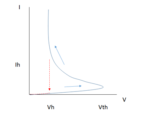
Threshold switch I V

The overwhelming majority of transistors produced in the world are used in memory cells, either as the memory itself (Flash, SRAM), or as the access device (DRAM). Yet, it is not necessary to have a transistor in every memory cell. In 2015, 3D XPoint, the first major product based on transistor-less memory cells, was announced [1].

… Read More

Feature-Selective Etching in SAQP for Sub-20 nm Patterning

Feature-Selective Etching in SAQP for Sub-20 nm Patterning
by Fred Chen on 06-02-2020 at 10:00 am

Feature Selective Etching in SAQP for Sub 20 nm Patterning

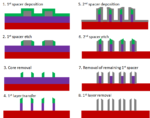
Self-aligned quadruple patterning (SAQP) is the most widely available technology used for patterning feature pitches less than 38 nm, with a projected capability to reach 19 nm pitch. It is actually an integration of multiple process steps, already being used to pattern the fins of FinFETs [1] and 1X DRAM [2]. These steps, shown… Read More


Contact Resistance: The Silent Device Scaling Barrier

Contact Resistance: The Silent Device Scaling Barrier
by Fred Chen on 05-24-2020 at 6:00 am

Contact Resistance The Silent Device Scaling Barrier

Moore’s Law has been about device density, specifically transistor density, increasing every certain number of years. Although cost is the most easily grasped advantage, there are two other benefits: higher performance (speed) and reduced power. When these benefits are compromised, they can also pose a scaling limitation.

… Read More

The Uncertain Phase Shifts of EUV Masks

The Uncertain Phase Shifts of EUV Masks
by Fred Chen on 05-13-2020 at 10:00 am

The Uncertain Phase Shifts of EUV Masks

EUV (Extreme UltraViolet) lithography has received attention within the semiconductor industry since its development inception in 1997 with the formation of the EUV LLC [1], and more recently, since the 7nm node began, with limited use by Samsung and TSMC being touted as key advantages [2, 3]. As with any key critical technology,

… Read More

MOSFET Gate Length Scaling Limit at Reduced Threshold Voltages

MOSFET Gate Length Scaling Limit at Reduced Threshold Voltages
by Fred Chen on 05-10-2020 at 6:00 am

MOSFET Gate Length Scaling Limit at Reduced Threshold Voltages

As transistor dimensions shrink to follow Moore’s Law, the functionality of the gate used to switch on or off the current is actually being degraded by the short channel effect (SCE) [1-5]. Moreover, the simultaneous reduction of voltage aggravates the degradation, as will be discussed below.

A Practical Lower Limit of… Read More