




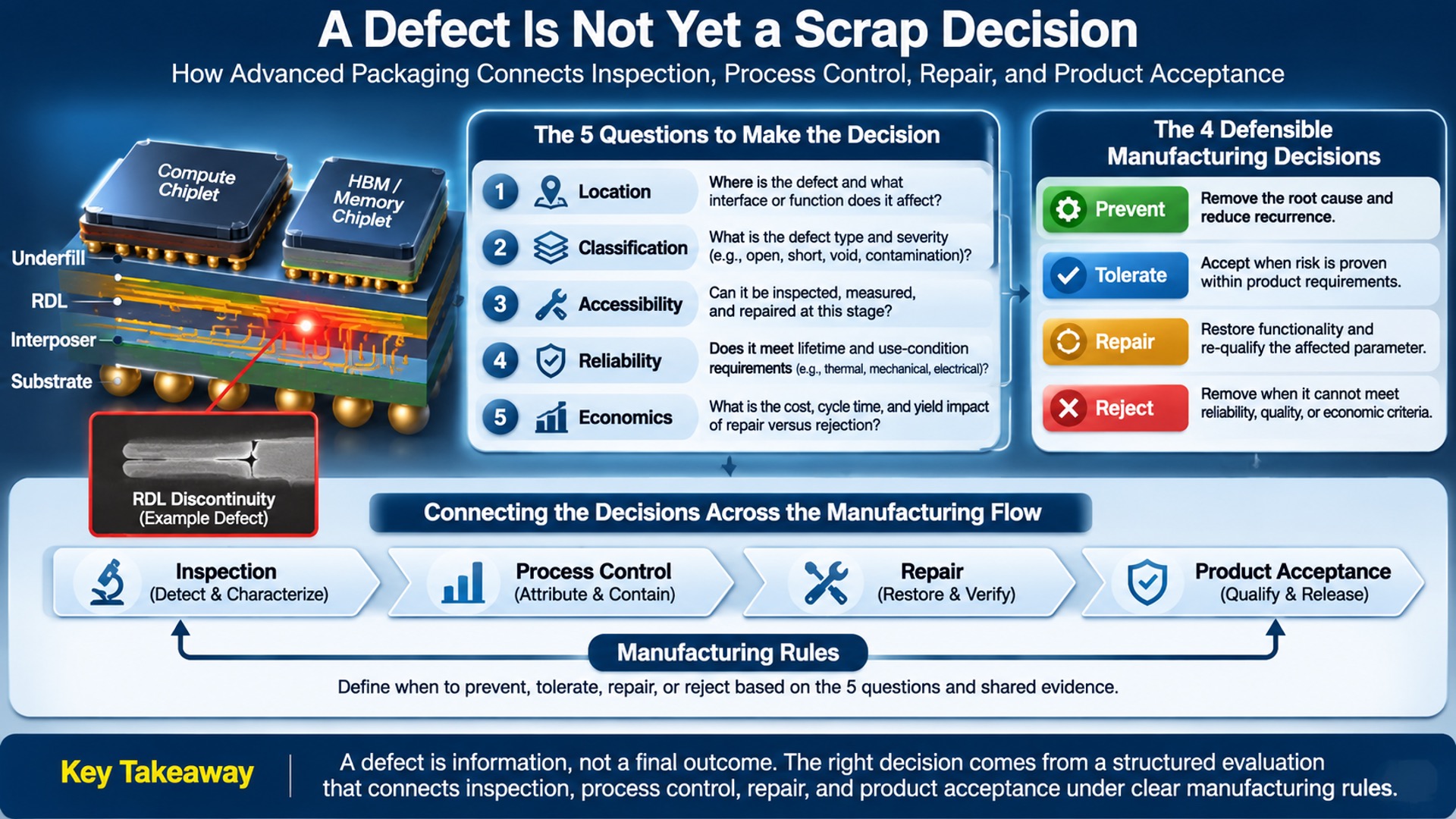
How advanced packaging connects inspection, process control, repair, and product acceptance
The decision begins before the defect is found
Advanced packaging is changing what a manufacturing defect means. A localized open, bridge, void, registration error, or delamination may be visible in one process step, yet its consequence depends on the circuitry it serves, the assembly operations still ahead, and the qualification requirements of the completed product. A defect is an observation; scrapping a package is a disposition. Between them lies an engineering decision.
This distinction matters as high-value chiplets, HBM stacks, interposers, substrates, and optical interfaces converge in one product. Material and assembly value accumulate as the build proceeds. An intervention that is inexpensive before die attach can become impractical after underfill or encapsulation. Conversely, a defect that appears minor at an early inspection station can become a reliability risk after thermal cycling or operating stress.
The industry is investing in more capable inspection and metrology, including methods that see defects earlier and at finer dimensions. But higher detection sensitivity alone does not establish which observations matter. To improve yield without compromising reliability, engineering teams must connect inspection to design intent, process capability, qualified repair options, and the acceptance criteria of the finished package.
Five questions that turn an observation into a decision
- Where is the defect? Location is more than a coordinate on an image. The record should establish the affected layer, net or feature, package configuration, manufacturing operation, and whether the condition is adjacent to a critical interface. A discontinuity on a redundant, noncritical route and a similar discontinuity on a high-current power path do not carry the same consequence. Location also determines whether the next assembly step will bury the feature.
- What kind of defect is it? Classification should connect appearance to physical mechanism and potential effect: open, short, dimensional excursion, contamination, weak bond, crack, delamination, or process-pattern anomaly. An optical image can suggest a failure mode but may not establish its electrical or mechanical significance. Targeted metrology, continuity tests, cross-sectioning on representative samples, or physics-based analysis may be needed. Recurring defects can also indicate a drifting process, not merely isolated bad units.
- Is intervention accessible? Repairability is set partly by manufacturing sequence. An exposed redistribution-layer (RDL) feature may be available for a qualified local correction before a die is mounted. After bonding, underfill, or encapsulation, that same feature may be inaccessible or too risky to touch. Design-for-inspection and design-for-repair therefore affect where inspection stations are placed and when the package becomes economically irreversible.
- Will the outcome remain reliable? A corrected route can pass continuity yet introduce different resistance, current density, dielectric spacing, local stress, or thermal behavior. The acceptance question is whether the actual, as-repaired structure satisfies relevant electrical, thermal, mechanical, and lifetime requirements. The verification plan must be appropriate to the defect and repair mechanism; a single room-temperature pass is not an all-purpose reliability qualification.
- Does the action make economic sense? The decision should consider inspection false positives and escapes, recovery success rate, repair cycle time, added metrology and retesting, material value already incorporated, downstream yield, and field exposure. A technically possible correction may have negative value when its repeatability is poor. Equally, automatically rejecting an accessible, demonstrably recoverable defect can waste substantial package value.
A practical case: an RDL discontinuity before chiplet attachment
Consider an illustrative 2.5D package in which inspection identifies a suspected discontinuity on an exposed redistribution trace before a costly chiplet is attached. The image alone does not determine the disposition. The inspection system first associates the location with the correct design revision and net. Electrical engineering asks whether the trace carries a critical signal or power path, what resistance and impedance margins are allowed, and whether an alternative path or redundancy actually exists.
Process engineering then investigates whether the observation is a true metal open, a measurement artifact, or part of a wider lithography or plating excursion. Additional checks may reveal that several neighboring panels exhibit similar defects near the same feature. At this point, prevention and lot containment can be more important than deciding whether one unit can be salvaged.
If the defect is confirmed and remains exposed, a qualified repair process may be considered. The repair has to fit the design rules and physical geometry; it cannot be justified solely because a tool is capable of adding or removing material. After intervention, the team checks geometry, continuity, relevant parasitic or current-handling limits, and any reliability risks introduced by the modified structure. Where needed, representative repaired structures undergo stress testing or a documented qualification-by-similarity assessment within an approved family.
Now change just one fact: the same type of defect is found after die attachment and underfill. The classification may be identical, but access and risk are not. A repair route qualified for exposed RDL cannot automatically be transferred to an encapsulated package. The correct answer may now be rejection, or it may be tolerance if independently established redundancy and product requirements permit acceptance. A past repair success is not permission to skip evaluation of a different assembly state.
This example is illustrative, not a claim that a particular RDL repair method is qualified for all products. It shows why defect disposition requires evidence linked to configuration, manufacturing state, and product acceptance.
Four defensible manufacturing actions
Prevent. When a defect mechanism repeats, the highest-leverage action is often to reduce its occurrence. Update process windows, materials, equipment settings, handling, inspection placement, or design rules as evidence supports. Prevention is a process-level response and should be evaluated using subsequent lots, not inferred from one improved build.
Tolerate. Some conditions may be accepted if a defined engineering envelope demonstrates that functionality and reliability are preserved. Built-in redundancy can enable this, but redundancy must be exercised and verified for the affected failure mode. Tolerance is a qualified exception with documented limits, not a blanket allowance for unknown defects.
Repair. A corrective procedure is defensible when it is accessible, repeatable, approved for the specific defect class and process stage, and followed by appropriate verification. Its success criteria should include more than restoring a visible connection. Failures, second attempts, and any resulting damage must remain part of the manufacturing history.
Reject. Reject when the feature is inaccessible, the risk cannot be bounded, verification is inadequate, or the economics do not support recovery. This is not a failure of manufacturing intelligence. An evidence-based rejection can avoid compounding cost and quality risk later in assembly and deployment.
The missing connection: inspection, process control, repair, product acceptance
These actions are often managed by separate groups. Inspection produces defect maps; process engineering maintains tool recipes and control plans; repair engineering develops interventions; product engineering owns functional and qualification requirements. If those records are disconnected, teams can make locally reasonable decisions that contradict one another.
A more useful operating model links the same defect identifier to its geometry and design feature, lot and equipment history, process revision, intervention record, before-and-after measurements, and product disposition. This allows a defect pattern to trigger process-control action even when individual units were successfully repaired. It also lets product engineers see whether apparently identical packages have different hidden histories.
The engineering decision should remain configuration-specific. Suppose a revised substrate changes material properties, interconnect dimensions, or the expected thermal operating envelope. Previously qualified acceptance or repair evidence might still be applicable, but the relationship must be checked. An unchanged inspection image does not imply unchanged reliability risk.
Over multiple builds, linked histories reveal whether prevention reduced defect frequency, whether repair improved yield after accounting for retest and fallout, and whether accepted units maintained reliability. Negative findings are as important as successful ones: a failed recovery method or an unrepeatable improvement should not vanish from the evidence base.
The manufacturing rule: protect qualified product value
The measure of a successful defect strategy is not the number of anomalies found or the number of repairs attempted. It is the amount of qualified product value recovered or preserved without hiding downstream risk.
This requires a connected decision: detect the physical condition, establish its functional consequence, evaluate accessible actions, verify the result, and retain evidence for future builds. The right outcome might be prevention, tolerance, repair, or rejection. Each is valid only within its engineering and manufacturing limits.
A local defect should lead to a system-level decision. Advanced packaging becomes scalable when those decisions are consistent, evidence-based, and repeatable—not when every visible defect is automatically scrapped or repaired.
Also Read:
Physics Over Probability: How Agentic AI Solves Electronic Systems Verification
CTO Interview with Paweł Banachowicz of Silicon Creations
The AI-First Platform the Disaggregated Semiconductor Industry Needs
Share this post via:


Semiconductor Market Doubling in 2026 – Last Issue