RVN! 26 Banner revised (800 x 100 px) (600 x 100 px)

Thick Data vs. Big Data

Thick Data vs. Big Data
by Ahmed Banafa on 11-07-2021 at 10:00 am

Thick Data vs. Big Data

One of the challenges facing businesses in post-COVID-19 world is the fact that consumer behavior won’t go back to pre-pandemic norms. Consumers will purchase more goods and services online, and increasing numbers of people will work remotely just to mention few major changes . As companies begin to navigate the post-COVID-19 world as economies slowly begin to reopen, the use of data analytics tools will be extremely valuable in helping them adapt to these new trends. Data analytics tools will be particularly useful for detecting new purchasing patterns and delivering a greater personalized experience to customers, in addition to better understanding of consumers new behavior.

However, many companies are still dealing with obstacles to successful big data projects. Across industries, the adoption of big data initiatives is way up. Spending has increased, and the vast majority of companies using big data expect return on investment. Nevertheless, companies still cite a lack of visibility into processes and information as a primary big data pain point. Modeling customer segments accurately can be impossible for businesses who don’t understand why, how and when their customers decide to make purchases for example.

To tackle this pain point companies might need to consider an alternative to big data, namely thick data, it’s helpful to define both terms, Big Data vs. Thick Data.

Big Data is large and complex unstructured data, defined by 3 V’s; Volume, with big data, you’ll have to process high volumes of low-density, unstructured data. This can be data of unknown value, such as Facebook actions, Twitter data feeds, clickstreams on a web page or a mobile app, or sensor-enabled equipment. For some organizations, this might be tens of terabytes of data. For others, it may be hundreds of petabytes. Velocity: is the fast rate at which data is received and acted on. Variety refers to the many types of data that are available. Unstructured and semi-structured data types, such as text, audio, and video, require additional preprocessing to derive meaning and support metadata.

Thick Data is about a complex range of primary and secondary research approaches, including surveys, questionnaires, focus groups, interviews, journals, videos and so on. It’s the result of the collaboration between data scientists and anthropologists working together to make sense of large amounts of data. Together, they analyze data, looking for qualitative information like insights, preferences, motivations and reasons for behaviors. At its core, thick data is qualitative data (like observations, feelings, reactions) that provides insights into consumers’ everyday emotional lives. Because thick data aims to uncover people’s emotions, stories, and models of the world they live in, it can be difficult to quantify.


Comparison of Big Data, and Thick Data

  • Big Data is quantitative, while Thick Data is qualitative.
  • Big Data produces so much information that it needs something more to bridge and/or reveal knowledge gaps. Thick Data uncovers the meaning behind Big Data visualization and analysis.
  • Big Data reveals insights with a particular range of data points, while Thick Data reveals the social context of and connections between data points.
  • Big Data delivers numbers; Thick Data delivers stories.
  • Big data relies on AI/Machine Learning; Thick Data relies on human learning.

Thick Data can be a top-notch differentiator, helping businesses uncover the kinds of insights they sometime hope to achieve from big data alone. It can help businesses look at the big picture and put all the different stories together, while embracing the differences between each medium and using them to pull out interesting themes and contrasts. Without a counterbalance the risk in a Big Data world is that organizations and individuals start making decisions and optimizing performance for metrics—metrics that are derived from algorithms, and in this whole optimization process, people, stories, actual experiences, are all but forgotten.

If the big tech companies of Silicon Valley really want to “understand the world” they need to capture both its (big data) quantities and its (thick data) qualities. Unfortunately, gathering the latter requires that instead of just ‘seeing the world through Google Glass’ (or in the case of Facebook, Virtual Reality) they leave the computers behind and experience the world first hand. There are two key reasons why:

  • To Understand People, You Need to Understand Their Context
  • Most of ‘the World’ Is Background Knowledge

Rather than seeking to understand us simply based on what we do as in the case of big data, thick data seeks to understand us in terms of how we relate to the many different worlds we inhabit.

Only by understanding our worlds can anyone really understand “the world” as a whole, which is precisely what companies like Google and Facebook say they want to do. To “understand the world” you need to capture both its (big data) quantities and its (thick data) qualities.

In fact, companies that rely too much on the numbers, graphs and factoids of Big Data risk insulating themselves from the rich, qualitative reality of their customers’ everyday lives. They can lose the ability to imagine and intuit how the world—and their own businesses—might be evolving. By outsourcing our thinking to Big Data, our ability to make sense of the world by careful observation begins to wither, just as you miss the feel and texture of a new city by navigating it only with the help of a GPS.

Successful companies and executives work to understand the emotional, even visceral context in which people encounter their product or service, and they are able to adapt when circumstances change. They are able to use what we like to call Thick Data which comprises the human element of Big Data.

One promising technology that can give us the best of both worlds (Big Data and Thick Data) is affective computing.

Affective computing is the study and development of systems and devices that can recognize, interpret, process, and simulate human affects. It is an interdisciplinary field spanning computer science, psychology, and cognitive science. While the origins of the field may be traced as far back as to early philosophical enquiries into emotion (“affect” is, basically, a synonym for “emotion.”), the more modern branch of computer science originated with Rosalind Picard’s 1995 paper on affective computing. A motivation for the research is the ability to simulate empathy. The machine should interpret the emotional state of humans and adapt its behavior to them, giving an appropriate response for those emotions.

Using affective computing algorithms in gathering and processing data will make the data more human and show both sides of data: quantitative and qualitative.

Ahmed Banafa, Author the Books:

Secure and Smart Internet of Things (IoT) Using Blockchain and AI

Blockchain Technology and Applications

Read more articles at: Prof. Banafa website

References

https://www.linkedin.com/pulse/8-key-tech-trends-post-covid-19-world-ahmed-banafa/

https://www.bdex.com/thick-data-why-marketers-must-understand-why-people-behave-the-way-they-do/

https://www.usertesting.com/blog/thick-data-vs-big-data

https://www.oracle.com/in/big-data/what-is-big-data/

https://www.cognizant.com/us/en/glossary/thick-data

http://www.brandwatch.com/2014/04/what-is-thick-data-and-why-should-you-use-it/

http://ethnographymatters.net/2013/05/13/big-data-needs-thick-data/

http://www.wired.com/2014/04/your-big-data-is-worthless-if-you-dont-bring-it-into-the-real-world/

http://www.big-dataforum.com/238/big-data-how-about-%E2%80%9Cthick-data%E2%80%9D-%E2%80%94-or-did-we-just-create-another-haystack

http://blog.marketresearch.com/thick-data-and-market-research-understanding-your-customers

http://www.wired.com/2013/03/clive-thompson-2104/


GM’s Postcard from Fantasyland

GM’s Postcard from Fantasyland
by Roger C. Lanctot on 11-07-2021 at 6:00 am

GMs Postcard from Fantasyland

In the midst of what may well be the greatest electric vehicle debacle of the nascent EV era, General Motors put on a happy face telling investors two weeks ago that all things EV and autonomous were going swimmingly to plan with gumdrops and sugar plums coming on the road ahead. GM claimed before-end-of-year availability for the absurd 1,000-horse-power, 4.5-ton Hummer EV and late 2022 availability for the Silverado EV.

Meanwhile, the General is facing a $1.9B financial hit* from buying back (or repairing) 141,000 Bolt EVs – a reality that GM CEO Mary Barra skirted in a Fox Business interview by referring to “cell replacements” for Bolt EV owners. Those comments clearly sidestepped the reality of a growing number of Bolt owners seeking outright buybacks of their cars after being told not to park them in their garages and discovering their vehicles were also prohibited from some public covered parking facilities including those at Detroit Metropolitan Airport. (*Worth noting battery supplier has accepted responsibility for the battery failure and is compensating GM to the tune of $1.9B – all the more reason for GM to accelerate customer compensation.)

Adding to the fanciful technology outlook painted for GM investors was a sunny forecast for millions of self-driving Origin robotaxis arriving in the market within a few short years – illustrated by a graph showing an exponential adoption rate. Based on a single deployment in a confined area in San Francisco this outlook is optimistic in the extreme.

Sadly, the exaggeration and chest-thumping on behalf of Cruise Automation’s self-driving efforts over-shadowed the more significant technological advances coming from GM’s own tech labs in Warren, Mich. What really deserved attention at the event was GM’s success in bringing semi-automated driving in the form of Super Cruise to the market without a hitch or whiff of a mishap or negative headline. In fact, the technology is on the cusp of a major global rollout reflecting impressive progress.

This technological achievement was worthy of glorification – not the billion-dollar boondoggle of Cruise, which represents a dumpster fire of a cash burn with little yet to show in terms of adoption, technological achievement, or even a compelling consumer application. Even Waymo’s modest progress is massively superior to Cruise’s gains – and Intel’s Mobileye continues to roll out its own robotaxi prototyping endeavors in groundbreaking launches and creative partnerships in New York, Munich, and elsewhere around the world.

But automated driving and semi-automated driving aside, GM’s EV situation is in the midst of a massive crisis. GM’s Barra claims the company is not intimidated by Tesla and is prepared to take the upstart EV maker on – but GM has more than Tesla to be concerned about. Hyundai, Kia, Ford Motor Company, and, now, Porsche are all in play with varying degrees of success.

An EV customer considering his or her options will be hard pressed to overlook the fact that Tesla has the strongest track record in the EV sector – with vehicles having demonstrated their ability to endure a wide range of operating conditions without catastrophic failures of the sort experienced by a handful of Bolt EVs (so far). Price is certainly a primary consideration – and incentives – but durability and reputation matter.

In the aforementioned Fox interview, the Fox correspondent noted that she was a recent convert from Lexus to Tesla and praised Tesla’s direct response when she had a tire inflation issue. In other words, GM is not simply competing on price or technology – it is also being forced to compete on customer service, and failing.

The Bolt EV debacle is something GM is trying to sweep under the rug – not unlike the ignition switch crisis which lingers on in litigation and incomplete recalls. Like the ignition switch recall and litigation, GM is taking on the Bolt EV failure on a case by case basis, resulting in a lingering stank on the GM brand. One begins to wonder whether anyone in GM’s warranty department has ever removed a band-aid before.

In essence, with the Bolt EV failure GM has wasted all or a substantial portion of its EV tax credits, it has massively undermined its own EV credibility in the midst of an announced $35B EV investment program, and it has minted thousands of new Tesla buyers – customers fed up with waiting for GM to get it right. Remember, GM’s journey began with the EV-1 that customers loved but that GM called back and crushed; and followed up with the extended range EV Volt, which customers loved but that GM threw overboard in favor of the Bolt.

GM promises that all will be right in a world built upon the new Ultium battery foundation. For that to happen, GM must A) buy back all 141,000 Bolts and B) offer a life-time warranty on any Ultium battery vehicles. Nothing less will restore long lost luster to the GM brand and prop up the customer retention necessary to the brand’s future. Happy talk, denial, and tap dancing will not suffice.


Podcast EP46: Arteris IP – the role and impact of system IP

Podcast EP46: Arteris IP – the role and impact of system IP
by Daniel Nenni on 11-05-2021 at 10:00 am

Dan is joined by industry veteran Charlie Janac, chairman, president and CEO of Arteris IP. Dan explores the various products that comprise system IP with Charlie, including the high growth markets he sees. Dan and Charlie also have an interesting discussion about autonomous driving – when and how it will likely be deployed throughout the world.

https://www.arteris.com/

The views, thoughts, and opinions expressed in these podcasts belong solely to the speaker, and not to the speaker’s employer, organization, committee or any other group or individual.


CEO Update: Tuomas Hollman, Minima Processor CEO

CEO Update: Tuomas Hollman, Minima Processor CEO
by Daniel Nenni on 11-05-2021 at 6:00 am

Tuomas Hollman Minima CEO 2

Tuomas Hollman is an experienced senior executive, with proficiency that ranges from strategy to product development and business management. He began his semiconductor industry career at Texas Instruments, serving for 15 years in increasingly important roles, including general management and profit and loss responsibility for multiple product lines. From Texas Instruments, Tuomas joined Exar Corporation as division vice president of power management and lighting with oversight of strategy, product development and marketing. Tuomas joined Minima Processor from MaxLinear, through its acquisition of Exar Corporation, where he continued to lead the power management and lighting products. Tuomas holds a Master of Science degree in Microelectronics Design from Helsinki University of Technology and a Master of Science degree in Economics and Business Administration from the Helsinki School of Economics, both in Finland.

Congratulations on your recent news that you have been selected in the first batch of 65 companies to join the European Innovation Council (EIC) Accelerator! What was the selection process like? What was the criteria for selection? What stood out in Minima’s submission that appealed to the EIC Accelerator?

The EIC Accelerator is a unique European funding instrument of the European Innovation Council. This was the first batch of companies selected from more than 800 applications for the EIC Accelerator. Prior to this, Minima participated in the SME Instrument, the predecessor programme to the EIC Accelerator. So they were familiar with us but the process still required an indepth video, application, pitch and intensive interview with a jury of investors and entrepreneurs. They are targeting companies looking to fund their
development and scale up their ground-breaking innovations in healthcare, digital technologies, energy, biotechnology, and space. They resonated with our value proposition to enable lower energy chips to save battery life and make that available to the broadest market possible through a semiconductor IP and EDA licensing model. We were the only semiconductor IP and EDA company selected this time.

You’re getting a full blended investment. What does that mean? How do you plan to use the investment?

The EIC Accelerator offers grants of up to ~€2.5 million combined with equity investments which is what they call a full blended investment. It supports the development of top-class innovations through crowding-in private investors for equity. Minima will be using the grant and potential equity in combination with private investors to scale up both the technology and the business. Remember in the last interview we discussed scaling our business not only by resource enabling us to support more customers, but by developing our IP delivery methods and Dynamic Margining EDA tools. This is precisely what the EIC Accelerator enables us to do. Tooling our solution enables our customers to explore and implement the technology more independently, enabling a step function in business growth, rather than scaling by mere resource growth.

Early in the year you spoke about the focus of Minima on the always on, sensing type applications such as hearables and wearables. How is that going?
Minima’s Dynamic Margining IP solution is a perfect fit for energy reduction in hearables and wearables, achieved by finding the minimum (stable) voltage at a given operating frequency. We have seen 60%+ energy savings for the chip designer’s processor of choice when combined with Minima’s Dynamic Margining. New energy savings benchmarks such as this one will drive the industry to adopt near threshold voltage solutions. We’re seeing the increase in the number of customer opportunities happen this year which is why we applied for the EIC Accelerator To meet the market demand, we need to scale both via our solution delivery technology and customer support resource. Hearables and wearables remain a very active area for us. We see also an increasing demand in Edge-AI / AIoT type devices, which are broadly expected to be the fastest growing product category among the typical always on SoCs.

How do you work with customers on an implementation of your solution? What do they need to be prepared to do and what does Minima provide? Will that model need to change to scale up the company?

Minima’s approach to what the industry has known as DVFS combined with AVS is totally new because we can scale to the optimal energy dynamically. It means that we are working with customers earlier than design implementation, we’re working with them at the architectural phase to help implement Dynamic Margining for their application case. At implementation time, we are process technology agnostic, compatible with the standard EDA flows and basically can enable the adaptive voltage scaling, enabled by our Dynamic Margining technology, down to threshold voltage level at any given process node.

What’s in store from Minima in the next 12 months as we look ahead to 2022?
Minima is continually improving our Dynamic Marging solution to make it as automated and tooled as possible for implementation, something we plan to do with the increased funding. The market opportunity in hearables, wearables plus IoT radios, MCUs, image recognition and edge AI is huge for us, it’s a multi-billion dollar revenue opportunity for us.

Also Read:

CEO Interview: Dr. Ashish Darbari of Axiomise

CEO Interview: Jothy Rosenberg of Dover Microsystems

CEO Interview: Mike Wishart of Efabless


Cliosoft Webinar: What’s Needed for Next Generation IP-Based Digital Design

Cliosoft Webinar: What’s Needed for Next Generation IP-Based Digital Design
by Mike Gianfagna on 11-04-2021 at 10:00 am

Cliosoft Webinar Whats Needed for Next Generation IP Based Digital Design

There’s plenty of talk about requirements for IP data management. The fundamental methods to prevent chaos, waste or worse are popular topics. I’ve covered webinars from Cliosoft on the topic on SemiWiki. But what about the future? What’s really needed to set up a path that scales, addressing the challenges of today and the new ones you’ll face tomorrow? Cliosoft recently presented a webinar that addressed this topic, and I found it quite enlightening. If you want to plan for your next design and be ready for its challenges, you need to watch this webinar. A replay link is coming that will let you know what’s needed for next generation IP-based digital design.

Simon Rance

The webinar is entitled IP Based Digital Design Management That Goes Beyond The Basics. It is presented by Simon Rance, vice president of marketing at Cliosoft. Simon has been an IP designer, system integrator, architect, and IP manager at Arm, so he brings substantial perspective to the conversation. Simon went beyond IP management in his discussion and detailed the benefits of IP platforms. I’ll take you on a quick tour of information Simon shares during the webinar.                                                                                                                     

Design Management Basics for Digital Design

The basics covered in this section include managing text and binary files, applying version control and labeling releases. Simon reviews all the sources of these basic capabilities and there are many. The names will be familiar. He goes on to expand the topic to a more complete set of capabilities, the ones required to truly implement IP-centric digital design. The figure below illustrates what’s involved.

IP Centric Digital Design

Simon than takes you through a real design project with various design personas to illustrate how the pieces fit. This is a great overview of the process and the benefits it delivers.  The following are some of the topics he covers.

The Project Dashboard

Early in the project, the architect will create a project dashboard. Here, the IP bill of materials (BoM) and various project documents such as architectural block diagrams, memory, and register maps will be assembled. To maintain coherency across the project teams, a home page, forum and news feed should be added. A sample block diagram is used for the balance of the discussion.

Finding the Right IP

Next, a structured method to locate the IP needed for the hypothetical design project is presented. Scenarios covered include reuse of internal IP, identifying useful third-party IP that is already licensed, the need to update or fix internal IP and identifying new IP that must be licensed.

IP Design

For the case where IP must be developed internally, Simon provides an overview of the processes required, including review of issue tracking and the knowledge base, and updating and publishing of new IP. The importance of hierarchical visibility is discussed.

System Integration

Here, Simon reviews IP BoM and conflict detection, IP assembly, glue logic requirements for IP integration and label systems. What label systems are and why they are needed is covered as well.

IP & System Verification

Here, simulation and formal verification are covered. How to increase coverage and reduce time results are discussed, along with an overview of techniques and tools to manage large design files and large storage requirements. Methods to fix issues found during verification are also covered, along with considerations for access control.

IP Traceability

Methods of implementing hierarchical IP and project tracking are discussed, along with the benefits of the approach.

RTL Signoff

To finish the presentation, an RTL and SoC signoff flow that supports design management snapshots is presented.

Hardware Design Management Checklist

As an extra benefit, Simon presents a complete hardware design management checklist to pull it all together.

To Learn More

The strategies and techniques presented in this webinar should find immediate use in any complex design project. I highly recommend you see this webinar. In under 30 minutes you will learn a lot. You can access the webinar replay here. After you watch the webinar, you’ll know what’s needed for next generation IP-based digital design.

Also Read

CEO Interview: Srinath Anantharaman of Cliosoft

Close the Year with Cliosoft – eBooks, Videos and a Fun Holiday Contest

The History and Physics of Cliosoft’s Academic Program!


KLAC- Foundry/Logic Drives Outperformance- No Supply Chain Woes- Nice Beat

KLAC- Foundry/Logic Drives Outperformance- No Supply Chain Woes- Nice Beat
by Robert Maire on 11-04-2021 at 8:00 am

KLAC Tencor SemiWiki

KLA- great quarter driven by continued strong foundry/logic
No supply chain hiccups- Riding high in the cycle
Wafer inspection remains driver with rest along for the ride
Financials remain best in industry

A superb quarter
There was little to complain about in the quarter. Revenues of $2.1B and EPS of $4.64, both nicely beating street estimates. Guidance is perhaps even better with revenue of $2.325B +- $100M and EPS of $4.95 to $5.85.

Free cash flow and return to shareholders remains very high as do gross margins which came in at just shy of 63%. Basically the usual great KLA ATM performance with little to complain about.

Process control continues to outgrow overall market for semi equipment
Process control remains one of the best segments of the equipment market. Even though KLA does not have a monopoly like ASML does in the EUV market, they have a near monopoly in some of the more critical areas of process control as they re several time the size of their nearest competitor with relatively few threats in the wafer inspection space.

Size matters
One of the reasons that KLA has outgrown the market is the pace at which new and improved products are brought out which is due to the huge R&D spending that they are doing and are continuing to ramp up. R&D spend was $960M over the last 12 months closing in on the billion dollar club.

Foundry/Logic is the biggest driver
We continue to live in a market dominated by foundry/logic spend as logic devices remain in tight supply and require the highest process control spend. While memory, and DRAM in particular continues to spend, this is a foundry/logic driven cycle.

Since KLA is the “poster child” for foundry/logic spend they are obviously the biggest beneficiary. We don’t see this changing any time soon, and if anything we are more concerned about memory slowing first as compared to foundry logic. This suggests that KLA will see both a stronger and longer benefit of spend.

China remains big at 33%
China continues to ramp its aspirations in the semi business and the best way to learn and ramp production is with a lot of process control tools and it makes sense for them to go with the industry standard.

We see China continuing to spend and will likely continue to spend even as supply and demand come into balance as China is not as driven by the near term shortage . This longer demand cycle bodes well for KLA.

Few places to complain
Wafer inspection is so great it overwhelms the good but not as great segments of KLA. Reticle inspection while good has been less stellar than wafer inspection because reticle inspection has lost share to Lasertec which has taken some of the wind out of its sales. The ex Orbotech business lines while OK are not much as compared to wafer inspection. But we knew that going into the Orbotech acquisition that anything KLA bought would likely be lower growth and certainly lower margin

The stocks
The stock will obviously have a strong positive reaction. A solid beat and guide coupled with zero supply chain impact that has haunted other names in the space from ASML on down.

Growth metrics are unlikely to slow any time soon though we could see moderation in 2022, the last quarter of 2021 is in the bag and likely just as strong as the quarter just reported.

KLA remains the stock to own in the process control space and remains a very solid and likely more defensible player in the semiconductor equipment space going forward.

Also Read:

Intel – “Super” Moore’s Law Time warp-“TSMC inside” GPU & Global Flounders IPO

Intel- Analysts/Investor flub shows disconnect on Intel, Industry & challenges

LRCX- Good Results Despite Supply Chain “Headwinds”- Is Memory Market OK?


Five Reasons Why a High Performance Reconfigurable SmartNIC Demands a 2D NoC

Five Reasons Why a High Performance Reconfigurable SmartNIC Demands a 2D NoC
by Kalar Rajendiran on 11-04-2021 at 6:00 am

6 Reason 1 High Bandwidth 6

As part of their webinar series, SemiWiki hosted one in June with the title “Five Reasons Why a High Performance Reconfigurable SmartNIC Demands a 2D NoC.” The talk by given by Scott Schweitzer, Sr. Manager, Product Planning at Achronix. Scott is a lifelong technology evangelist and focuses on recognizing technology trends and identifying ways to accelerate networking communications. I recently watched it on-demand.

Before I summarize Scott’s talk, let’s breakdown the long title of the webinar. First the NIC and the NoC. NIC stands for Network Interface Card and NoC here stands for “Network on a Chip.” This NoC is not to be confused with the other NOC which stands for Network Operations Center, both of course relating to communications. 2D NoC is analogous to a grid of highways that quickly gets traffic through to their final destinations. In the case of the NoC, it is data traffic. The pivotal part of the long title is “High Performance.”

To understand high-performance in this context, let’s look at an analogy that many of us can relate to. If a broadband connection into a home is very fast but the modem hardware slows things down, the benefit is lost. Similarly, if a home WiFi network is slow, the benefit of a very fast broadband connection is lost. But what if one already has a fast modem and a fast WiFi network? In reality, most home WiFi networks cannot fully benefit from the higher than 1Gbps broadband connections that are available to them. While this mismatch may not even be noticed at homes, today’s data centers, hyperscale data centers, edge AI applications, etc., cannot afford to tolerate these bottlenecks. This is the context for Scott’s talk.

Scott starts off by making a case for single-chip SmartNIC implementations at 100GbE and above. No contention there as on-chip communications are faster than when data paths having to jump through many different chips before getting to their final destinations. He states that studies show that a 2x10GbE interface network could move 25% more data than a 8xPCIeGen1 link can handle. That gap increases to 56% when we consider a 2x400GbE interface network with a 16xPCIeGen5 link. In other words, Ethernet bandwidths are fast outpacing PCIe speeds. Refer to Figure below. That shows the first of his five reasons for the need for high-performance SmartNICs overlayed on to a 2D NoC. The maximum data rate coming into a chip could be as high as 3.2Tbps if we consider a Cisco 5500 series router supplying the data. This external data has to be touched a number of times before sending to the host for processing.


Reasons 2 through 5:

The current generation of SmartNICs relies heavily on semiconductor devices with many processor cores to process packets. This approach, which is already challenged at 25GbE, becomes very difficult to scale beyond 100GbE.

Add virtualization requirements and software define (SD) overlay networks and we have increased the number of processing/touch points before the data can get to the final destination. The logical network (virtualization defined) may look like it has a couple of touch points. But the physical network through which the data is routed may have many SmartNICs through which the data has to go through. And each of these SmartNICs may have to do lot of work on the data before sending to the next SmartNIC.

More and more functions are being thrust upon the SmartNICs to handle. Security, filtering and key management are important functions that SmartNICs are tasked with. Processing data to identify if it is safe or not could be a simple task or a complicated deep analysis task depending on the application.

Offloading tasks that were traditionally handled by the host is becoming more common. For example, NVMe storage is being used like network attached storage with access managed by a SmartNIC.

The above reasons revolve around the need for having both reconfigurability and fast processing speed. A programmable-logic-based implementation is more efficient with packet processing than a processor-based implementation which requires executing multiple instructions for this processing. The same programmable-logic also enables the reconfigurability of the SmartNIC, which essentially boils down to solution flexibility.


It is a big benefit to be able to swap the algorithms running on these SmartNICs as the requirements of the supported applications evolve.


2D Network on Chip (NoC)

After handling more data and processing them very fast, it doesn’t make sense to wait. Like the phrase “hurry up and wait.” This is where overlaying the programmable-logic based SmartNIC on to a 2D NoC on the same FPGA platform comes in. As you see in the Figure below, the north-south and east-west data highways can get the data quickly to the host/final destination.


Summary

SmartNICs are being expected to handle more functionality and offer flexibility to handle changing requirements. They are expected to process incoming external data very efficiently and get the data to the final destination rapidly. Programmable-logic based single chip SmartNIC solution that leverages a 2D NoC offers an attractive approach as the gap between Ethernet bandwidths and PCIe speeds widen. You can watch the entire webinar on-demand by registering here.


Alchip Reveals How to Extend Moore’s Law at TSMC OIP Ecosystem Forum

Alchip Reveals How to Extend Moore’s Law at TSMC OIP Ecosystem Forum
by Mike Gianfagna on 11-03-2021 at 10:00 am

Alchip Reveals How to Extend Moores Law at TSMC OIP Ecosystem Forum

The TSMC Open Innovation Platform (OIP) event brings together a wide array of companies reporting cutting edge work that are part of TSMC’s rather substantial ecosystem. The event covers everything from high-performance computing to mobile, automotive, IoT, RF and 3D IC design. Of particular interest for this post is a presentation made by Alchip. At the current incredible pace of innovation, methods to extend and enhance Moore’s law are of great interest to many. At the event, Alchip reveals how to extend Moore’s law with a targeted combination of technology and know-how. Read on to learn more.

Yield vs. number of die

The presentation was given by James Huang, vice president of R&D at Alchip Technologies. James began his presentation describing the yield challenges associated with a very large die at advanced technology nodes. As die size increases, yield decreases, sometimes approaching single-digit numbers. An alternative approach to address this issue is to segment the design into smaller portions, or chiplets and integrate the resulting pieces with advanced interface and packaging technology. A group of smaller chips, or chiplets will deliver a yield far better than a single, large die as shown in the figure.

James pointed out this approach does introduce additional costs from the advanced package, die to die interfaces and higher testing costs. The approach still delivers competitive total cost in many cases, however. There are several key ingredients required to make this approach viable. They include:

  • 2.5/3D packaging technology: TSMC 3DFabric™ & CoWoS® makes high bandwidth memory multi-die integration feasible.
  • Die-to-die communication: Alchip APLink (Advanced Package Link) D2D IOs enables high-speed data traffic between multiple chiplets.

James explained that Alchip’s APLink 4.0 is compatible with TSMC’s N3 process and offers a 16 Gbps line rate. It can use TSMC’s most advanced CoWos technology, offering five metal layers. An approach like this can definitely cut the large die yield issue down to size. This method of chip decomposition and reintegration is illustrated in the figure below.

2.5D package

He provided some information about APLink 4.0. Key features include:

  • Source-synchronous I/O bus running with standard core voltage
    • 12Tbps per PHY macro
    • 16Gbps per DQ line
    • 25+ pJ/bit
    • 5ns latency
  • Reliable system operation
    • De-skew, DBI
    • Eye training & monitoring
    • Lane repair
    • PVT monitoring

The APLink IP is delivered as a hard PHY macro with a soft controller. The IP supports south/north and east/west orientations. Symmetric PHY alignment achieves minimum die-to-die wire length. James then discussed the steps required to develop an effective chiplet-based design approach. Items to consider include:

  • Fundamentals
    • Process node selection for each chiplet
    • D2D IP performance and readiness
    • 5D/3D packaging lengthens the design cycle and introduces new risks
    • Total design and manufacturing cost
  • System architecture considerations
    • How to distribute sub-systems across multiple chiplets (chiplet partitioning)
    • Are power distribution networks sufficient?
    • Timing, thermal and SI/PI budgeting
    • Can individual chiplets be shut off?

As you can see, there is a lot to consider. James went on to point out other considerations, such as thermal dissipation, mechanical stress and warpage, and overall routing space for the interfaces. A lot of these issues must be considered early in the design process. These problems can be tamed, however. A successful 2.5D design was showcased during his presentation that contained multiple chiplets and HBM memory stacks.

He also discussed strategies for energy management for complex chiplet-based designs, as well as signal and power integrity considerations. Testing strategies for this kind of design were also discussed. Test can be quite a bit more complex when compared to a monolithic design.

James concluded with an overview of Alchip’s customer engagement model. The company works with the customer at every step in a collaborative way to ensure project success. If you are considering a chiplet-based approach for your next design, you should carefully consider your ASIC partner. There are many challenges with this type of design, and James demonstrated in his presentation a strong command of the requirements needed to achieve success.

You can learn more at www.alchip.com. You can also get lots of good information about Alchip on SemiWiki here, including a copy of the press release about the TSMC OIP presentation. And that is the story of how Alchip reveals how to extend Moore’s law with a targeted combination of technology and know-how.

Also Read:

Alchip is Painting a Bright Future for the ASIC Market

Maximizing ASIC Performance through Post-GDSII Backend Services

Alchip at TSMC OIP – Reticle Size Design and Chiplet Capabilities


Update on TSMC’s 3D Fabric Technology

Update on TSMC’s 3D Fabric Technology
by Tom Dillinger on 11-03-2021 at 8:00 am

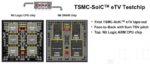
3D eTV testchip

TSMC recently held their 10th annual Open Innovation Platform (OIP) Ecosystem Forum.  An earlier article summarized the highlights of the keynote presentation from L.C. Lu, TSMC Fellow and Vice-President, Design and Technology Platform, entitled “TSMC and Its Ecosystem for Innovation” (link).

Overview of 3D Fabric

The TSMC 3D Fabric advanced packaging technology spans both the 2.5D and vertical die stacking offerings, as depicted below.

The Integrated FanOut (InFO) packages utilize a reconstituted wafer consisting of die embedded face down, surrounded by a molding compound (link).

Redistribution interconnect layers (RDL) are fabricated on the epoxy wafer.  (InFO-L refers to a silicon “bridge chiplet” between die embedded in the InFO package for improved inter-die connectivity over the RDL metallization pitch.)

The 2.5D CoWoS technology integrates die (and often, high-bandwidth memory stacks) on an interposer utilizing microbump attach.  The original CoWoS technology offering (now CoWoS-S) used a silicon interposer, and related silicon-based lithography for RDL fabrication;  through-silicon vias (TSVs) provide connectivity to the package bumps.  The silicon interposer technology offers improved interconnect density, critical for the high signal count HBM interface.  More recently, TSMC has been offering an organic interposer (CoWoS-R), providing a tradeoff between interconnect density versus cost.

The 3D SoIC offering provides vertical integration utilizing hybrid bonding between die pads.  The die may be oriented in face-to-face or face-to-back configurations.  TSVs provide connectivity through the (thinned) die.

InFO and CoWoS offerings have been in high-volume production for several years.  The recent innovations in CoWoS development relate to expanding the maximum silicon interposer dimensions to greater than the maximum reticle size to accommodate a larger number of die (especially, HBM stacks), stitching together the RDL interconnects.

The majority of Jim’s presentation covered advanced in SoIC development.

SoIC Testchip

TSMC shared results of a recent SoIC qualification test vehicle, as shown below.

The configuration used was the vertical bonding of an (N5) CPU die with an (N6) SRAM die, in a face-to-back topology.  (Indeed, a major CPU vendor has pre-announced plans for a vertical “last-level” SRAM cache die attached to a CPU using TSMC’s SoIC, to be available in 1Q2022.)

SoIC Design Flow

Jim presented a high-level design flow for vertical die integration, as shown in the figure below.

The flow requires concurrent focus on both top-down system partitioning into individual die implementations, plus early analysis of the thermal heat dissipation in the composite configuration, as highlighted above.

The discussion on thermal analysis highlighted the “chimney” nature of the low thermal resistance paths of the BEOL PDN and interconnect, compared to the surrounding dielectrics, as shown above.  Specifically, TSMC has collaborated with EDA vendors on improving the accuracy of the SoIC model discretization techniques, applying a more detailed mesh in specific “hotspot” areas initially identified with a coarse grid analysis.

TSMC also presented a methodology recommendation to incorporate thermal analysis results into the calculation of SoIC static timing analysis derate factors.  Much like on-chip variation (OCV) is dependent upon the distance spanned by (clock and data) timing paths, the thermal gradient for the SoIC paths is an additional derate factor.  TSMC reported that on-die temperature gradients for a path are typically ~5-10C, and a small flat derate timing margin for temperature should suffice.  For SoIC paths, large gradients of ~20-30C are feasible.  A flat derate to cover this range would be too pessimistic for paths with a small temperature difference – results of SoIC thermal analysis should be used for derate factor calculation.

SoIC Testing

The IEEE 1838 standardization effort pertains to the definition of die-to-die interface testing (link).

Much like the IEEE 1149 standard for boundary-scan chains on-die for package-to-package testing on a printed circuit board, this standard defines the control and data signal ports on each die for post-stack testing.  The primary focus of the standard is to exercise the validity of the face-to-face bonds and TSVs introduced during SoIC assembly.

Jim indicated that this definition is sufficient for low-speed I/Os between SoIC die, yet a more extensive BIST method will be required for high-speed I/O interfaces.

TSMC Foundation IP for SoIC – LiteIO

TSMC’s library development teams commonly provide general-purpose I/O cells (GPIOs) for each silicon process node.  For the die-to-die connections in SoIC configurations, where the driver loading is less, TSMC offers a “LiteIO” design.  As illustrated below, the LiteIO design focuses on optimizing the layout to reduce parasitic ESD and antenna capacitances, to enable faster datarates between die.

EDA Enablement

The figure below lists the key tool features recently developed in collaboration with major EDA vendors for the InFO and SoIC package technologies.

Summary

TSMC continues to invest heavily in 2.5D/3D advanced packaging technology development.  The key recent initiatives have focused on the methodology for 3D SoIC direct die attach – i.e., partitioning, physical design, analysis.  Specifically, early thermal analysis is a mandatory step.  Additionally, TSMC shared results of their SoIC eTV qualification testchip vehicle.  2022 is shaping up to see the rapid emergence of 3D SoIC designs.

-chipguy

Also read:

Highlights of the TSMC Open Innovation Platform Ecosystem Forum

Highlights of the TSMC Open Innovation Platform Ecosystem Forum


Back to Basics in RTL Design Quality

Back to Basics in RTL Design Quality
by Bernard Murphy on 11-03-2021 at 6:00 am

Deming min

Harry Foster waxes philosophical in a recent white paper from Siemens EDA, in this case on the origins of bugs and the best way to avoid them. Spoiler alert, the answer is not to make them in the first place or at least to flush them out very quickly. I’m not being cynical – that really is the answer though practice often falls short of ideal. Harry suggests we need to get back to basics in RTL design quality, and what better place to start than W. Edwards Deming, a founding father of Total Quality Management.

W. Edwards Deming

Quality must be designed in

This seems trite but it’s often the simple mistakes that bite us, like an out-of-range indexing error. Best case they slow down system level testing, worst case they make it through to silicon. It’s easy for us to believe that we are mostly infallible and what few mistakes we make will be caught in verification. But survey after survey proves that trivial mistakes still slip through, because we should know we left the mirage of exhaustive testing behind a long time ago.

Following Deming, we need to design quality in, not try to paste it on in verification. Harry proposes a 3-step process for design, based on a combination of design plus intent. The first step, Produce, starts with producing correct RTL by design (I assume we’re talking here about new IP or subsystems). The argument here is that bugs per line of code (LOC) are more or less constant at 15-50 bugs per thousand LOC irrespective of whether you are creating RTL, C++ or Javascript. The best way to create less bugs is therefore less lines of code, using a higher level of abstraction like SystemC /C++, Chisel or some other domain specific language.

Proving that intent is met

Since the method connects design and intent, the second step aims to prove in design that the intent is met. Harry’s suggestion here is particularly to leverage static and formal verification tools. We are designing quality in, so this is a task for RTL designers. Who already have access to a wide range of apps to simplify this analysis. They can find FSM deadlocks, arithmetic overflow possibilities and potential indexing errors. For possible domain crossing bugs, they can find metastability potential and other domain crossing errors which in many cases cannot be detected at all in simulation. Another possible source of errors is in X optimism and pessimism. The former may at least waste valuable time in system-level verification and the latter can create mismatches between RTL and gate-level sims which even equivalence checking may not find.

Your system verification team will thank you. Or they may curse you if they find problems you could have fixed before you checked in your code.

Protecting intent

The third pillar requires that intent should be protected through the rest of the design lifecycle by continued testing. Harry’s suggestion is to adopt a continuous integration (CI) flow here. We simply reuse the static and formal tests we developed and proved in design. These are largely hands-free and fast tests which should quickly flag checkin mistakes (we all make them).

A final (blogger) thought

This is a worth addition to the canon. We all nod wisely but we still trip up sometimes. With tools like CI we should be able to flush out more of these problems early on.

That said, there are some system-level problems which remain challenging, and which can’t be fixed (I think) at the unit-level. Cache coherence problems, emerging only after billions of cycles are one good example. Power bugs are difficult to cover fully in designs with very complex power and voltage switching. Security problems around speculative execution are another example. It would be great to find some kind of “unit test” methodologies around these system-level “IP”.

You can access the white paper HERE.

Also Read

APR Tool Gets a Speed Boost and Uses Less RAM

DARPA Toolbox Initiative Boosts Design Productivity

Heterogeneous Package Design Challenges for ADAS