







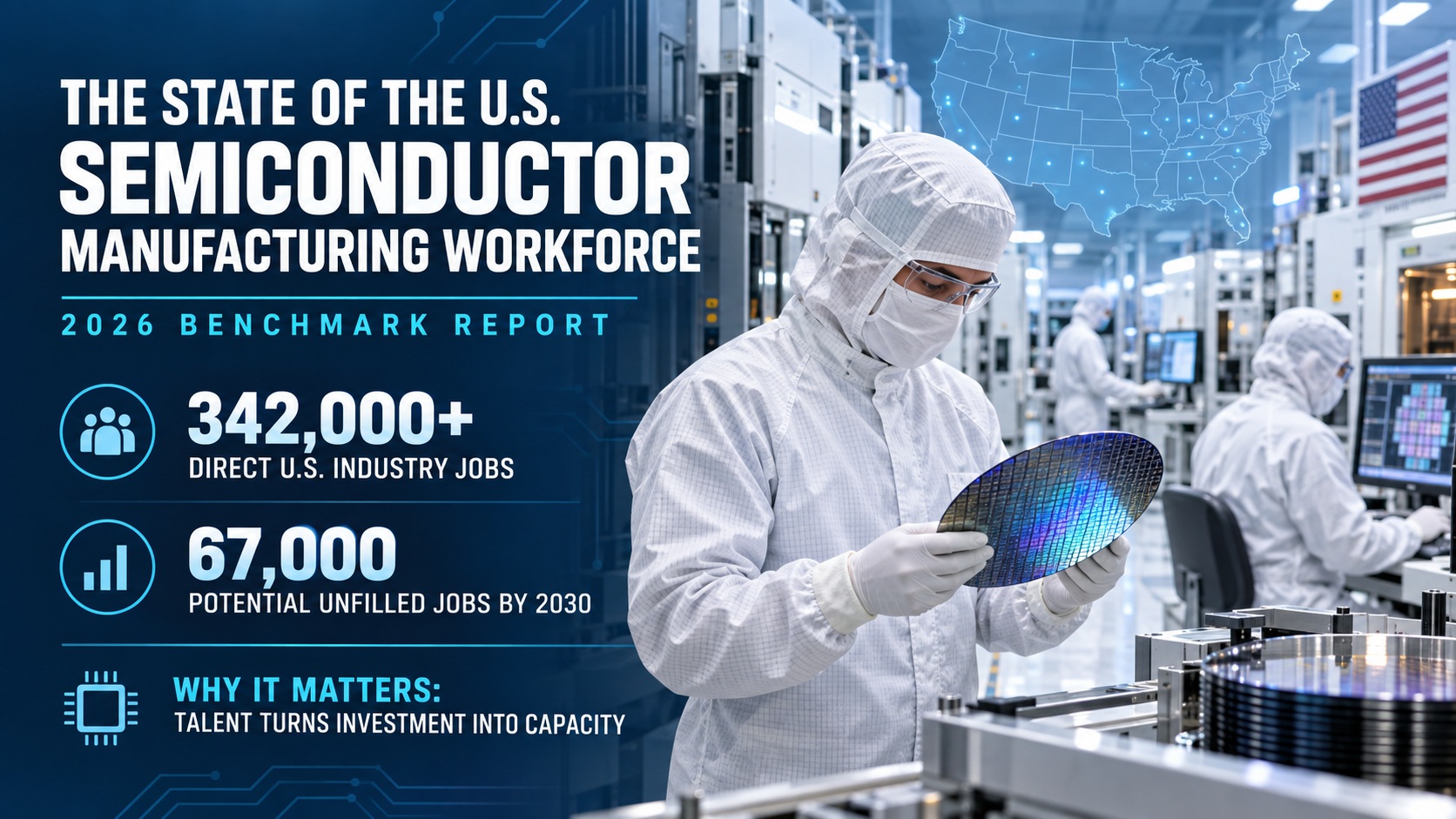
America’s semiconductor workforce is entering a decisive growth period, but employment capacity is not yet keeping pace with investment. New fabrication plants, packaging facilities, and supplier expansions are creating demand for thousands of engineers, technicians, operators, and skilled tradespeople. Whether the United States can recruit and train them will help determine whether its semiconductor expansion delivers lasting production capacity or merely a collection of expensive, understaffed facilities.
The 2026 baseline
Workforce totals vary according to what is counted. The Semiconductor Industry Association reports that the broader U.S. semiconductor industry—including manufacturing, design, research, and related functions—directly employs more than 342,000 people and supports over two million additional jobs. By comparison, Bureau of Labor Statistics data for May 2026 show approximately 180,000 employees in the narrower “semiconductor and related device manufacturing” category. The broader semiconductor and electronic-component manufacturing sector employed about 369,000 people.
These distinctions matter. The industry requires far more than workers inside wafer-fabrication plants. Its labor ecosystem includes chip designers, process and equipment engineers, software specialists, chemical and materials suppliers, construction trades, maintenance personnel, and advanced-packaging technicians.
Investment is expanding the employment requirement. Federal incentives awarded through CHIPS for America were associated with projects expected to create more than 125,000 construction and permanent jobs, while semiconductor and electronics companies had announced nearly $450 billion in private investment by early 2025. Additional commitments followed, including Micron’s expanded plan to invest approximately $200 billion in U.S. manufacturing and research.
The central workforce gap
The most widely cited projection remains sobering. An SIA–Oxford Economics study estimated that the domestic semiconductor industry would add about 115,000 jobs between 2023 and 2030, increasing employment to roughly 460,000. Without corrective action, approximately 67,000—or 58 percent—of those new positions could remain unfilled.
The projected shortfall includes approximately 27,300 engineers, 26,400 technicians, and 13,400 computer scientists. This is not simply a shortage of advanced-degree researchers. A large portion of the risk sits in technician and skilled-production roles that can be accessed through associate degrees, certificates, apprenticeships, military experience, or employer-based training.
Hiring conditions also reveal a mismatch between demand and preparation. NIST reported that advertised salaries for semiconductor positions rose by more than 35 percent after passage of the CHIPS Act. Yet employers continue to report difficulty finding candidates with experience in cleanroom procedures, vacuum systems, robotics, industrial maintenance, statistical process control, chemistry, and precision manufacturing.
Geography intensifies the challenge. Semiconductor growth is concentrated in regional clusters—including Arizona, Texas, New York, Ohio, Idaho, Oregon, and upstate New York—where companies often compete for the same limited supply of engineers and technicians. New facilities also depend on housing, transportation, childcare, and community infrastructure. A technically qualified worker who cannot relocate or manage rotating shifts is not an accessible worker.
What is improving
The workforce response is becoming more practical and localized. Community colleges are developing short-term semiconductor certificates and technician degrees. Universities are expanding microelectronics research and engineering programs. Employers are supporting apprenticeships, internships, equipment-specific training, and tuition assistance. Federal initiatives are also treating workforce development as part of industrial capacity rather than as a separate education issue.
The strongest programs connect training directly to actual jobs. They involve employers in curriculum design, provide hands-on access to relevant equipment, recognize transferable military and manufacturing skills, and offer paid work-based learning. They also widen recruitment to women, veterans, rural communities, and groups historically underrepresented in technical occupations.
Why it matters
Semiconductor plants cannot operate on capital alone. A fabrication facility is productive only when skilled people can install, calibrate, maintain, and continuously improve its extraordinarily complex equipment.
Failure to close the workforce gap would delay factory ramp-ups, raise operating costs, and weaken returns on public and private investment. It could also leave the United States dependent on overseas production for chips essential to artificial intelligence, communications, vehicles, energy systems, medical equipment, and defense.
Bottom line: Success would deliver more than additional jobs. It would create durable regional career pathways, strengthen supply-chain resilience, accelerate innovation, and convert historic investment into real manufacturing capability. In 2026, workforce development is therefore not a supporting component of semiconductor policy. It is one of the principal measures by which that policy will succeed or fail.
Sources: Semiconductor Industry Association, U.S. Bureau of Labor Statistics, NIST workforce briefing, and U.S. Department of Commerce.
Also Read:
Nvidia Sees AGI While OpenAI Sees Danger
Samsung Might Be the Most Unusual Company on Earth
TSMC’s 2026 OIP Forum to Spotlight the Technologies Shaping the Next Era of Chips
Share this post via:




ASML Has High-NA and Chipmakers Can’t Say No