





Weebit Nano’s FY26 ESG Report shows how sustainability, governance and operational resilience are becoming integrated into the company’s commercialisation of resistive random-access memory (ReRAM). This integration matters because Weebit’s value is not derived from manufacturing and selling finished chips directly. Its business model depends on licensing semiconductor intellectual property to foundries, integrated device manufacturers and product companies, with future revenue expected from licence fees and royalties. Consequently, environmental efficiency, intellectual-property protection, cybersecurity and supply-chain governance directly affect whether customers can confidently qualify and deploy its technology.
Technically, ReRAM stores information by changing the resistance of a thin material layer rather than retaining electrical charge, as conventional flash memory does. The resulting non-volatile memory can retain data without continuous power. Weebit positions its ReRAM as a lower-power, high-performance and cost-effective alternative to established embedded non-volatile memories, particularly where embedded flash becomes difficult to scale at advanced process nodes. Potential applications include microcontrollers, automotive electronics, edge-AI processors, power-management devices and neuromorphic computing systems.
Its environmental relevance begins at the semiconductor-fabrication stage. Weebit states that ReRAM uses standard, widely available fabrication materials, avoids rare-earth elements and requires fewer production steps than conventional memory technologies. It can also reduce dependence on dedicated cleanrooms and highly specialised, energy-intensive processes. In operation, ReRAM’s low-power characteristics may reduce electricity consumption in devices that repeatedly access stored data. These advantages are especially relevant to battery-powered sensors and edge-AI systems, where memory movement and standby power can materially affect energy use. However, the report presents these benefits primarily as design characteristics and potential outcomes; it does not provide a complete product life-cycle assessment or independently assured comparison with competing memories.
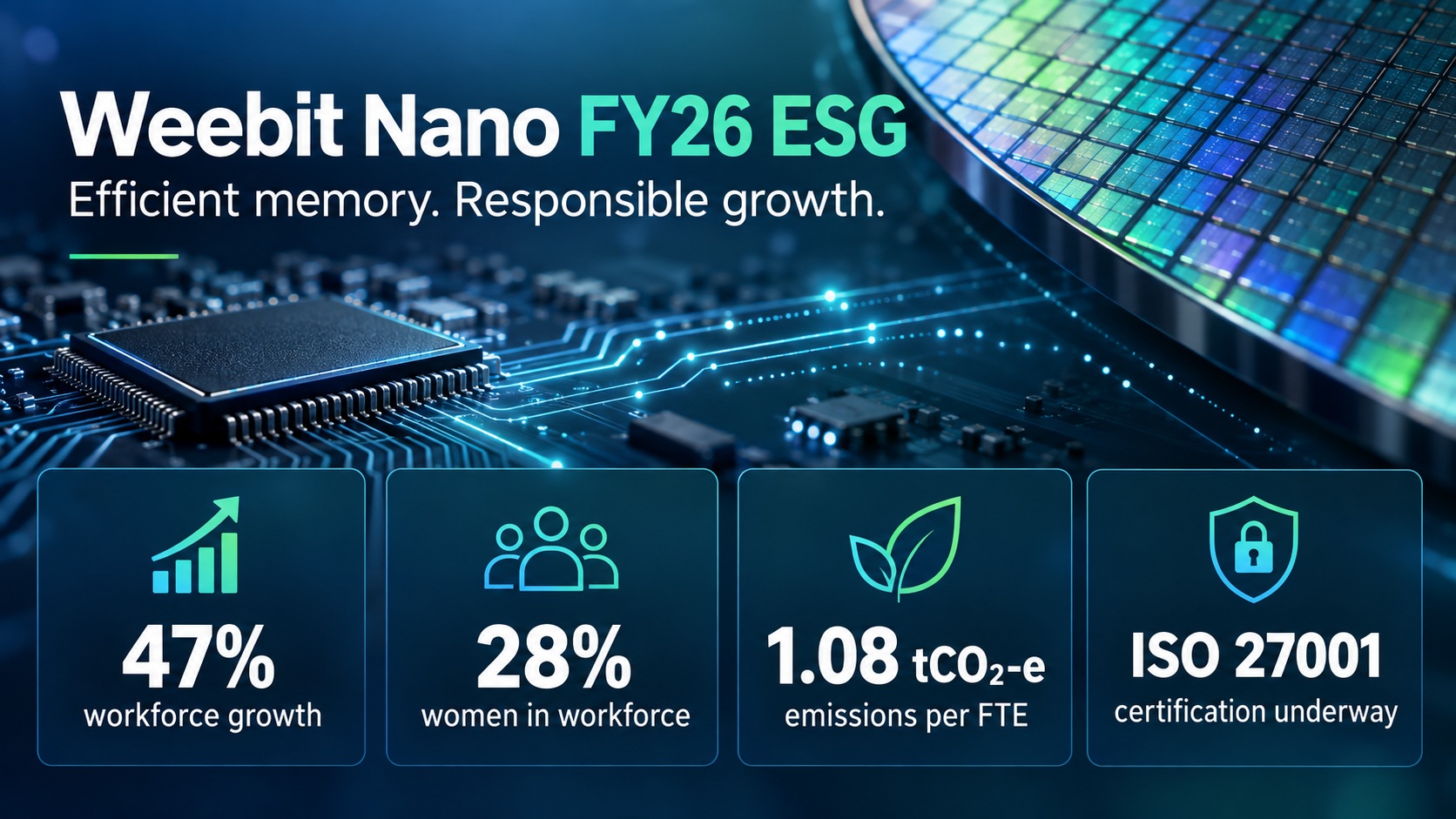
For its own operations, Weebit calculated Scope 1 and Scope 2 greenhouse-gas emissions using an operational-control boundary covering leased vehicles and purchased electricity in Israel and France. Combined emissions increased 17.8% from 53.30 tonnes of carbon-dioxide equivalent in FY24 to 62.78 tonnes in FY26, largely because expanding operations increased vehicle-related Scope 1 emissions. Scope 2 emissions nevertheless declined 32% over that period, despite workforce and office growth. Emissions intensity reached 1.08 tonnes per full-time equivalent in FY26, compared with 1.31 in FY25. The planned relocation to a renewable-energy-supplied office in January 2027 should reduce electricity-related emissions, although material Scope 3 categories—including impacts from contracted semiconductor manufacturing—remain to be identified.
This matters because most of the environmental footprint associated with a semiconductor-IP company is likely to sit outside its offices. Foundry processing, materials, outsourced services and downstream product use occur across the value chain. Assessing Scope 3 emissions and obtaining limited assurance over Scope 1 and 2 data would therefore make future claims more decision-useful. Weebit is developing its climate-governance, strategy, risk-management, metrics and targets in preparation for Australia’s AASB S2 climate-disclosure regime, but explicitly states that the FY26 report is voluntary, unaudited and not AASB S2-compliant.
Cybersecurity is similarly material because the company’s proprietary designs are its principal economic asset. Weebit has filed more than 70 patent applications, uses a Patent Committee and distinguishes between patenting inventions and retaining hard-to-detect techniques as confidential know-how. During FY26 it appointed an internal IT manager and an external chief information security officer, began ISO 27001 certification and developed 12 supporting policies. Technical controls included Cloudflare One secure access, zero-trust architecture, Microsoft Entra P2 identity monitoring, 1Password, mobile-application management and emergency-access accounts. Planned SIEM, managed detection and response, security-operations-centre capability, GitHub Enterprise security and stronger endpoint management should improve detection and recovery.
Bottom line: Governance supports these technical controls. Weebit defined its risk appetite, strengthened business-continuity testing, embedded ESG requirements into supplier documents and appointed Deloitte Australia to operate an independent whistleblowing hotline. Workforce growth of 47% increased organisational capacity, while women represented about 28% of employees and 29% of the board.
The inaugural S&P Global Corporate Sustainability Assessment score of 14 out of 100 demonstrates that the programme remains early-stage. More importantly, it creates a measurable baseline. For investors and semiconductor partners, the FY26 report therefore signals improving operational maturity while clearly revealing the next priorities: assured data, Scope 3 measurement, supplier screening, climate scenario analysis and fully implemented cybersecurity controls.
Also Read:
Weebit Nano ReRAM Reaches Commercial Tape-Out Milestone
2026 Outlook with Coby Hanoch of Weebit Nano
Weebit Nano Reports on 2025 Targets
Share this post via:




Comments
There are no comments yet.
You must register or log in to view/post comments.