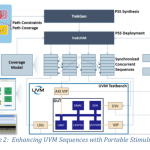

Frequent Semiwiki readers are well aware of the industry momentum behind machine learning applications. New opportunities are emerging at a rapid pace. High-level programming language semantics and compilers to capture and simulate neural network models have been developed to enhance developer productivity (link). Researchers… Read More
3D ESD verification: Tackling new challenges in advanced IC designBy Dina Medhat Three key takeaways 3D ICs…Read More
Reimagining Architectural Exploration in the Age of AIThis is not about architecting a full SoC…Read More
S2C, MachineWare, and Andes Introduce RISC-V Co-Emulation Solution to Accelerate Chip DevelopmentMachineWare, and Andes Technology today announced a collaborative…Read More
A Webinar About Electrical Verification – The Invisible Bottleneck in IC DesignElectrical rule checking (ERC) is a standard part…Read MoreDAC versus SEMICON ES Design West!
As I mentioned in a previous post, the big drama at last year’s Design Automation Conference was the acquisition of the Electronic Systems Design Alliance (formerly EDAC) by SEMI, the owner of the SEMICON West Conference franchise. The plan is to add an ES Design West wing to the SEMICON West conference in San Francisco next year.… Read More
Ampere: More on Arm-Based Servers
Since I talked recently about AWS adding access to Arm-based server instances in their cloud offering, I thought it would be interesting to look further into other Arm-based server solutions. I had a meeting with Ampere Computing at Arm TechCon. They offer server devices and are worth closer examination as a player in this game.… Read More
SoC Design Partitioning to Save Time and Avoid Mistakes
I started designing ICs in 1978 and continued through 1986, and each chip used hierarchy and partitioning but our methodology was totally ad-hoc, and documented on paper, so it was time consuming to make revisions to the chip or train someone else on the history or our chip, let alone re-use any portion of our chips again. Those old,… Read More
Cadence Automotive Summit Sensor Enablement Highlights
At the November 14 Cadence Automotive Summit, Ian Dennison, Senior Group Director, outlined sensor enablement technologies and SoC mixed-signal design solutions, from Virtuoso electrically aware design with high current, high reliability, yield and performance tools and methodologies enabling ADAS/AV sensors for vehicle… Read More
Photonics with CurvyCore
As a preferred carrier to data or energy, photonics technology is becoming broad and diverse. In IC design, silicon-photonics technology has been the enabler of new capabilities and has revolutionized many applications as Moore’s-based scaling started to experience a slowdown. It acts as new on-chip inductor in HPC design … Read More
Intel Discontinues the Custom Foundry Business!
After mentioning what I heard at IEDM 2018, that Intel was officially closing the merchant foundry business as an aside in a SemiWiki forum discussion, I got a lot of email responses so let me clarify. Honestly I did not think it was a big surprise. Intel Custom Foundry was an ill conceived idea (my opinion) from the very start and was… Read More
Next-Generation Formal Verification
As SoC and IP designs continue to increase in complexity while schedules accelerate, verification teams are looking for methodologies to improve design confidence more quickly. Formal verification techniques provide one route to improved design confidence, and the increase in papers and interest at industry conferences… Read More
Embeddable FPGA Fabric on TSMC 7nm
With their current line-up of embeddable and discrete FPGA products, Achronix has made a big impact on their markets. They started with their Speedster FPGA standard products, and then essentially created a brand-new market for embeddable FPGA IP cores. They have just announced a new generation of their Speedcore embeddable… Read More
Sequential Equivalency Checks in HLS
Higher level synthesis (HLS) of an IP block involves taking its high-level design specification –usually captured in SystemC or C++, synthesizes and generates its RTL equivalent. HLS provides a faster convergence path to design code stability, promotes design reuse and lowers front-end design inception cost.
HLS and Mentor… Read More


Quantum Computing Technologies and Challenges