






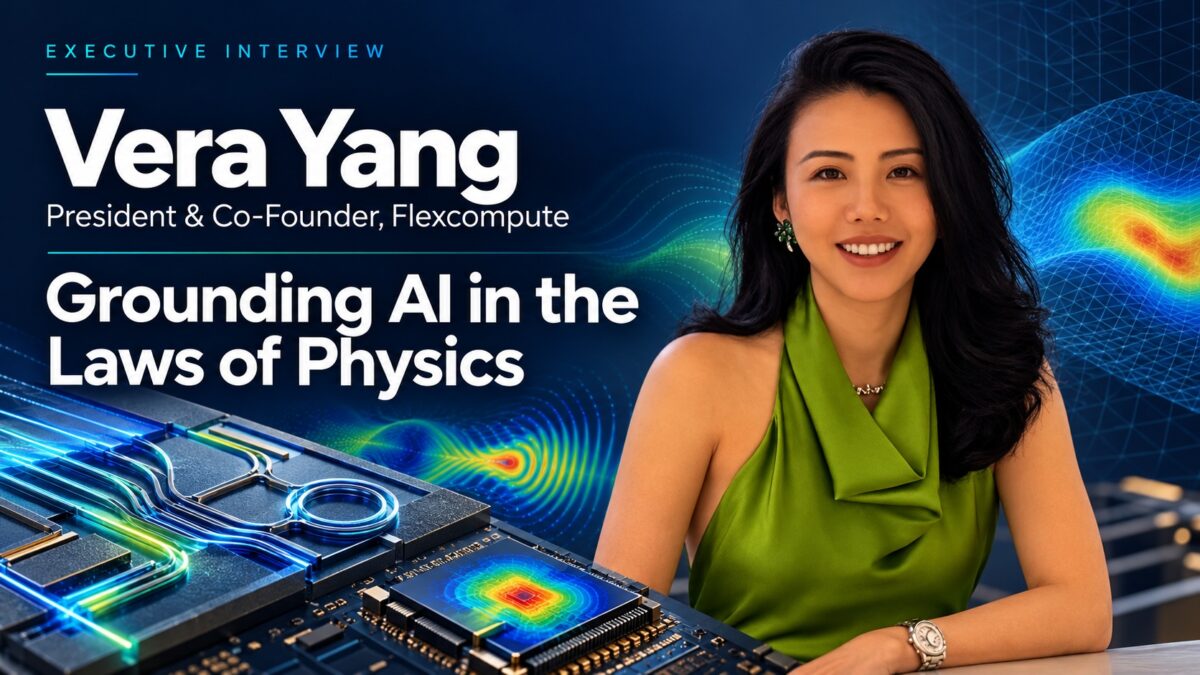
Vera Yang is President and Co-Founder of Flexcompute, a frontier AI lab building a Physics World Model that bridges data-driven AI and the laws of physics. She focuses on the problems where the stakes are highest and the physics hardest, including photonic chips for AI data centers, advanced semiconductor packaging and spacecraft operations in orbit. Before Flexcompute, Vera was a partner at Hedosophia and Warburg Pincus and led the New York Stock Exchange’s Asia business, advising more than 30 companies.
Tell us about your company?
Flexcompute is a frontier AI lab building a Physics World Model, which grounds AI in the laws of physics so engineers and AI agents can know how a design will perform before it’s built. Researchers from Stanford and MIT founded the company, and our team of more than 70 PhDs builds physics solvers for electromagnetics, fluid dynamics, structures and heat. Through Tokenized Physics, we build neural networks and our physics solvers directly into one model. It represents complex physical systems efficiently while preserving the governing physics, which makes our validated solvers fast enough to work inside AI-driven design loops and gives AI a verification layer grounded in trusted physics.
More than 250 companies use our technology across semiconductors, photonics, aerospace, automotive and defense. SemiWiki readers may know us through Tidy3D, our photonics and electromagnetics solver, and PhotonForge, our photonic chip design platform. In October, Samsung Ventures and Applied Ventures invested in Flexcompute.
What problems are you solving?
AI needs more chips, and the way to design more of them better is with AI agents working alongside engineers. Agents are already good at generating designs. Our team asked a group of five agents to rebuild photonic circuits from published papers, and they have built 34 so far, including a 32×32 switch with 1,024 Mach-Zehnder interferometers. Every one passed DRC and LVS.
So the hard part is shifting from generating options to knowing which ones will work: capturing design intent, simulating the full circuit and closing the loop with measured data. That is the problem we solve. Flexcompute validates every design against real-world physics at the speed of AI, giving engineers the freedom to explore and the confidence to build.
What application areas are your strongest?
Photonics is our deepest. Teams at AMD, Anduril, Nvidia, Samsung Display, Coherent, TDK, Ayar Labs, and Global Foundry use our solutions to integrate foundry PDKs and EDA tools. Optical I/O and co-packaged optics for AI data centers are the fastest-growing part of that work.
We’re also strong in the physics of advanced packaging: heat, stress, warpage and reliability. As chiplets, HBM and optics share one package, those effects interact. Tokenized Physics lets engineers ask system-level questions that used to be too large or too slow to simulate. Our warpage Physics Twin, for example, predicts which of more than 800,000 solder points will fail under heat before the design goes to production.
What keeps your customers up at night?
Respins. A photonic chip or advanced package that fails after tapeout costs months and millions of dollars, and the stakes rise as optics move closer to the processor. The most dangerous problems hide between components. One of our engineers recently built a full optical I/O chip in PhotonForge, eight wavelength channels at 100 Gb/s each, in an agentic workflow. Each demultiplexer filter had about −18 dB of crosstalk to its neighbor, which looks fine on a datasheet. Simulated as a full link with every channel present, the leakage added up across the receiver and noticeably degraded the eye. You only see that when the whole chip is simulated together.
And as teams bring agents into the flow, the question becomes: if an agent proposes a design, can we trust it enough to send it to the fab? Our answer is to put trusted physics behind every step.
What does the competitive landscape look like and how do you differentiate?
There are established simulation and EDA vendors, and a growing number of AI companies building surrogate models trained on past simulation data. Surrogates are only as good as their data and can be confidently wrong on a design no one has seen before. We differentiate in three ways.
● First, we build our own frontier physics capabilities through novel solvers across multi-physics domains, so answers come from validated physics rather than from patterns in old data.
● Second, Tokenized Physics builds neural networks and first-principles physics into one model, so we can handle multi-scale problems that no other simulation company can solve.
● Third, our verification layer is agent-native and fast enough to keep pace with generative design, checking every design against the laws of physics as quickly as AI can create it.
What new features/technology are you working on?
In October we released PhotonForge 2.0, built on a simple idea: agents will increasingly design chips with engineers, so both need the same tools. Engineers and agents work on one design, from PDK and schematic through layout, multi-physics simulation, DRC, LVS and tapeout. Recent releases added physics-verified compact models and automatic Verilog-A export, so device physics carries through to circuit simulation.
Next, we’re extending physics verification of AI-assisted designs into the industry-standard EDA flows our customers rely on, and expanding our Physics Twins for advanced packaging, starting with warpage, thermal, and signal integrity problems. All of them are proven by Flexcompute’s Physics World Model.
How do customers normally engage with your company?
Most teams start with PhotonForge Community. It’s free, runs on the engineer’s own machine, and any agent can start using it from our docs. When a team is ready to take designs to production, Enterprise adds foundry PDK integration, EDA connectors, version control and traceability that ties every revision to the tapeout and to the data measured back.
For the hardest, highest-stakes problems, like warpage in advanced packages, we work directly with a customer’s team to build a Physics Twin: a working model of their product, backed by our solvers, that their engineers and AI agents can question, test and improve before anything is built. We also run agentic design workshops and complimentary teaching programs for universities.
Also Read:
Share this post via:


TSMC’s Patent and the Harsh Realities of 3D DRAM Competition