Bronco Webinar 800x100 1

TSMC 5nm and EUV Update 2018

TSMC 5nm and EUV Update 2018
by Daniel Nenni on 01-23-2018 at 12:00 pm

The TSMC Q4 2017 earnings call transcript is up and I found it to be quite interesting for several reasons. First and foremost, this is the last call Chairman Dr. Morris Chang will participate in which signifies the end of a world changing era for me and the fabless semiconductor ecosystem, absolutely. TSMC announced his retirement with Mark Liu, who has been co-CEO along with C.C. Wei since 2013, replacing Morris as Chairman and C.C. Wei taking over the role of single CEO. Earnings calls were much more interesting when Morris Chang participated especially in the Q&A session when he questioned some of the questions. Here is his good-bye:

I really have spent many years with some of you, many years, more than 20 years. Although I think most of you probably haven’t attended this particular conference that long. But having here almost 30 years I think, yes. And I enjoyed it, and I think that we all — at least I hope that I had a good time. I hope that you had a good time, too. And I will miss you, and thank you very, very much. Thank you. Thank you. Thank you.

The call started out with Laura Ho and financial recaps but also revenue by technology:

10-nanometer process technology continues to ramp strongly, accounted for 25% of total wafer revenue in the fourth quarter. The combined 16/20 contribution was 20% of total wafer revenue. Advanced technologies, meaning 28-nanometer and below, accounted for 63% of total wafer revenue, up from 57% in the third quarter. On a full year basis, 10-nanometer contribution reached 10% of total wafer revenue in 2017. The combined 16 and 20 contribution was 25% of total wafer revenue. Advanced technology, 28-nanometer and below, accounted for 58% of total wafer revenue, up from 54% in 2016.

This really is good news for TSMC since the more mature nodes (40nm and above) are more competitive thus lower margined. It will be interesting to see when TSMC lowers that advanced node bar below 28/22nm, probably in two years when 7nm hits HVM and 5nm is ramping.

Laura ended her remarks with a solid Q1 guidance:

Based on the current business outlook, we expect first quarter revenue to be between USD 8.4 billion and USD 8.5 billion, which is an 8.3% sequential decline but a 12.6% year-over-year increase at the midpoint and represent a new record high in terms of first quarter revenue.

Mark Lui started his prepared remarks with an introduction to the TSMC “Everyone’s Foundry” strategy:

Firstly, I would like to talk about our “Everyone’s Foundry” strategy. Being everyone’s foundry is the strategy TSMC takes by heart. Through our technology and services, we build an Open Innovation Platform, where all innovators in the semiconductor industry can come to realize their innovation and bring their products to life. As our customers continue to innovate, they bring new requirements to us, and we need to continuously develop new capabilities to answer them. In the meantime, they utilize those shared capabilities such as yield improvement, design, utilities, foundation IPs and our large-scale and flexible capacities. In this way, this open innovation ecosystem expands its scale and its value. We do not compete with our customers. We are everyone’s foundry.

The translation here in Silicon Valley is that TSMC does not compete with customers or partners which is a direct shot at Samsung, my opinion. Mark also talked about the latest semiconductor killer app and that is cryptocurrency mining which is booming in China:

Now on cryptocurrency demand: In the past, TSMC’s open innovation ecosystem incubates numerous growth drivers for the semiconductor industry. In the ’90s, it was the PC chipsets; then in the early ’20s, the graphic processors; in the mid- to late ’20s, it was chipset for cellular phone; recently, start 2010, it was for smartphones. Those ways of innovation continuously sprout in our ecosystem and drive the growth of TSMC. Furthermore, we are quite certain that deep learning and blockchain technologies, which are the core technology of cryptocurrency mining, will lead to new waves of semiconductor innovation and demand for years to come.

Mark then switched to 5nm (N5) and EUV readiness. According to Mark, N5 is on track for Q1 2019 risk production which gives plenty of room for Apple to get 5nm SoCs out in time for 2020 Apple products. I have not heard any fake news about Apple switching foundries which is a nice change. TSMC and Apple are like peanut butter and jelly…

EUV is also progressing with high yields on N7+ and N5 development. Some customers have mentioned getting EUV at the contacts and vias at 7N before getting EUV for metals and shrink at 7N+ which makes complete sense to me.

Mark also mentions that EUV source power is at 160 watts for N7 with N5 development activities at 250 watt waiting in the wings. This all jives with what Scott Jones presented at ISS 2018 last week. Mark’s EUV pellicle comment however left me with a question:

EUV pellicle making has also been established with low defect level and good transmission properties. So we are confident that our EUV technology will be ready for high-volume production for N7+ in 2019 and N5 in 2020.

I’m curious to know what “good transmission properties” are. From what I am told they need to be 90%+ but they are currently in the low 80% range. Does else anybody know? Can someone share their pellicle wisdom here? The other EUV question I have is about the 10% performance and density gain between 7N and 7N+. Is that EUV related or just additional process optimization? I will be in Hsinchu next week so I can follow-up after that.

All-in-all it really was a good call, you can read the full transcript HERE.


Simulation and Formal – Finding the Right Balance

Simulation and Formal – Finding the Right Balance
by Bernard Murphy on 01-23-2018 at 7:00 am

Simulation dominates hardware functional verification today and likely will continue to dominate for the foreseeable future. Meanwhile formal verification, once thought to be a possible challenger for the title, has instead converged on a more effective role as a complement to simulation. Formal excels at finding problems in shallow but very broad state graphs and avoids a good deal of the overhead in testbench setup, while simulation has the advantage over formal in deep sequential problems, mixed-level (AMS, SystemC) and asynchronous behavior modeling. Unsurprisingly, many verification teams already use both to maximize signoff quality and throughput.


The trick is finding the right balance. Sticking to simulation may be easy but that doesn’t help if it takes you longer to get to signoff than your competitors or if that signoff still misses important problems. Equally an over-enthusiastic view of how widely you can use formal may get you bogged down in tangled abstractions and constraints with an unclear view of what you really have or have not signed-off at the end of it all. Fortunately, a lot of experience has grown up around this topic; Infineon and one of the Cadence IP teams shared their experiences at CDNLive and Jasper User Group events. Also, Marvell added some important input on optimizing simulation turn-times.

Based on their CDNLive presentation, I would characterize this Infineon team as cautious mid-range users in the world of formal; neither pushing the envelope in complex system verification or heavy usage, nor at the very early stages of adoption. They are using formal to look for corner cases in ~10-20% of test-cases then re-testing those in simulation, and using formal standalone (no simulation backup) in ~5-10% of cases. They start with a common split between blocks:

  • Formal-friendly: low sequential depth, control, data transfer, simpler data transform and concurrent blocks of these types. Interesting to note, per Pete Hardee (product management director at Cadence) that the simpler datapath blocks (think CSA) are starting to appear in the formal-friendly set.
  • Formal-unfriendly: high number of state elements, high sequential depth, complex datapath elements (think Wallace-tree)

Infineon made use of a number of pre-packaged apps in JasperGold, including the connectivity app and the control and status register app. They also created some of their own properties for specialized checks, especially at IP boundaries. Infineon put a lot of work into determining coverage from these proofs which they then merged with simulation coverage, both to confirm the correctness of their split between formal and simulation and to discover where they could reduce simulation effort in coverage. Quite interesting – take a look at how they scaled back effort in their UVM development after examining what they felt was already well-proven around register-file testing.


The Cadence IP group also uses formal verification and their input is in some ways even more revealing. They have to optimize to their business goals independent of tools teams and they have to satisfy a very wide range of potential use models. Interestingly, the team that presented acknowledged initially an even more cautious view of formal, seeing it as a specialized capability playing no major role in serious signoff (sound familiar?). They chose to step up to more active usage on a CCIX block (a new standard for chip-to-chip cache coherence messaging), where they ran simulation and formal methods in parallel.


A big goal again was to get meaningful coverage from formal and to this end the IP group used several approaches:

  • Classic formal coverage based on full and bounded proofs, with coverage analyzed using proof-core methods. They view this as valuable for finding bugs but not primary for signoff
  • Something Cadence calls state-swarm where the search for bugs is driven by end-to-end properties, but is guided by multiple cover-points along the way, in what amounts to a random walk (they view this as somewhat like to a constrained random analysis). This was the IP group’s main signoff criterion, for me a variant on the proof-depth cover-point approach.
  • Guide-pointing which is similar to state-swarm except that proving must hit the cover-points in order (this is more like a formal variant on directed testing)

The second and third cases here are ways to reach out beyond conventional formal cycle-depth limits in what is generally known as bug-hunting, not usually considered a contributor to formal coverage, but it seems like the IP group are confident these methods are sufficiently structured that they can be an effective contributor.

Meanwhile, while verification teams look for ways to offload work for simulation, what remains for simulation gets harder. Marvell talked at the same event about the turnaround time challenge in simply compiling and elaborating designs now running to a billion gates (you read that right – a billion gates in simulation). Even for simulation, that can run to many hours. When you’re tweaking a design, you really want to make this as incremental as possible to minimize major down-times between runs. Making compile incremental is easy – you can do that with Makefile-like methods. But incremental elaboration isn’t so easy; that’s where you’re flattening the netlist and optimizing for simulation performance, which tends to be a chip-wide operation.

Cadence now supports, in its Xcelium Parallel Logic Simulation, a technique it calls Multi-Snapshot Incremental Elaboration (MSIE), which allows for user control of partitions in elaboration to enable reuse from earlier elaborations (replace only partitions that have changed). Bottom line, Marvell reported improvements of 30-100X in TAT over monolithic compile/elaboration run-times. Adam Sherer (product management group director at Cadence) also noted that Xcelium is now supported on ARM servers, which means that massive simulation workloads can be pushed into datacenters hosting tens of thousands of ARM cores in dense new server-architectures.

Back to the balance. Simulation is still the main workhorse, especially for huge designs and giant workloads. Formal adds a first-class complement to that effort, contributing not just in proving and bug hunting but also in coverage, relieving simulation of some important components of signoff. Speakers at the conference also noted that where simulation and formal were run side-by-side, formal found some problems not found by simulation, and vice-versa. Both add to a higher quality result, as long as you get the balance right.


How many engineers does it take to get an IoT security certificate?

How many engineers does it take to get an IoT security certificate?
by Diya Soubra on 01-22-2018 at 12:00 pm

Spoiler alert, the answer is none!

Let me take you back to the beginning to explain that answer.


For the sake of this discussion, I will reduce a complex IoT solution to three fundamental blocks:

  • IoT node
  • IoT Gateway
  • IoT Server

The IoT node is a sensor that converts analog, physical world context into digital data. The node has to have a processor to run an IoT protocol stack and a radio to connect to the network. The technology for building nodes is abundant. Every week there is a release of best-in-class devices such as this one:

For the radio part, in-between LoRa, SigFox and NB-IoT, system designers have a wide choice to fit each specific vertical application. SigFox seems to be so successful that it has to be attacked with fake news to slow it down.

There is also an abundance of IoT node stacks. Choice is always a good thing to have as a vibrant ecosystem is essential in any industry:

Express Logic’s X-Ware IoT Platform™ to Bring Industrial Grade Connectivity to Thread® Networked Devices

Amazon Free RTOS

ARM Mbed

ARM Coretex-A7 based industrial IoT Gateway From Cascademic Solutions

The conclusion so far is that we have the technology to build and connect a trillion end points in a cost efficient manner.

Moving up, the IoT Gateway benefits from the economy of scale of mobile phones. The same devices used in mobile phones are fit for purpose for gateways. Raspberry Pi copycat boards are on the market for $9.

For gateways, the concern is about software and the ease of bringing web developers to integrate IoT nodes into their web infrastructure. The offer is abundant.

Universal IoT Gateway Middleware – Speed up IoT Development

Once we reach the server side we enter the well established domain of the cloud and cloud software where compute power and storage are infinite. True, we need a new service for IoT node management but that is an add-on to the cloud infrastructure, not a new one. Server software is about converting digital data into information to make decisions which is where the value resides.

Get started with Azure IoT Hub Device Management

IoT solution providers are abundant too. They do magic to pull together all these building blocks into a coherent end to end solution.

KILKA-TECH Portfolio

IOTA Data Marketplace

Smart Energy

Even the subject that I have been ranting about for a long time seems to be en route to be resolved, the IoT Data Market place that removes the need for data brokers. This is the ultimate goal for IoT, automatic node to node contracts on the fly.

At this point we should all be feeling very warm and fuzzy. We have solved all the issues blocking the deployment of billions of nodes. right? Yes, except for the question relating to liability in case of a security breach.

Arm took the initiative to highlight this to the industry by issuing a security manifestoand by releasing a Platform Security Architecture.

For IoT, we are talking about thousands of companies and verticals. How does a company manage the liability from a security breach across millions of nodes? Usually there is a set of industry specific regulations that one can certify a solution against and thus limit the liability in case of a hack.

Given the lack of governmental IoT security regulations then there is no certification possible hence the number of engineers required to certify an IoT node is zero. et voila!

Yes, I know, it took a while to get to this point.

In the past five years the industry has taken giant steps to supply all the building blocks required to release the value locked in IoT deployment, at scale. We are at the finish line with IoT security certification and regulations. Relativity tells us that time runs slower in political circles than in hi-tech. Eventually we will start to see regulations issued world wide for IoT security. Once the regulation is in place then we need to sort out the logistics of certification for a trillion nodes with firmware that changes over time. Meanwhile may be we should explore self certification in the spirit of the security manifesto!

Thousands of verticals with millions of nodes each, such exciting opportunities!


Autonomous Automobile Update ISS 2018

Autonomous Automobile Update ISS 2018
by Daniel Nenni on 01-22-2018 at 7:00 am

As a car enthusiast and a semiconductor professional the latest automotive trends are of great interest to me. My father raced sports cars and I remember being part of the pit crew (but not really) and impatiently waiting for my turn to drive. The years before my 16[SUP]th[/SUP] birthday when I could legally drive were the slowest in my life, definitely.

Today I am told that my grandchildren will not need to learn to drive thanks to autonomous cars and other forms of autonomous transportation which makes me happy but also sad that they will not have that level of responsibility. Driving really is a big part of life experience and I wonder how my grandchild will get along without it.

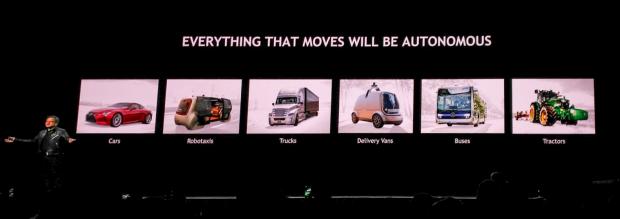
The question in my mind has always been not IF but WHEN we have fully autonomous cars on the road and that timeline in my head is getting much shorter. Technology is certainly moving forward but the big “driver” in California is traffic. When your average commuting speed is 10-20 miles per hour on Highway 101 the safety risks of autonomous driving are dramatically reduced. And quite possibly distracted driving will be replaced by tickets for sleeping while driving.

In Silicon Valley construction is still booming with both high density commercial and residential buildings but the one constant is the roads, they are not changing so our only hope is technology. Eliminating the human factor of transportation with autonomous cars above and below ground which will ultimately lead to a transportation system like the Hyperloop.

At ISS 2018 Dr. Maarten Sierhuis (Director of Nissan Research Center Silicon Valley for Nissan North) gave us an autonomous update which was quite interesting.

Maarten leads a team of researchers tasked with developing autonomous vehicles, connected vehicles, and Human-Machine Interaction and Interfaces to help shape the future of intelligent transportation. Previously Maarten spent 12 years at NASA where he created a computer language that was used to develop an intelligent system for all communication between Mission Control and the International Space Station. He also developed an autonomous system to monitor and give advice to astronauts during spacewalks.

Maarten’s slides were not made available but I did find a recent article on Wired.com “Nissan’s path to self-driving cars?” which is déjà vu of his presentation. In regards to city autonomous driving:

“There is so much cognition that you need here,” Sierhuis says. The driver—or the car—has to interpret the placement of the cones and the behavior of the human worker to understand that in this case, it’s OK to drive through a red light on the wrong side of the road. “This is not gonna happen in the next five to ten years.”

According to Maarten a human will need to be in the loop in a supervisory role which Nissan now calls “Seamless Autonomous Mobility”. Think call center for autonomous cars that may need human intervention or ONSTAR on steroids. Even better, think NASA and the supervision of autonomous and teleoperated satellites and vehicles since Maarten is from NASA.

Bottom line:
From what I have read, there are close to 300 companies developing autonomous automotive technology so we will definitely get there. In China it will be mandated by the government. In California it will be mandated by the brutal gridlock and increasing highway fatalities due to human error/ignorance, absolutely.


A New Year’s resolution: Turn off computers

A New Year’s resolution: Turn off computers
by Vivek Wadhwa on 01-20-2018 at 7:00 am

Facebook’s recent acknowledgment that social media may be making its users feel bad in some cases is a significant milestone. So far, the technology industry hardly has talked about the downsides of their products. Now a realization seems to be setting in that perhaps something has gone wrong along the way.

Academic research that Facebook cited in a corporate blog post documented that when people spend a lot of time passively consuming information they feel worse. For example, reading Facebook posts for even 10 minutes can put people in a bad mood, and clicking or liking too many links and posts can have a negative effect on mental health. Some researchers also believe that reading rosy stories about others leads to negative comparisons about one’s life and that being online too much reduces in-person socializing.

Social media may well be making many of us unhappy, jealous and anti-social.

While Facebook said that as a result of the assessments, it would make some changes to its platform (e.g. give people more control of what they see and help with suicide prevention), it also highlighted some of the benefits of using the social network. It pointed to research it helped conduct which concludes that “sharing messages, posts and comments with close friends and reminiscing about past interactions” can make people feel better. Facebook said it is working with sociologists and scientists to find ways to enhance “well-being through meaningful interactions” and more-active engagement.

“In sum, our research and other academic literature suggests that it’s about how you use social media that matters when it comes to your well-being,” Facebook said. It posits that if we engage or interact with others more on its platform, we will be happier.

But that approach doesn’t seem to be an effective solution for those who can’t pull themselves away from such platforms. The Pew Research Center estimates that 24 percent of teens go online “almost constantly,” for example. It is becoming a matter of addiction.

]In July 2016, former Google “design ethicist” Tristan Harris published the essay “A Slot Machine in Our Pocket,” which detailed the many ways in which technology affects people’s minds and makes them addicted. He drew a direct line of descent to phones and computer screens from the numerous techniques that slot-machine designers use to entice gamblers to sit for hours losing money.

These techniques are similar to the work of psychologist B.F. Skinner, who in the 1930s put rats in boxes and taught them to push levers to receive a food pellet. They would push the levers only when hungry, though. To get the rats to press the lever repeatedly, even when they did not need food, he gave them a pellet only some of the time, a concept now known as intermittent variable rewards.

The casinos took variable rewards to a new level, designing multiple forms of rewards into slot machines. Those machines now bring in the majority of casino profits. Players not only receive payouts at seemingly random intervals but also partial payouts that impart the feeling of a win even if the player in fact loses money overall on a turn.

These techniques entice humans to keep playing, because our brains are hard-wired to become addicted to variable rewards, as Skinner had found. And it is intermittent variable rewards that have us checking our smartphones for emails, new followers on Twitter or more likes on photographs we posted on Facebook.

The “bottomless bowl” of information we are served also leaves us always seeking more.

]Cornell University researcher Brian Wansink led a 2005 study that found that people who ate soup from bowls that had a tube in the bottom, which constantly refilled themselves, consumed 73 percent more than those who ate out of normal bowls. And they felt no more satiated. This is the effect Netflix has when it auto-plays the next episode of a show after a cliffhanger and you continue watching, thinking, “I can make up the sleep over the weekend.” And it is the effect that Facebook, Instagram and Twitter have in tacking on their scrolling pages and updating news feeds, causing each article to roll into the next.

This doesn’t seem to be a fair fight. The tech industry is constantly mining our data, using artificial intelligence to learn our habits and building tools to have us returning for more. We can turn off our applications, but some of us are subconsciously addicted to them.

So we need to be aware of what we are up against. Technology, when used correctly, can be wonderful. But perhaps the best solution is just to use technology in moderation.

Remember when we would just pick up the phone and call someone rather than emailing them and creating greater misunderstandings? This may be an old-fashioned choice, but the right one. And maybe we should just turn away from our screens sometimes and meet our friends and family in person.

This is based on my forthcoming book,Your Happiness Was Hacked: Why Tech Is Winning the Battle to Control Your Brain–and How to Fight Back. You can pre-order this now!


Moore’s Law Drives Foundries and IP Providers

Moore’s Law Drives Foundries and IP Providers
by Daniel Payne on 01-19-2018 at 7:00 am

2017 was a banner year for semiconductor sales as they topped $400B for the first time, an increase of some 20%, there is happiness in Silicon Valley, Taiwan, South Korea, and well, everywhere. With the foundries pushing to ever-smaller process dimensions and even going back to mature nodes and offering more variations that are more power or area efficient, I am noticing a proliferation of process nodes to choose from. The big challenge that crops up is how to get all of that much-needed semiconductor IP onto the latest process node in order to attract new customer design starts. I’ve been following one semiconductor IP provider in the UK called Moortecthat has embedded in-chip monitoring blocks that allow chip engineers to dynamically monitor the Process, Voltage and Temperature (PVT). What’s new this week is their announcement that the TSMC 12nm FinFET process called 12FFC is now supported by their PVT monitoring IP.

The 12FFC process from TSMC has a new six-track (6T) standard cell library, compared to the 16FFC node that used 9T and 7.5T. So going from the 16FFC to 12FFC process you would expect an area decrease up to 18% and about 5% faster speeds. Nominal supply voltage level can go down to 0.5V.

Related blog – Top 10 Updates from the TSMC Technology Symposium, Part II


TSMC 12FFC photograph. Source: TSMC

Related blog – Embedded In-chip Monitoring, Webinar Recap

So why do you need in-chip monitoring?

Here’s seven good reasons to consider using in-chip monitoring:

  • Optimize SoC performance
  • Detect process variations per chip
  • Enable Dynamic Frequency and Voltage Scaling (DVFS) to optimize power
  • Gate delay measurements
  • Critical path analysis
  • Dynamic voltage analysis
  • Monitor aging effects of the FinFET transistors

OK, you like the concept of PVT monitoring and see the benefits, but how do you communicate with this IP?

Moortec IP uses AMBA APB interfacing and you can even have multiple instances of monitor IP on the same chip, then you connect with a test access port.

Read the latest press release from Moortec here.


ISS 2018 – The Impact of EUV on the Semiconductor Supply Chain

ISS 2018 – The Impact of EUV on the Semiconductor Supply Chain
by Scotten Jones on 01-18-2018 at 8:00 am

I was invited to give a talk at the ISS conference on the Impact of EUV on the Semiconductor Supply Chain. The ISS conference is an annual gathering of semiconductor executives to review technology and global trends. In this article I will walk through my presentation and conclusions.
Continue reading “ISS 2018 – The Impact of EUV on the Semiconductor Supply Chain”


Thermal Modeling for ADAS goes MultiPhysics

Thermal Modeling for ADAS goes MultiPhysics
by Bernard Murphy on 01-18-2018 at 7:00 am

In electronic system design, we have grown comfortable with the idea that different regimes of analysis, such as the chip, the package and the system, or electrical, thermal and stress are more or less independent – what starts in one regime stays in that regime, give or take some margin information passed onto other regimes. And why not? It’s worked pretty well for us so far. But now we face a convergence of factors challenging the effectiveness of that decoupling: ADAS expecting significantly longer system lifetimes in more extreme environments, FinFET technologies in which self-heating and Joule heating are becoming more important and wafer-level packaging technologies crowding more electronics into smaller spaces.


Something has to give and what’s giving in this case is the assumption that these factors can be modeled independently. Which is a little scary – now you have to think about modeling heating at the chip, package and system levels across a wide range, from hot-spots on die to a wafer-level package and system enclosures, cooling effectiveness through radiative and convective cooling, and mechanical/stress factors where bonds may break or traces may lift off the interposer or board. Putting all this together requires a broader portfolio of technologies than we commonly expect in EDA.


Start with a thermal-aware electromigration (EM) analysis, a factor of great importance to reliability in devices where power level can switch, such as in PMICs or power-managed SoCs. In such cases, higher temperatures mean higher resistance and power-switching means inrush currents through those higher resistance paths, so you have a higher risk of EM. Assuming that massive over-design is not an option, selectively mitigating problem cases requires a fine-grained understanding of heating across the die, which isn’t practical in standard EDA thermal analytics, entering finite-element analysis (FEA). You use traditional methods like FEA to model thermal effects within small, manageable regions and use a variety of methods to minimize / smooth out discontinuities between those regions. All of which helps you understand true temperature exposure at a detailed level. That in turn allows you to manage EM risk at the same level without having to over-design everywhere.


Thermally-induced stress is another important factor for reliability. In wafer-level packaging, as one example, thermal stress on very thin redistribution layers (RDL), popular for thin wafer-level packages, can stress traces, vias and dielectric. Cumulative stress cycling leads to fatigue and therefore reliability problems (increased-resistance in connections or opens). A perhaps lesser-known problem relates to a very significant increase in the coefficient of thermal expansion in dielectrics at something known as the glass transition temperature (Tg). This can lead to significant warpage in the dielectric, especially in WLP, with obvious consequences for reliability. Indeed, especially in WLP, thermally-induced stress analysis becomes particularly important in the highly complex structures found in these technologies, all depending on a variety of materials with unavoidably highly-nonlinear thermal expansion properties.


Finally, there’s the small matter of cooling. These are thermal problems after all, so cooling is a part of mitigating those problems. In an ADAS enclosure, modeling the impact of proposed cooling solutions (fans, device positioning, reducing heat from devices) calls for modeling through CFD. Not a chip problem you say? Remember that opening paragraph. We’re building ADAS solutions and they have to be co-optimized in the total package. So yes, CFD modeling is a part of the analysis, perhaps as part of a collaborative development between the Tier 1 and the chip-developer, but each has to be able to exchange models and results to collaborate effectively.

ANSYS unsurprisingly has solutions to these needs, from their chip-package-system (CPS) modeling to their system level thermal and mechanical modeling. You can learn more from work they describe in a paper they presented on thermal-induced stress for fanout wafer-level packaging HERE and a paper they presented on a transient thermal simulation methodology for PMICs HERE.


A Reliable Way to Forecast Growth of Semiconductor Markets

A Reliable Way to Forecast Growth of Semiconductor Markets
by Daniel Nenni on 01-17-2018 at 12:00 pm

Wally Rhines, President and CEO of Mentor, a Siemens Group, did another one of his famous deep learning presentations at SEMI ISS 2018. Using the Gompertz Curve Lifecycle to forecast the future growth of semiconductor markets, Wally looks at: Image sensors, Desktop PCs, PC Notebooks, Cell Phone Subscribers, Smartphones, and IoT products (smart meters, wearables, fitness trackers, and medical wearables). Wally then applied Gompertz to the limitations of growing markets: 3D TVs, Automotive Night Vision, and Drowsiness Systems.

Next Wally used Gompertz to answer the ever burning question: Where are we in the life cycle of semiconductor manufacturing? As it turns out we still have quite a bit of room to grow before we need an alternative to the silicon transistor switch.

Wally and I have discussed the non-traditional semiconductor chip company phenomena many times and he gave a couple of prime examples: Automotive, there are hundreds on new car companies with products in development. Consolidation will come very quickly but not before EDA and IP companies collect their chip design toll. Medical, remember the Google contact lens project that can potentially track hundreds of bio markers including glucose for the hundreds of million people with diabetes? There are a slew of health and wellness related chips and devices coming. IoT, there are thousands of companies buying EDA tools and IP making chips that will be in just about every device we will touch in the coming years.

In his “Where’s the Money” section Wally focused on IoT Data Center, Gateway, and Edge Devices, and rightly so. Here is the “IoT As a Source of Future Semiconductor Revenue Growth” bullet points:

  • IoT data owners will make most of the money
  • Traditional semiconductor companies will attempt to capture data ownership value
  • Growing semiconductor/sensor capability will create new semiconductor applications and bring new companies into semiconductor design

Wally sent me a copy of his presentation which is available HERE.

During breakfast Wally and I discussed a wide variety of topics both personal and professional. I met Wally in my early blogging days when my mantra was “I blog for food”. Wally invited me for lunch and we have been friends ever since. While it is important that I do not play favorites (as the founder of a mega semiconductor media channel) what I can tell you is that Wally is my beautiful wife’s favorite EDA CEO, absolutely. She says Wally is charming…

At the conference Wally was much more relaxed and upbeat than ever before. Engineering the most incredible EDA exit of all times (Siemens) is only part of it. The transformation of Mentor, a Siemens Business, over the last year is something I feel honored to witness. Seriously, in the last 30 years I have seen nothing like it! It is a shame Siemens does not break out IC Design revenue because my guess from customer visits in 2017 is that Mentor, a Siemens Business, is consuming EDA market share at an unheard of rate.


Mentor Tessent Products Ready for Second Edition of ISO 26262 Coming in March 2018

Mentor Tessent Products Ready for Second Edition of ISO 26262 Coming in March 2018
by Mitch Heins on 01-17-2018 at 7:00 am

Have you notice how smart your automobile is getting? Watching the first round of NFL playoffs I lost count on the number of TV commercials showing cars weaving through tight construction zones (and Star Wars figures), big trucks parking in incredibly tight spaces, cars avoiding rear-end collisions and pedestrians, and even a pickup with specialized sensors used when pulling a trailer. That of course is just the beginning. There is much more to come and the electronics for these systems will be big business for IC providers, but it does beg the question of safety and reliability. And as you would expect, more standards are coming out to address this very thing.

Mentor, a Siemens Business, issued a new white paper outlining the upcoming second edition of the ISO 26262 Functional Safety Standard for road vehicles. The standard’s second edition adds sections to cover heavier road cars, trucks, buses and motorcycles. More interesting to IC folks is a completely new section to the standard that covers design and test of semiconductors that go into vehicles. For all those IC providers hoping to leverage this market, you need to take notice of these changes.

The original ISO 26262 was intended to be applied to safety-related systems that include electrical and/or electronic (E/E) systems in series production passenger cars with a maximum grows weight of 3500 kg. The standard provides a definition of what is meant by “safety” and how safety goals are determine and what is a “safe state” (e.g. where do we end up when we do have a malfunction). The standard also speaks to the safety life cycle from management, development, production, operation, service and eventual decommissioning.

Per ISO 26262, designers must develop a safety plan to achieve stated safety goals. Safety integrity levels for automotive-specific risks are classified depending on the level of severity of effects of a device failure. These are known as ASILs (Automotive Safety Integrity Levels). ASIL levels range from ASIL-A through ASIL-D, with ASIL-D being the most stringent. ASIL-D implies that the likely potential for severe life-threatening or fatal injury in the event of a malfunction. Each vehicle E/E component is ASIL-classified based on the severity of the effects of a failure to the driver and passengers as well to persons near the vehicle.

ISO 26262 was first introduced in late 2011. The standard was revised again in 2012 to give clarity to the standard (section 10) and more recently again in 2016 to add section 11, dealing with semiconductors and section 12 dealing with the additional vehicle types already mentioned. The draft standard from 2016 is the basis for the 2[SUP]nd[/SUP] edition of the standard that is to be released in March of 2018.

Mentor’s interest in this comes from their Tessent family of design automation tools that address quality and reliability of semiconductors during both manufacturing and in-system operation. Tessent test solutions are used to target zero-DPM silicon and their unique diagnosis and yield analysis capabilities enable designers to quickly determine root-cause analysis of field returns as well as the identification of systematic defects that lead to yield excursions. Designers use Tessent products to show evidence (as required by ISO 26262) of how work product functional safety has been reached. Not only can the tool be used to prove how functional safety is built into an IC, but they also specify specific customer use cases which can be used to judge the tools’ impact on safety, so even the Tessent tools get ISO certification.

The new part 11 of the ISO 26262 spec gives a comprehensive overview of functional-safety related items for development of semiconductor parts. Pertinent to Mentor is the Design-for-Test (DFT) section that covers hardware faults, errors and failure modes including definitions of fault models and failure modes in relation to functional safety. Semiconductor IP is also addressed relating to how to qualify an IP and how that IP affects parts of the design that use that IP.

Design-for-manufacturing (DFM) tools work to identify systematic design issues that can cause failure and yield loss. ISO 26262 however focuses on random failures that may be introduced by the environment. Causes of these failures may be things like vibration, moisture, dirt, or circuit effects like noise, EMI or electro-migration. The new part 11 of the standard gives clarity and guidelines with examples for how to calculate and use base failure rates. It also provides guidelines for identification of possible common cause and cascading failures between elements through something known as Dependent Failure Analysis (DFA). Look for more functionality from the Mentor Tessent family of products to address these kinds of analysis in the future.

In the meantime, the new section 11 describes important semiconductor use cases covering digital components, memories, analog and mixed-signal, programmable devices, multi-core components as well as sensors and transducers. These are all right down Mentor’s alley, especially with their recent focus on internet-of-things (IoT) design flows that cut across nearly all of Mentor’s IC products. Currently, Mentor’s Tessent DFT and yield family of tools are all ISO 26262 qualified and available now to help IC makers go after the automotive IC market. Check out their white paper for more details on the Tessent product line and the upcoming 2[SUP]nd[/SUP] Edition to ISO 26262

See Also:
White Paper: ISO 26262 Second Edition: What’s New for Semiconductor Test?
Mentor Tessent DFT and Yield Family of Tools