Bronco Webinar 800x100 1

Numerical Sizing and Tuning Shortens Analog Design Cycles

Numerical Sizing and Tuning Shortens Analog Design Cycles
by Tom Simon on 11-22-2021 at 6:00 am

Sizing and tuning

By any measure analog circuit design is a difficult and complex process. This point is driven home in a recent webinar by MunEDA. Michael Pronath, VP Products and Solutions at MunEDA, lays out why, even with the assistance of simulators, analog circuit sizing and tuning can consume weeks of time in what can potentially be a non-convergent process. The webinar titled “Optimal circuit sizing strategies for performance, low power, and high yield of analog and full custom IP” describes the problems designers encounter and offers a solution.

Memories, custom cells, RF and analog blocks are facing challenges that include smaller process nodes, difficult PPA trade-offs, reliability, low noise requirements, yield, etc. Equation-based circuit sizing can become intractable, especially when numerous performance specifications are added to the problem. It quite quickly becomes an expanding n-dimensional problem. Not only is it hard to find a working solution through manual iteration, manual approaches often prevent significant further optimization from being achieved. In many cases Michael explains reaching the optimal value of one spec violates another spec. This can arise from non-linear parameter dependencies resulting in mixed effects. He suggests that it’s not enough just to shift nominal values, but instead sensitivities need to be minimized so that yields can be improved.

Sizing and tuning

MunEDA has developed an automated tool that performs numerical resizing based on simulation results to refine device parameters to achieve all of a design’s specifications. The initial design needs some initial sizes, but even if it does not meet all design specs, MunEDA’s circuit sizing, optimization and variation analysis tools can find optimum results, or tell the designers that a different topology is necessary. MunEDA’s WiCkeD Tool Suite delivers performance optimization over multiple PVT corners on all test benches simultaneously. It is smart enough to perform automatic analog structure recognition. It performs yield optimization, and power & area optimization. It is suitable for traditional process technologies and FinFET nodes. As the WiCkeD tools work on a design they keep a design history and database at each step, so it is easy to perform experimentation and exploration.

MunEDA’s automated numerical circuit sizing with WiCkeD progresses through four distinct stages. Feasibility optimization locates the design with correct DC biasing for MOS devices. Nominal tuning at typical PVT fulfills specs at typical conditions. Worst case operating conditions are met through tuning at different PVTs. Design centering is done to improve the robustness of the design against process variation and mismatch. Each phase narrows down the design parameters to achieve the best result.

After this discussion Michael moves the webinar on to a thorough demo that shows in detail how designers interact with the tool as they go through a design. There were several interesting highlights during this part of the webinar. The user interface provides both text and graphic feedback on the design state and performance. There is a fascinating view of the design that shows pairwise dependencies between specs so it is easy to comprehend where trade-offs might be difficult or easy to make. At each step of the sizing, tuning and optimization process there are graphs available that show values for each specification.

Michael runs through a convergent process of fitting specifications and moving toward completion. Frequently a process that might have taken weeks through manual optimization can be completed in several hours – including setup. The design history allows reverting to earlier steps and repeating them with different goals to find the best result.

Michael concludes with several case studies of customer designs where the WiCkeD Tool Suite has delivered impressive results. He shows a high speed DDRx IO, a PA core & filter, and a rail to rail input push-pull output AMP. In each of these examples the design time was reduced from weeks to hours and the PPA often was better than the by-hand results by a wide margin.

Michael’s expertise shows though in this concise but detailed talk on how to improve analog circuit design efforts. Breaking the bottleneck on analog circuit sizing and tuning can have meaningful result in shortening time to tape out. The webinar is available to view on-demand at the MunEDA website.

Also Read

Webinar on Methods for Monte Carlo and High Sigma Analysis

CEO Interview: Harald Neubauer of MunEDA

Webinar on Tools and Solutions for Analog IP Migration


Supply Chain Breaks Under Strain Causes Miss, Weak Guide, Repairs Needed

Supply Chain Breaks Under Strain Causes Miss, Weak Guide, Repairs Needed
by Robert Maire on 11-21-2021 at 8:00 am

Applied Materials

-AMAT -Supply chain can’t keep up with expanding business
-May be longer term issue which will limit upside
-Being tough on vendors may have come back to bite Applied
-Fixing supply chain will likely take longer than the current cycle

Supply Chain issues come home to roost

Applied Materials missed on both earnings and revenues versus the street coming in at EPS of $1.94 and revenues of $6.123B versus street expectations of $1.96 and $6.375B with whispers of over $2 and about $6.5B.

Guidance is for $1.85 +- $0.07 and revenues of $6.16B +- $250M …which sounds like flattish in a world of huge demand. Street expectations were $2.01 and $6.5B.

As compared to the rest of the semiconductor equipment industry which ranged from virtually zero supply chain impact to significant impact, Applied was most negatively impacted of any company. This clearly implies that the problems reported were likely Applied specific. According to the company the supply chain related impact was around $300M.

Shoemakers Children go barefoot

Applied laid the blame primarily on semiconductor shortages although we think it likely goes well beyond that to subsystems using semiconductors. It also sounded like most of the issues were on process tools.

We find it a bit odd that after navigating issues for much of the year that supply chain problems finally caught up with them. We would imagine that much of the inventory and stock in the supply chain has likely been used up to the point where there is little to no buffer left in the system.

Its not question of if upside will be limited but how much it will be limited?

We had predicted in our quarterly preview note of October 4th that we would likely see more impact from supply chain issues that we had not previously seen in previous quarters and that upside would likely start to limit performance which would in turn limit stock upside. Applied’s report is the best example of that projected issue

We have at the very least two quarters of negative impact on revenue and earnings and likely beyond into 2022. Although the reported quarter is only about a 5% hit to revenues it could worsen

Does inability to supply lead to share loss to competitors?

From Applied management it was clear that the areas most impacted were coincidentally those areas with the most competition such as deposition and etch. Could we see Lam, Tokyo Electron, Hitachi and ASMI pick up some share as customers get more desperate for tools that Applied can’t supply.

This is obviously more damaging as it causes a longer term problem because its harder to get back lost share

Demand is beyond huge…. its all a supply issue

Demand remains at super strong levels and we will likely see record demand in the near term. Sooner or later this “super duper cycle” will subside and things will slow so its very important to “make hay while the sun shines” and not miss any opportunities. We would hope that Applied can address the supply issues before the current cycle slows.

Being tough on vendors may have come back to bite Applied

Applied has always been very proud of being tough on suppliers…. perhaps a bit too tough, always trying to squeeze the last margin point or concession out of vendors. It seems that management has recognized this, perhaps a little late in the current demand environment.

CEO Gary Dickerson said during opening remarks on the call ” the economic value of capturing upside opportunities far outweighs pure efficiency savings, we’re also seeing changes in supply agreements across the eco-system as companies place a premium on having preferential access to capacity”.

Its certainly better late than never but it will take a long time to change the ingrained habits of the supply chain managers at Applied (similar to those in the auto industry). In our long history in the semiconductor industry we know of a number of sub suppliers who either didn’t do business with Applied or preferred doing business with others due to Applied’s hardball tactics. Now that things are tight its going to be even tougher to get new/more suppliers that are already servicing other customers..

We will likely see some impact on margins near term for expediting supplies or shipments or simply paying more to incentivize suppliers.

The stocks

We will likely see a knee jerk reaction across the space for what is a problem that is more specific to Applied although not completely limited to Applied as others have issues though not as bad.

The fear will be that supply issues will get worse and spread further across the industry which is not untrue.

We had suggested in our Oct 4th preview that the stocks had seen their near term peak and supply chain fears could be the reason that keeps them in check for the near term.

In general we think that KLAC and LRCX have done a better job on the supply chain issues with KLAC seeing essentially zero impact. ASML trades in another universe so even supply chain issues are of little impact given their monopolistic position.

We continue with the view that upside is limited in general as the fears will likely grow especially after Applied’s report.

Sub-suppliers may see a bit more love in the near term but shouldn’t expect it to last through a downturn when it comes.

Also Read:

KLAC- Foundry/Logic Drives Outperformance- No Supply Chain Woes- Nice Beat

Intel – “Super” Moore’s Law Time warp-“TSMC inside” GPU & Global Flounders IPO

Intel- Analysts/Investor flub shows disconnect on Intel, Industry & challenges


The Story of Ultra-Wideband Part 6: The Secret Revealed

The Story of Ultra-Wideband Part 6: The Secret Revealed
by Frederic Nabki & Dominic Deslandes on 11-21-2021 at 6:00 am

energy efficiency graph

This 6-article series started by asking the question: Why did Apple leap ahead of demand in 2019 by designing a UWB transceiver into the iPhone 11? Then in early 2020, why was UWB chip supplier Decawave acquired for an estimated $400-$500 Million? Why are automakers GM, Ford, Toyota, Nissan, Honda, Hyundai, Volkswagen, BMW and Mercedes all investing in UWB?

The answer is now clear: UWB offers a unique combination of accurate positioning, ultra-low power, ultra-low latency and high bandwidth that cannot be matched by any other short-range wireless technology. UWB deployments in 2021 have focused on precise positioning and location-based services: secure keyless entry, hands-free payments and indoor navigation. Coming soon are low-power and battery-free data IoT networks with up to 10X the bandwidth of Bluetooth.

This last article in the UWB series focuses on UWB’s superpowers as we enter the extreme-low-power and battery-free era.

UWB’s Superpowers: A Chronology

In the first five articles in this series, we examined the 100-year history of UWB and the development of each of its superpowers:

1912:                 Titanic uses wideband (WB) spark gap transmitters to call for help; all commercial ships are subsequently required to be equipped with WB transmitters and receivers are monitored 24/7. Spark gap transmitters took advantage of the first of wideband’s superpowers: using a wide spectrum to achieve a wideband signal.

1920s:               Narrowband displaces WB in communications to serve the booming demand for code and voice channels.

1930s-1940s:    Secret military research continues into wideband for its ranging capabilities, resulting in the RADAR revolution during World War II. RADAR takes full advantage of the second UWB superpower: high-precision positioning and ranging.

1980s-2000s:    Medical imaging; ground, wall and foliage penetrating radars and synthetic aperture radar (SAR) take advantage of ultra-wideband’s high-precision imaging.

Early 2000s:      Worldwide frequency allocations approved for UWB, but orthogonal frequency-division multiplexing (OFDM) UWB achieves limited deployment and mostly fails due to WiFi advances. Building on this experience, SPARK Microsystems develops a proprietary third UWB superpower: technology to make low-power low-latency UWB resilient to narrowband interference.

Early 2020s:      Apple and automakers start shipping hundreds of millions of UWB transceivers for secure keyless entry and location-based services. These applications take full advantage of UWB’s superpower of accurate positioning. In parallel, SPARK Microsystems starts to present ultra-low latency audio and video links leveraging its UWB technology, showing off UWB’s fourth superpower: extreme low latency for interactivity.

UWB Smashes Through Bluetooth Design Limitations

Bluetooth has been wildly successful serving low-bandwidth, low-fidelity communications (wireless headsets and earbuds, for example). So why did Apple design yet another transceiver into the iPhone 11? To serve emerging applications that dramatically exceed Bluetooth’s design limitations, notably accurate positioning.

In Part 5 of this series, we explored how narrowband protocols like Bluetooth have fundamental limitations that make them less suitable than UWB for extremely low power, low latency and battery-less applications:

Data rate limits: The Bluetooth specification limits over the air bandwidth to just 3 Mbps, and in most system is limited to less than 1 Mbps. UWB can operate at tens of Mbps.

Low data rate power: Oscillator overhead and long packet duration keeps Bluetooth minimum power at several milliwatts for even at lowest data rates. UWB tailored to low power operation and to data streaming, as achieved with SPARK Microsystems’ implementation, can transmit 1 kbps at under 10 μW, making possible battery-free sensors powered by energy harvesting.

Latency:            Bluetooth latency often exceeds 100 ms, which is noticed by headset users as echoes, long audio delays and speaking over each other on phone calls. This latency makes Bluetooth unattractive for interactive applications like game controllers and AR/VR, and unacceptable for industrial sensor and control systems. UWB offers sub-millisecond latency for near-real-time machine control and interactive entertainment systems.

Positioning:      Location services and precise positioning are well-known strong points of UWB, which can measure relative locations within 10 cm accuracy. This is out of the reach of Bluetooth which struggles getting sub few meters accuracy.

Interference robustness: The 3-10 GHz band is becoming crowded. In addition to LTE, 5G and WiFi, including the recently announced WiFi 6E, all occupy different parts of this spectrum. It is possible to achieve robust UWB communications but this has to be done carefully in order to operate without impeding all of the other carrier-based signals, and effectively rejecting them. SPARK Microsystems’ UWB transceiver implementation has demonstrated robust operation with these interferers while providing robust data communications in the UWB spectrum.

UWB Ideal for Short-Range, Extreme Low-Power Applications:

Indeed, for short-range, low-power applications, UWB is superior to WLAN and Zigbee as well as classic Bluetooth and BLE:

The Bottom Line: Energy Consumed for a Complete Link

This chart compares the energy efficiency for a complete link at 200kbps for Zigbee, BLE and UWB:

Energy efficiency for complete link (200kbps)

When you add up all the power required to energize and stabilize the carrier frequency and transmit narrowband data, the total is 1-2 orders of magnitude greater than UWB when tailored to operate at low power.

Conclusion:

Today’s UWB doesn’t resemble its spark gap predecessors from 100 years ago. And although narrowband radios have dominated communications since the demise of the spark gap almost a century ago, UWB is at the beginning of a massive resurgence. After all, it is the first new unlicensed-spectrum wireless technology to be included into smartphones in about 20 years and other phone manufacturers have followed Apple’s lead. UWB’s ‘superpowers’ directly address the power, bandwidth and latency demands of new applications that narrowband cannot deliver. UWB is uniquely suited to dominate many emerging low-power, low-latency, higher data rate applications and pave the way toward battery-less applications.

Our sincere thanks to SemiWiki for giving us the opportunity to recap and share the history of UWB to date. It goes without saying that there is much more history still to be written! Be sure to ‘watch this space’ for subsequent entries detailing UWB’s many technologies and commercial milestones on the path to mainstream adoption.

About Frederic Nabki

Dr. Frederic Nabki is cofounder and CTO of SPARK Microsystems, a wireless start-up bringing a new ultra low-power and low-latency UWB wireless connectivity technology to the market. He directs the technological innovations that SPARK Microsystems is introducing to market. He has 18 years of experience in research and development of RFICs and MEMS. He obtained his Ph.D. in Electrical Engineering from McGill University in 2010. Dr. Nabki has contributed to setting the direction of the technological roadmap for start-up companies, coordinated the development of advanced technologies and participated in product development efforts. His technical expertise includes analog, RF, and mixed-signal integrated circuits and MEMS sensors and actuators. He is a professor of electrical engineering at the École de Technologie Supérieure in Montreal, Canada. He has published several scientific publications, and he holds multiple patents on novel devices and technologies touching on microsystems and integrated circuits.

About Dominic Deslandes

Dr. Dominic Deslandes is cofounder and CSO of SPARK Microsystems, a wireless start-up bringing a new ultra low-power and low-latency UWB wireless connectivity technology to the market. He leads SPARK Microsystems’s long-term technology vision. Dominic has 21 years of experience in the design of RF systems. In the course of his career, he managed several research and development projects in the field of antenna design, RF system integration and interconnections, sensor networks and UWB communication systems. He has collaborated with several companies to develop innovative solutions for microwave sub-systems. Dr. Deslandes holds a doctorate in electrical engineering and a Master of Science in electrical engineering for Ecole Polytechnique of Montreal, where his research focused on high frequency system integration. He is a professor of electrical engineering at the École de Technologie Supérieure in Montreal, Canada.


Podcast EP50: Perforce at DAC

Podcast EP50: Perforce at DAC
by Daniel Nenni on 11-19-2021 at 10:00 am

Dan and Mike are joined by Simon Butler, general manager of the Methodics Business Unit at Perforce. Some history of DAC is discussed; what it’s like attending the show both as a small company and a larger one. The products Perforce will showcase at DAC this year are then discussed, The breadth of technology to support design infrastructure that Perforce brings to the industry is detailed by Simon.

The views, thoughts, and opinions expressed in these podcasts belong solely to the speaker, and not to the speaker’s employer, organization, committee or any other group or individual.

https://www.perforce.com/

https://www.dac.com/


2021 Semiconductors Finishing Strong with 2022 Moderating

2021 Semiconductors Finishing Strong with 2022 Moderating
by Bill Jewell on 11-19-2021 at 8:00 am

Top Semiconductor Comoany Reveue 2021

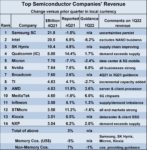
The semiconductor market in 3rd quarter 2021 was $144.8 billion, according to WSTS, up 7.4% from the prior quarter and up 27.6% from a year ago. The strong year-to-year growth was a slight deceleration from 30.4% in 2nd quarter 2021. The major memory companies reported very healthy 3Q21 revenue increases versus 2Q21 with all of them up double digits, led by Kioxia at 21.5%. Among the leading non-memory companies Qualcomm, AMD, Infineon, and NXP all had double digit growth. Intel was the only top semiconductor company with a revenue decline, down 2.2% in 3Q21 versus 2Q21.

The top semiconductor companies’ guidance for 4Q21 are mixed. Qualcomm expects 11.9% 4Q21 growth versus 3Q21 driven by strong handset growth, especially for Android smartphones. Nvidia, AMD, STMicroelectronics and NXP all project mid-single-digit revenue increases – citing datacenter, servers, gaming, automotive, and industrial as key drivers. Intel, Micron, MediaTek, Texas Instruments and Infineon all guided for 4Q21 revenue declines. The automotive market has drawn much attention for semiconductor shortages, however other markets are also showing problems. Weakness in the PC market due to shortages of some key components was highlighted as a concern by Intel, SK Hynix, Micron and Kioxia.

Constraints on supplies of semiconductors and other components are reflected in lower forecasts for the key end equipment categories of PCs and smartphones. In May 2021, IDC projected 2021 PC shipments of 357 million units, up 17.6% from 2020. In August 2021, IDC reduced its 2021 forecast to 347 million units, up 14.2% from 2020 and 10 million units lower than the May forecast. IDC cited supply chain issues for the lower forecast. Counterpoint Research in July 2021 expected 2021 smartphone shipments of 1,447 million units, up 8.7% from 2020. In September 2021, Counterpoint reduced its 2021 forecast to 1,414 million units, up 6.2% from 2020 and 33 million units lower than the July projection. Counterpoint blamed semiconductor shortages for its downward revision.

The most recent forecasts for the semiconductor market in 2021 and 2022 also incorporate the impact of supply constraints. Our November forecast from Semiconductor Intelligence calls for 2021 growth of 24.5% (down from 26% in our August forecast) and 14% growth in 2022 (down from 15% in August). IC Insights’ November projection of 23% growth in 2021 is down from their June forecast of 24.1%. Gartner is the most optimistic with an October estimate of a 27% increase in 2021. IDC has the lowest 2021 projection at 17%. With three quarters of data from WSTS and 4Q21 revenue guidance from most major companies, the 2021 semiconductor market will almost certainly finish in a range of 23% to 26%, the highest growth since 31.8% in 2010 following the great recession.

Our Semiconductor Intelligence forecast of 14% semiconductor market growth in 2022 is based on these key assumptions:

Normalization of growth of end equipment after higher-than-normal growth in 2021.

Relief of most major semiconductor and other component supply problems.

Continued recovery of most worldwide economies in 2022 following the worst of the pandemic.

The biggest uncertainty is the impact of COVID-19 in 2022. According to the Johns Hopkins University of Medicine, cases have risen over the last month following a decline from an August peak. Only 42% of the world’s population has been fully vaccinated, with the U.S. at 60%. Although most of the world has opened up, there are still numerous cases of local lockdowns. If COVID-19 is not mostly under control in 2022, the entire global economy will perform below its potential.

Also Read:

Semiconductor CapEx too strong?

Auto Semiconductor Shortage Worsens

Electronics Recovery Mixed


CEO Interview: Charbel Rizk of Oculi

CEO Interview: Charbel Rizk of Oculi
by Daniel Nenni on 11-19-2021 at 6:00 am

Charbel Rizk CEO Interview SemiWiki

Charbel Rizk is CEO of Oculi®, a spinout from Johns Hopkins University, a fabless semiconductor startup commercializing technology to address the high power and latency challenges of vision technology.  Dr. Rizk recognized these as barriers to effective AI in his years of experience as a Principal Systems Engineer, Lead Innovator, and Professor at Rockwell Aerospace, McDonnell Douglas, Boeing, JHUAPL and Johns Hopkins University. The Oculi vision solution reduces latency, bandwidth, and/or power consumption by up to 30x.

Why did you decide to create this technology?
Our original motivation was simply to enable more effective autonomy. Our perspective is that the planet needs the “human eye” in AI for energy efficiency and safety. Machines outperform humans in most tasks but human vision remains far superior despite technology advances. Cameras, being the predominant sensors for machine vision, have mega-pixels of resolution. Advanced processors can perform trillions of operations per second. With this combination, one would expect vision architecture (camera + computer) today to be on par with human vision. However, current technology is as much as ~40,000x behind, when looking at the combination of time and energy wasted in extracting the required information. There is a fundamental tradeoff between time and energy, and most solutions optimize one at the expense of the other. Just like biology, machine vision must generate the “best” actionable information very efficiently (in time and power consumption) from the available signal (photons).

What are the major problems with the current technology available in the market?
Cameras and processors operate very differently compared to the eye+brain combination, largely because they have been historically developed for different purposes. Cameras are for accurate communication and reproduction of a scene. Processors have evolved over time with certain applications in mind, with the primary performance measure being operations per second. The latest trend is domain specific architectures (i.e. custom chips), driven by demand from applications such as image processing.

Another important disconnect, albeit less obvious, is the architecture itself. When a solution is developed from existing components (i.e. off-the-self cameras and processors), it becomes difficult to integrate into a flexible solution and more importantly to dynamically optimize in real-time which is a key aspect of human vision.

As the world of automation grows exponentially and the demand for imaging sensors skyrockets, efficient (time and resources) vision technology becomes even more critical to safety (reducing latency) and to conserving energy.

What are the solutions proposed by Oculi?
Oculi has developed an integrated sensing and processing architecture for imaging or vision applications. Oculi patented technology is agnostic to both the sensing modality on the front end (linear, Geiger, DVS, infrared, depth or TOF) and the post-processing (CPU, GPU, AI Processors…) that follows.We have also demonstrated key IP in silicon that can materialize this architecture into commercial products within 12-18 months.

A processing platform that equals the brain is an important step in matching human perception, but it will not be sufficient to achieve human vision without “eye-like” sensors. In the world of vision technology, the eye represents the power and effectiveness of parallel edge processing and dynamic sensor optimization. The eye not only senses the light, it also performs a good bit of parallel processing and only transfers to the brain relevant information. It also receives feedback signals from the brain to dynamically adjust to changing conditions and/or objectives. Oculi has developed a novel vision architecture that deploys parallel processing and in-memory compute in the pixel (zero-distance between sensing and processing) that delivers up to 30x improvements in efficiency (time and/or energy).

The OCULI SPU™ (Sensing & Processing Unit), is a single chip complete vision solution delivering real-time Vision Intelligence (VI) at the edge with software-defined features and an output compatible with most computer vision ecosystems of tools and algorithms. Being fitted with the IntelliPixel™ technology, the OCULI SPU reduces bandwidth and external post-processing down to ~1% with zero loss of relevant information. The OCULI SPU S12, Our GEN 1 Go-To-Market product, is the industry’s first integrated neuromorphic (eye+brain) silicon deploying sparse sensing, parallel processing + memory, and dynamic optimization

It offers Efficient Vision Intelligence (VI) that is a prerequisite for effective Artificial Intelligence (AI) for edge applications.  OCULI SPU is the first single-chip vision solution on a standard CMOS process that delivers unparalleled selectivity, efficiency, and speed.

There is significant room for improvement in today’s products by simply optimizing the architecture, in particular the signal processing chain from capture to action, and human vision is a perfect example of what’s possible. At Oculi, we have developed a new architecture for computer and machine vision that promises efficiency on par with human vision but outperforms in speed.

Do you want to talk about the potential markets? R&D?
We have developed a healthy pipeline of customers/partners engagements over a variety of markets from industrial and intelligent transportation to consumers to automotive. Our initial focus is on edge applications for eye, gesture, and face tracking for interactive/smart display and AR/VR markets. These are near term market opportunities with high volume and Oculi technology offers a clear competitive edge. As biology and nature have been the inspiration for much of the technology innovations, developing imaging technology that mimics human vision in efficiency but outperforms in speed is a logical path. It is a low hanging fruit (performance versus price) as Oculi has successfully demonstrated in multiple paid pilot projects with large international customers. Also unlike photos and videos we collect for personal consumption, machine vision is not about pretty images and the most number of pixels.

Also Read:

CEO Update: Tuomas Hollman, Minima Processor CEO

CEO Interview: Dr. Ashish Darbari of Axiomise

CEO Interview: Da Chaung of Expedera


Synopsys Expands into Silicon Lifecycle Management

Synopsys Expands into Silicon Lifecycle Management
by Daniel Payne on 11-18-2021 at 10:00 am

SLM, Synopsys

I spoke with Steve Pateras of Synopsys last week to better understand what was happening with their Silicon Lifecycle Management vision, and I was reminded of a Forbes article from last year: Never Heard of Silicon Lifecycle Management? Join the Club. At least two major EDA vendors are now using the relatively new acronym SLM, and Synopsys defines it this way:

Silicon Lifecycle Management (SLM) is a relatively new process associated with the monitoring, analysis and optimization of semiconductor devices as they are designed, manufactured, tested and deployed in end user systems.

I had followed Moortec for a few years, and knew that Synopsys acquired this company for their embedded PVT sensors in November 2020. The second part of SLM is then to gather and analyze silicon data throughout the entire lifespan, so that even when the chips are running in a system you can analyze and even optimize the operation of your system.

Another strategic acquisition that Synopsys made to start building up its SLM vision was Qualtera back in June 2020, and they provide big data analytics for semiconductor test and manufacturing. The early tools in SLM are well-known to IC design and test engineers, because they include DFT and ATPG. The later tools in SLM are the analytics and in-field optimization.  This is precisely where the latest acquisition of Concertio comes in, because they provide AI-based optimization of a running system. Here’s a graphical flow of the SLM vision, so that you can see all of the areas that it applies to:

Specific IP and EDA tools included within SLM, include:

  • DesignWare PVT monitors
  • Fusion Design Platform – placement of PVT monitors
  • SiliconDash – data analytics for semiconductor manufacturing
  • YieldExplorer – design centric yield management
  • SiliconMax high-speed access IP, TestMAX Adaptive Learning Engine

For in-field operations, the idea is to observer the software running on the system, analyze it, then tune the system. One example that comes to mind is how a vertically integrated company like Apple have optimized how their MacBook Pro laptop  has it’s battery charged to optimize it’s lifespan, because they know how often each app is run, what the power and RAM use for an app is, and can then control clock speeds based on workloads, control the RPM rate of fans and ultimately extend the lifetime of the battery.

Concertio is being used by systems companies to monitor work loads, optimize the compute resources through firmware settings, OS setting and even app settings, or Kubernetes settings on cloud apps. They use reinforcement learning in their AI approach for continuous, realtime optimizations. Users of Concertio technology are reporting improvements in the range of 5-15%.

From a marketing perspective, the SLM tools fall under the platform name SiliconMAX. I learned that the Concertio company was incorporated in New York, while their R&D team is in Israel, and they serve multiple markets, like: Cloud, on-premise compute centers, silicon design, high frequency trading. Synopsys has a good record of treating acquired companies quite well, and you can still visit the concertio.com web site, as they support customers and grow their business.

I could see some similarities in the approaches between the DSO.ai technology and what Concertio offers, as they both use reinforcement learning, so it will be interesting to see what kind of synergy there may be in the future. Stay tuned for more news as Synopsys integrates Concertio technology so that PVT analytics are fed into the system optimization loop, keeping SoCs running reliably.

Related Blogs


A Flexible and Efficient Edge-AI Solution Using InferX X1 and InferX SDK

A Flexible and Efficient Edge-AI Solution Using InferX X1 and InferX SDK
by Kalar Rajendiran on 11-18-2021 at 6:00 am

15 Transformer vs Traditional CNN 2

The Linley Group held its Fall Processor Conference 2021 last week. There were several informative talks from various companies updating the audience on the latest research and development work happening in the industry. The presentations were categorized as per their focus, under eight different sessions. The sessions topics were, Applying Programmable Logic to AI Inference, SoC Design, Edge-AI Software, High-Performance Processors, Low-Power Sensing & AI, Server Acceleration, Edge-AI Processing, High-Performance Processor Design.

Edge-AI processing has been garnering a lot of attention over the recent years and accelerators are being designed-in for this important function. Flex Logix, Inc, delivered a couple of presentations at the conference. The talk titled “A  Flexible Yet Powerful Approach to Evolving Edge AI Workloads,” was given by Cheng Wang, their Sr.VP Software Architecture Engineering. This presentation covered details of their InferX X1 hardware, designed to support evolving learning models, higher throughput and lower training requirements. The other talk titled “Real-time Embedded Vision Solutions with the InferX SDK,” was given by  Jeremy Roberson, their Technical Director and AI Inference Software Architect. This presentation covered details of their software development kit (SDK) that makes it easy for customers to design an accelerator solution for Edge-AI applications. The following is an integrated summary of what I gathered from the two presentations.

Market Needs and Product Requirements

As fast as the market for edge processing is growing, the performance, power and cost requirements of these applications are also getting increasingly demanding. And AI adoption is pushing processing requirement more toward data manipulation rather than general purpose computing. Hardware accelerator solutions are being sought after to meet the needs of a growing number of consumer and commercial applications. While an ASIC-based accelerator solution is efficient from a performance and power perspective, it doesn’t offer the flexibility to address the changing needs of an application. A CPU or GPU based accelerator solution is flexible but not efficient in terms of performance, power and cost efficiencies. A solution that is both efficient and flexible will be a good fit for edge-AI processing applications.

The Flex Logix InferX™ X1 Chip

The InferX X1 chip is an accelerator/co-processor for the host processor. It is based on a dynamic Tensor processing approach. The Tensor array and datapath are programmed via a standard AI model paradigm described using TensorFlow. The hardware path is reconfigured and optimized for each layer of AI model processing. As a layer completes processing, the next layer configuration is reconfigured in microseconds. This allows efficiencies approaching what can be expected from a full custom ASIC at the same time providing the flexibility to accommodate new AI models.  This reconfigurable hardware approach makes it well suited for executing new neural network model types.

A Transformer is a new type of neural network architecture that is gaining adoption due to better efficiencies and accuracies for certain edge applications. But transformer’s computational complexity far exceeds what host processors can handle. Transformers also have a very different memory access pattern than CNNs. The flexibility of the InferX technology can handle this.  ASICs and other approaches (MPP for example) may not be able to easily support the memory access requirements of transformers. X1 can also help implement more complex transformers efficiently in exchange for simpler neural network backbone.

The InferX X1 chip includes a huge bank of multiply accumulate units (MACs) that do the neural math very efficiently. The hardware blocks are threaded together using configurable logic which is what delivers the flexibility. The chip has 8MB of internal memory, so performance is not impacted due to being external memory-bound. Very large network models can be run off of external memories.

Current Focus for Flex Logix

Although the InferX X1 can handle text input, audio input and generic data input, Flex Logix is currently focused on embedded vision market segments. Embedded vision applications are proliferating across multiple industries.

The InferX SDK

The SDK is responsible for compiling the model and enabling inference on the X1 Inference Accelerator.

How the Compiler Works

The compiler traverses the neural network layer by layer and optimizes each operator by mapping to the right hardware on X1. It converts TensorFlow graph model to dynamic InferX hardware instances. It automatically selects memory blocks and the 1D-TPU (MACs) and connects these blocks and other functions such as non-linearity and activation functions. And it finally adds and configures the output memory blocks for receiving the inference results.

Minimal effort is required to go from Model to Inference results. The customer supplies just a TFLite/ONNX model as input to the compiler. The compiler converts the model into a bit file for runtime processing of the customer’s data stream on the X1 hardware.

Runtime

API calls to the InferX X1 are made from the runtime environment. The API is architected to be able to handle the entire runtime specification with just a few API calls. The function call names are self-explanatory. This makes it easy and intuitive to implement.

Assuring High Quality

Each convolution operator has to be optimized differently as that depends on the channel depth. Flex Logix engages the hardware, software and apps team to rigorously test the usual as well as the corner cases. This is the diligent process they use to confirm that both the performance and functionality of the operators are met. Flex Logix has also quantized image de-noising and object detection models and verified a less than 0.1% accuracy loss in exchange for huge benefits in memory requirement.

Summary

Customers can implement their accelerator/inference solutions based on the InferX X1 chip. The InferX SDK makes it easy to implement edge acceleration solutions. Customers can optimize the solutions around their specific use cases in the embedded vision market segments.  The compiler ensures maximum performance with minimal user intervention. The InferX Runtime API is streamlined for ease-of-use. The end result is CPU/GPU kind of flexibility with ASIC kind of performance at low-power. Because of the reconfigurability, the solution is future-proofed for handling newer learning models.

Cheng’s and Jeremy’s presentations can be downloaded from here. [Session 2 and Session 10]


Podcast EP49: Where Semifore fits in the design flow

Podcast EP49: Where Semifore fits in the design flow
by Daniel Nenni on 11-17-2021 at 10:00 am

Dan and Mike are joined by Rich Weber, co-founder and CEO of Semifore. Rich describes what the hardware/software interface is, where it fits in the design flow and the importance of a well-documented and robust design. He touches on industry standards, where they help and how Semifore’s products complete the flow. RIch also addresses what comes next with Semifore’s development.

https://semifore.com/

The views, thoughts, and opinions expressed in these podcasts belong solely to the speaker, and not to the speaker’s employer, organization, committee or any other group or individual.


Register Management is the Foundation of Every Chip

Register Management is the Foundation of Every Chip
by Mike Gianfagna on 11-17-2021 at 6:00 am

Register Management is the Foundation of Every Chip

Virtually every chip today runs software. And that software needs to interact with and control the hardware on the chip. There are typically many interfaces to manage as well as dedicated hardware accelerators to coordinate. In fact, many of those hardware accelerators are present only to support the execution of the software in a specific way. Most AI algorithms work like this. If you’re a software engineer, you will recognize the need for device drivers to accomplish these tasks. If you’re an architect, you know the register map is what makes the device drivers work. Managing those registers is a complex task and Semifore has a great white paper that explains the moving parts of this process. Read on to see why register management is the foundation of every chip.

The HSI

The register map implements something often called the hardware/software interface, or HSI. It’s the critical part of the design that ensures the device drivers can do what they’re supposed to. Getting the details of this part of the design correct, at the beginning is an important part of a successful project. It doesn’t end there, however.  A complex HSI can have millions of 64-bit registers. During design, bits in those registers can change quite often, many times per day. That necessitates creating a new version of the HSI and all the supporting documentation that often as well.  A methodology with substantial automation is the only way forward in this situation.

Where Semifore Fits

Semifore focuses exclusively on addressing the development of a verified, correct-by-construction HSI and propagating all the required formats to the various members of the design team. Ensuring everyone on the team is using consistent, up-to-date information is a critical item for smooth execution. Team members that need a unique format describing the HSI include RTL designers, verification engineers, software engineers and documentation staff. You can learn more about Semifore in this interview with Rich Weber, Semifore’s co-founder and CEO.

The White Paper

The Semifore white paper provides a great overview of the challenges of building the HSI and details that methodology with substantial automation I previously mentioned. The benefits of such a methodology are outlined in the white paper, as well as the pitfalls of trying to do it yourself.

A product design cycle is detailed to help you understand how the methodology fits. Aspects covered include:

  • Product definition phase
  • Product implementation phase
  • RTL verification
  • Software development
  • Documentation

Each section includes a detailed look at best practices and the benefits of following those practices. This document summarizes many years of experience Semifore has logged helping customers design highly complex chips. Reading it will save you a lot of time. You can access the white paper here.

One of the very challenging aspects of the HSI is managing all the objects and parameters that define its structure and behavior. There are industry standards that address part of this problem. There are also aspects not covered by those standards. It turns out Semifore has a solution for this problem as well. They have developed a language that is part of its product offering that picks up where the standards leave off.

It’s a way to build a real executable specification of your design. As a bonus, here is a link to the document that explains all the formats that need to be tracked, and how to capture them. After reading these white papers, you will appreciate why register management is the foundation of every chip, and how to build a solid foundation.

Also Read:

Webinar: Semifore Offers Three Perspectives on System Design Challenges

CEO Interview: Rich Weber of Semifore, Inc.