RVN! 26 Banner revised (800 x 100 px) (600 x 100 px)

Podcast EP48: Wally Rhines on the Morris Chang Award and $50M for Cornami

Podcast EP48: Wally Rhines on the Morris Chang Award and $50M for Cornami
by Daniel Nenni on 11-12-2021 at 10:00 am

Dan is joined by Dr. Wally Rhines. Dan discusses the recent announcement that Wally is the newest recipient of the Dr. Morris Chang Exemplary Leadership Award. The meaning of the award and some history of Morris Chang and TSMC are discussed. The recent funding round for Cornami, led by SoftBank, is also discussed. What is Cornami developing and why is it likely to change the world?

Cornami.com

The views, thoughts, and opinions expressed in these podcasts belong solely to the speaker, and not to the speaker’s employer, organization, committee or any other group or individual.


Taiwan Semiconductor Outlook May 1988

Taiwan Semiconductor Outlook May 1988
by Daniel Nenni on 11-12-2021 at 6:00 am

James E. Dykes

This is an interesting piece of TSMC history. From 1987 to 1988 James E. Dykes served as the first President and Chief Executive Officer of Taiwan Semiconductor Manufacturing Company Ltd.

Taiwan Semiconductor Outlook
by James E. Dykes
President & Chief Executive Officer
Taiwan Semiconductor Manufacturing Company

Given at:

Fourth Annual In-Stat Inc. Semiconductor Forum

Held at the Pointe at South Mountain.
Phoenix, Arizona
Monday, May 2, 1988

— Opening Comments —

As Jack said, I’m here to talk about the Taiwan semiconductor outlook.

That outlook is, in a word, great.

The Economist Magazine, in its March 5 issue, called Taiwan and its nearly 20 million people “The most dynamic country in east Asia.” And it’s all true. The country is going through a rare and rapid period of enlightenment.

Politically, martial law has been lifted, newspaper censorship and control have been revised, and new political reforms are expected to continue under President Lee Teng-hui, who took office in January after the death of President Chiang Ching-kuo.

Economically, productivity is rising at a record rate. In 1952, for example, per capita GNP was $48. Today it’s more than $5,000 and next year, it’s projected to be more than $6,000. In response to U.S. trade pressures, import tariffs across a whole range of goods are being sharply reduced. And Taiwan’s foreign exchange reserves exceed $75 billion, the world’s third largest after Japan and west Germany. All this in a country with few natural resources.

Yet to really understand the impact Taiwan will have on the semiconductor industry, you have to know why the country is in transition. For a variety of reasons, Taiwanese manufacturers are heading upmarket across a whole range of industries and leaving behind their image as manufacturers of cheap, shoddy, or imitation goods.

Korea and Taiwan are often mentioned as exhibiting the same trends, but the driving forces are quite different. Korea is dominated by large, vertically integrated companies, the chaebol, with massive government investment and direction for strategic industries.

Taiwan, by comparison, is more like Silicon Valley. You find in Taiwan the same entrepreneurial spirit the same willingness to trade hard work for business success and the opportunities to make it happen, that you find in Santa Clara County, and here in the Valley of the Sun. Even Taiwan’s version of Wall Street will seem familiar to many of you. There’s a red-hot stock market where an entrepreneur can take a company public and become rich overnight.

The Taiwanese people are hard-working and well-educated. One in every four is a student and the literacy rate is 91%. Society as a whole is stable and is becoming more affluent, the average family income last year of over $18,000 is projected to rise to more than $40,000 in the early 1990s. Yet the nation’s wealth is distributed fairly equitably, with the wealthiest 20% of households having an income less than five times that of the poorest 20%.

The society is becoming more cosmopolitan. Three-quarters of the population now live in urban areas and agriculture as a percentage of gross domestic product has dropped from about one-third in 1952 to about than one-twentieth today.

During the same time period, the percentage of industrial output more than doubled and now accounts for about half of GDP.

Taiwan, as a whole, has a GNP of about $98 billion, but the more telling economic statistics have to do with the volume and type of foreign trade. Because the country’s economic growth has been fueled largely by exports and Taiwan now faces a different set of export conditions.

In 1953, Taiwan’s overall foreign trade amounted to $320 million. In 1986, total foreign trade amounted to about $64 billion, and the country ran a $16.6 billion surplus with the U.S., its largest trading partner.

Overall, Taiwan’s trade surplus was about $19 billion.

As I said earlier, Taiwan has foreign exchange reserves of more than $75 billion. But it has a foreign debt of only about $3 billion. And as you know, Taiwan’s rising trade surplus has brought U.S. protests. including a decision by the U.S. administration to remove Taiwan from the generalized system of preferences program, which exempts selected countries and product categories from U.S. import tariffs.

In response to the overall trade situation, Taiwan has acted in a number of areas, reducing its own import tariffs on a range of products, widening its market to foreign goods and services and spending more on capital-intensive domestic public-works projects. Even boating and coastal fishing are being opened and targeted as tourist attractions.

Currency exchange rates are also changing the nature of many Taiwanese enterprises. Over the last few years, the Taiwan dollar has appreciated dramatically against the U.S. dollar, nearly 20% in 1987 alone. Clearly, Taiwan is losing its edge as a source of low-cost labor.

The government is actively encouraging Taiwanese companies to look for more domestic markets, to find export opportunities in countries other than the U.S., to move upmarket, to products of greater sophistication with greater added-value and competitive worth and to increase R&D expenses.

The electronics industry accounted for 4.2% of Taiwan’s GNP last year and 20% of the value of exports. Planners talk about raising the proportion of such technology-intensive industries from the current 24% to 35% of the manufacturing sector by next year.

You can look at semiconductors as a microcosm of this overall trend.

While the Taiwanese have historically served the labor-intensive test and assembly segments, they are moving upmarket into silicon integrated circuit production. The value of ICs shipped from 1979 to 1985 grew by almost 195%, from $133 million to $391 million.

The value of transistor shipments grew by an impressive but smaller 111%, while growth in the value of low-technology diodes and capacitors remained virtually flat in the same time period.

The emphasis is obviously changing. As you know, semiconductor consumption is a barometer of end-use electronics production. According to Dataquest, last year total Taiwan semiconductor consumption was about $1.1 billion out of a worldwide $37 billion. This year, Taiwan’s semiconductor consumption is projected to rise by 31.5%, versus 20% worldwide. In dollar terms, Taiwan’s share is expected to grow to more than $3 billion over the next five years for a compound annual growth rate of 22.5%.

The major chip end-users in Taiwan are manufacturers of personal computers and associated products and consumer electronics equipment chiefly VCRs and TVs. Broken down by segment, the personal computer area will show 22.3% compound annual growth in the next five years, followed by the VCR segment at 11%, and TV production at about 8.5%.

Two trends here underscore the move upmarket from test and assembly activities: one, the Japanese are moving production of high-performance consumer electronics to Taiwan, and two, the government is encouraging Taiwanese companies to develop their own manufacturing skills in products with high growth potential: CDs, digital TV, digital audio tape.

The semiconductor industry in Taiwan is beginning to blossom. It’s interesting to note that although Taiwan’s growth as a semiconductor supplier was fueled largely by foreign firms until the early 1980s. The island’s first semiconductor factory for transistors was started in 1963 by a native Chinese with technology developed at Cheng Kung University.

Following that, of course, there was a virtual explosion of discretes production, beginning with general instrument, which established a facility for germanium transistors in 1965. That was soon followed by investments in assembly facilities by Texas Instruments and American Microsystems, and later by a host of others.

By 1984, there were 57 companies and organizations in semiconductors, 13 of them in ICs, and 44 in discretes and optoelectronics.

The Hsinchu Science Park, where we are based, is home to an increasing critical mass of semiconductor companies alongside other firms engaged in electronics design and production, there are about 70 high-technology companies located there today. The concept is to have semiconductor producers and customers in the same industrial complex.

Let me describe the IC-related firms in Taiwan. Besides ERSO, the governmental electronic research service organization, there are eight firms with wafer and/or IC manufacturing capability. They are TSMC, United Microelectronics Corporation, or UMC, Vitelic, Mosel, Quasel, Hualon, Winbond, and UTIC.

Taiwan has a combined capability to produce 61,000 4-inch wafers per month now.

But with already announced expansion plans, by 1990 Taiwanese producers will have the additional monthly capability for 80,000 6-inch wafers and 35,000 5-inch wafers.

There are more than 40 new design houses, like STK, Holtek, and Silicon Integrated Systems. ERSO serves as a photomask supplier and a new mask shop is now being incorporated. It’s called Taiwan Mask Corporation and it will consist of the ERSO facilities now being used plus new investment in the science park for additional e-beam mask-making capability.

And of course, there are more than 30 assembly and test facilities on the island, TI, Philips, General Instrument, GE Solid State, and so on.

Dataquest ranked UMC third in 1987 as a supplier of MOS logic devices in the Asia-Pacific/rest of world market. In 1987, ERSO and UMC accounted for nearly 3% of total semiconductor production in that market 7% of total MOS production and 10% of total MOS logic devices.

Taiwan’s future IC design efforts will likely focus on ASIC circuits and CAD tools. Process options will include sub-micron CMOS, and several others: BiCMOS, CCDs, power ICs, thin-film devices, and gallium arsenide. Package development will be directed at high pin-count and multi-chip, multi-layer configurations.

However, much work remains to be done for this to happen. If Taiwan is to achieve its IC goals in the next five years, it must develop an infrastructure adequate to serve local industry needs. The most pressing need is for a locally based network of material, equipment and service suppliers to support the growth of the industry.

Let me give you a sense of that projected growth. Winbond is a maker of ICs for the personal computer, telecommunications, and consumer electronics industries. It now has sales of less than $35 million but plans to be a $100 million company by 1991 with 300 employees instead of its current 110.

It is building a class 10 wafer fab in the Science Park, with a capacity of 15,000 5-inch wafers per month. The fab will run 2-micron CMOS and NMOS processes and will be ready in September. A second fab is under serious consideration for operation in 1992.

UMC is building a new 6-inch fab to add capacity of 30,000 6-inch wafers per month. The company expects to spend about $140 million over the next three years for capacity additions.

TSMC is building a new manufacturing facility in the Science Park, with a capacity for 30,000 6-inch CMOS wafers per month, although a portion is convertible to 8-inch. The entire facility is designed for sub-micron geometries, but initial production will center on 1.2-micron feature sizes. It is geared toward turnkey production, from reticle generation to assembly and final test… And we expect it to be operational by the end of next year.

And design house SiS projects a 240% increase in sales to $68 million in 1992.

As you can see, Taiwan is growing and maturing. It is becoming a more respected competitor in the world’s economy and is leaving behind its heritage of disrespect for intellectual property rights.

There are risks and rewards for technology companies who wish to ally themselves with the most dynamic country in east Asia. The risks generally have to do with issues of technology development and availability.

The rewards generally have to do with what you might expect from dealing with a proud, talented, and hard-working people. Quality products at competitive prices and long-term, mutually beneficial relationships.

Thank you very much.

Battery Sipping HiFi DSP Offers Always-On Sensor Fusion

Battery Sipping HiFi DSP Offers Always-On Sensor Fusion
by Tom Simon on 11-11-2021 at 10:00 am

HiFi DSP

Earbuds are one of the fastest growing market segments, which is creating the need for audio DSPs with higher performance and a smaller energy footprint. More than just being wireless speakers – earbuds, and wearables for that matter, have become a sophisticated extension of the user interface of phones and laptops, etc. I recently talked to Prakash Madhvapathy from Cadence about his presentation on their new HiFi 1 DSP at the Linley Fall Processor Conference. The HiFi 1 DSP is an ultra-low energy DSP for hearables and wearables, but also has uses that extend into laptops and other power sensitive devices.

Prakash talked about five use cases that highlight the top requirements for HiFi DSPs. First off is low power always-on keyword spotting (KWS). There are now many devices that need to support low power local keyword recognition to initiate voice control. Without efficient local support for Neural Networks, battery life and potentially privacy could be compromised. HiFi 1 has special NN instructions that aid in this task.

The next use case is long battery life. Users want to enjoy listening to music and have long phone calls without worrying about battery charging hassles. Let’s face it, there is little room for batteries in earbuds and even with LC3 (low complexity communications codec) an efficient DSP is required to ensure low energy consumption. Small silicon area and cycle count optimized codecs can save static and dynamic power when the HiFi 1 is employed. Additionally, the HiFi 1 also offers optimized cache and memory access to conserve power.

HiFi 1’s low power always-on sensor fusion can be applied in several ways to help reduce unnecessary phone power usage due to screen on time. Phone position detection for on-ear, face down, in pocket, etc. can help trigger switching off the phone display. It’s essential that the processing cost for detection not outweigh the benefits.

The HiFi 1 DSP can also be used in laptops for controlling screen lock and unlock. This not only serves as a power savings technique but can greatly improve system security. People are notorious for walking away from their laptops without locking them. HiFi 1 can assist in detecting when the user has left and also when an authorized user is approaching.

In perhaps the most interesting use case, using AI the HiFi 1 DSP can help with context awareness in earbuds and other applications. The DSP can be used to help detect what environment the user is in and respond by adjusting volume, noise suppression, and more to help adapt. For instance, in noisy environments noise suppression can improve the listening experience.

HiFi DSP

Though it is the smallest HiFi DSP that Cadence offers, the HiFi 1 offers impressive features that give it outstanding performance. Cadence designed it to be efficient for control as well, giving it a high CoreMark score. It has an optional vector FPU to help speed up conversion of algorithms from MATLAB. The NN ISA offers efficient load and store for 8-bit data, and there are instructions for efficient dot-product and convolution operations.

The HiFi 1 DSP also comes with support for VFPU operations in both of its 2 slots. There are fixed point MAC operations – one 32×32, two 32×16 and four 16×16/8×8. Conditionals are made more efficient with a Vector Boolean Register. HiFi 1 is synthesizable to 1 GHZ+ in a range of technology nodes.

The HiFi 1 DSP is the newest and smallest member of the esteemed Cadence Tensilica HiFi DSP family. Its sibling the HiFi 3 is easily the most popular audio DSP on the market. Cadence reports over 130 licensees, with more than 1.5 billion instances shipping annually in silicon. The HiFi 1 DSP is software and development stack compatible with all the other Cadence HiFi DSPs. With its excellent Bluetooth LE Audio support and DSP kernel performance it seems like a favored choice for many new wearable, mobile, IoT and even laptop applications. Full information on the architecture and features of the HiFi 1 DSP can be found on the Cadence website.

Also Read

Memory Consistency Checks at RTL. Innovation in Verification

Cadence Reveals Front-to-Back Safety

An ISA-like Accelerator Abstraction. Innovation in Verification


Minimizing MCU Supply Chain Grief

Minimizing MCU Supply Chain Grief
by Bernard Murphy on 11-11-2021 at 6:00 am

Siemens AUTOSAR min

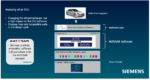
I doubt there is anyone who hasn’t felt the impact of supply chain problems, from late ecommerce deliveries (weeks) to kitchen appliances (up to 6 months or more). Perhaps no industry has been more affected than auto makers, whose cars are now critically dependent on advanced electronics. According to a white paper recently released by Siemens Digital Industries Software, there can be up to 150 electronic control units (ECUs) in a car, dependent on microcontroller devices (MCUs) whose delivery is suffering just these problems. Which is driving automakers and suppliers to accelerate other aspects of development or redesign these systems around alternative MCU devices.

Workarounds

In simpler times there was a concept of “second sourcing”. If your product was critically dependent on some device, you had a preferred source for that device plus a plan B option delivering more or less identical functionality. Like Intel and AMD for processors (not necessarily in that order). But now products and devices are more complex, and both evolve more rapidly. Suitable plan B options don’t just evolve through market forces, they must now be considered up front.

In the case of MCUs for automotive applications, Siemens suggests three options:

  • At minimum, allow software development to progress while you’re waiting for MCU deliveries. Developing, debugging and qualifying the software for the ECU is a big task in itself. You can progress on all those tasks by running on a virtual model of the ECU before you receive MCU shipments.
  • Plan for a replacement MCU. Perhaps lead times and/or uncertainties for your preferred option are too risky to meet your market objectives. You want to switch to an alternative. That may require some software redesign to deal with incompatibilities between the two devices
  • And maybe, while you’ll figure out a path through one of these two options, you’d like to reduce your exposure to similar risks in the future. By developing against a hardware independent software interface widely accepted in the industry – AUTOSAR.

Early development before hardware arrives

Siemens suggests their Capital VSTAR platform to support all three cases; this platform is built around the AUTOSAR standard. The flow front-end is the Capital VSTAR Integrator which will includes an ECU configuration generator to process input from upstream development tools ad to configure the VSTAR platform. This also provides support for application software components.

The heart of the system is the Capital VSTAR Virtualizer. By default, this will run application software against a generic virtual MCU and I/O model. This is ready to integrate with the supplied AUTOSAR RTE, OS, basic applications and the AUTOSAR MCU abstraction layer (MCAL). Considering the first option above, software developers can build and test almost all their application software against this generic model, before they even see hardware for the MCU. They can run virtual hardware in the loop testing, network testing over standard auto network protocols like CAN and FlexRay, and run diagnostic and calibration checks against standard tools.

When ready to test against a specific MCU virtual model, developers can replace the generic model with a targeted model. This they can also extend to model ECU-specific characteristics. This method supports both first and second options above – either refining the generic model to a target model or switching out one MCU model for another.

De-risking through AUTOSAR-compliant development

Finally, since the Capital VSTAR platform is based on AUTOSAR it encourages development to that hardware independent standard. In future you limit your risk in switching MCU devices to just what is unique in the MCAL layer. This is a much simpler rework if you ever need to switch again 

Siemens adds that they are experienced in providing expert engineering services to help mitigate risks in changing device platforms. From performance through safety, security, communications, diagnostics and calibration. You don’t need to figure out how to mitigate supply chain problems on your own!

You can learn more about Capital VSTAR from this white paper.

Also Read:

Back to Basics in RTL Design Quality

APR Tool Gets a Speed Boost and Uses Less RAM

DARPA Toolbox Initiative Boosts Design Productivity


High-Speed Data Converters Accelerating Automotive and 5G Products

High-Speed Data Converters Accelerating Automotive and 5G Products
by Kalar Rajendiran on 11-10-2021 at 10:00 am

Enabling Technology Omni Design SWIFT

While the trend towards System-on-Chip (SoC) has been gathering momentum for quite some time, the primary driver has been integration of digital components, spurred by Moore’s law. Integrating more and more digital circuitry into a single chip has been consistently beneficial for performance, power, form factor and economic reasons. Hence, the digital components of a system kept getting integrated into an SoC while many of the analog functions were still left as separate chips and for good reasons. For one, analog circuits did not benefit from process scaling to the same extent as digital circuits did with every advancing process node. For another, general availability of analog functions as IP blocks on advanced process nodes trailed because porting analog to FinFET nodes was seen as more challenging. That is one reason for the tremendous growth of semiconductor companies supplying analog ICs.

Many of today’s applications require edge processing and have very demanding requirements, whether it is in automotive, AI, or 5G. The products are expected to deliver higher performance at lower latency, consume lower power, have smaller form factor and be available at attractive price points. This is driving many semiconductor companies to look at innovative ways to integrate more of the analog functionality into an SoC.

It is in this context that a presentation at the recent TSMC OIP Forum would be of interest to system architects and SoC designers alike. The talk was given by Manar El-Chammas, vice president of engineering at Omni Design Technologies.

Omni Design Technologies

Omni Design innovates across multiple levels from transistor level designs to algorithms. Their IP offerings address multiple markets including 5G, automotive, AI, image sensors, etc.

Omni Design’s IP portfolio consists of analog-to-digital converters (ADCs) and digital-to-analog converters (DACs) ranging from 6-bit to 14-bit resolutions, and sampling rates from a few mega samples/second (Msps) to 20+ giga samples/second (Gsps). Omni Design also offers complete analog front-ends (AFEs) that can include multiple ADCs and DACs, PLLs, PVT monitors, PGAs, LDOs, and bandgap references. The fully integrated AFE macro enables seamless integration of the analog components into SoCs.

Transitioning From Boards to SoCs

There is a significant shift in the industry towards integration of analog functions from PC boards into SoCs in many of the applications identified earlier. These applications require higher performance, lower power, and smaller form factor chips. The integration of more components into the SoC helps reduce system cost and bill of materials (BOM) complexity. An integrated solution makes for easier clock synchronization of ADC arrays and excellent matching between channels. One of the key things that has made these integrated SoCs a reality, is of course, the availability of high-resolution, high sampling rate, ultra-low power data converters in advanced FinFET process nodes.

Enabling Technology

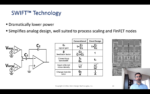
Applications such as 5G and automotive LiDAR required high-speed, high-resolution data converters that maintain high linearity over 60dB SFDR and 60dB IMD3 and low NSD. Through use of a variety of proprietary and patented solutions, Omni Design is able to address these stringent requirements. For example, their time-proven SWIFT™ technology can deliver both power and speed efficiencies compared to more conventional solutions. Refer to Figure below. A comparison with conventional amplifier is shown in the table. The SWIFT technology allows the reference capacitors to be bootstrapped in such a way as to optimize the overall performance of the amplifier. As a result, Omni Design is able to develop ultra-low power, high-performance data converters.

Analog Front End (AFE) Integration into Advanced Node SoC

5G and Automotive are two of the many different growing markets that Omni Design’s IP portfolio addresses. As mentioned earlier, Omni Design delivers individual blocks of IP and entire AFE subsystems.

One complete AFE subsystem that Omni Design offers is for use in 5G SoCs. The subsystem includes everything that is needed in the signal processing path between the antenna and the digital signal processing (DSP) block. For a high-level block diagram of a 5G subsystem, refer to Figure below.

Another complete AFE subsystem that Omni Design offers is for use in automotive LiDAR SoCs. The subsystem includes everything that is needed in the signal processing path between the photo diode and the DSP. For a high-level block diagram of a LiDAR subsystem, refer to Figure below.

LeddarTech®, a global leader in Level 1-5 ADAS and AD sensing technology is integrating Omni Design’s AFE subsystem into their automotive LiDAR SoC. Omni Design recently announced general availability of a complete receiver front-end for a LiDAR SoC.

Summary

Automotive and 5G require high-performance ADCs and DACs in FinFET process nodes for integration into SoCs. Omni Design’s modular architecture and proprietary technologies help deliver these as IP cores and complete subsystems for ease of SoC integration. These IP cores are optimized for power, performance and area/form factor and exhibit low NSD and high SFDR as demonstrated in silicon. Customers have been integrating Omni Design’s IP blocks and/or complete subsystems into their SoCs.

You may be interested in some of Omni Design’s recent announcements. A press release about their customer MegaChips, announcing the integration of ultra-low power, high-performance data converters into their automotive Ethernet SoC for the Vehicle-to-Everything (V2X) communications market. Another press release about availability of their Lepton family of high-performance ADCs and DACs on TSMC 16nm technology.

You may also be interested in reading their recently published whitepaper on “LiDAR Implementations for Autonomous Vehicle Applications.”


Podcast EP47: A Chat with Industry Legend Joe Costello

Podcast EP47: A Chat with Industry Legend Joe Costello
by Daniel Nenni on 11-10-2021 at 8:00 am

Dan and Mike are joined by EDA legend Joe Costello. Joe discusses his perspective on the state of the EDA industry and what opportunities and challenges lie ahead, He also gives a preview of the keynote he will present at the upcoming Design Automation Conference.

www.dac.com

The views, thoughts, and opinions expressed in these podcasts belong solely to the speaker, and not to the speaker’s employer, organization, committee or any other group or individual.


Webinar: Boosting Analog IC Layout Productivity

Webinar: Boosting Analog IC Layout Productivity
by Daniel Payne on 11-09-2021 at 10:00 am

Animate Preview

Digital IC designers use a well-known methodology with pre-designed standard cells and other IP blocks playing a major re-use role, however in the analog IC design world there are more nuanced requirements which often dictate that a new analog block be highly customized. The downside is that customizing analog IC layout takes way too much time using traditional, manual efforts. Automation is highly desired for analog IC layout in order to reduce time to market, all while meeting custom specifications. There’s an REPLAY on this timely topic from Pulsic.

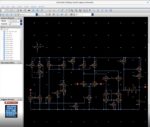
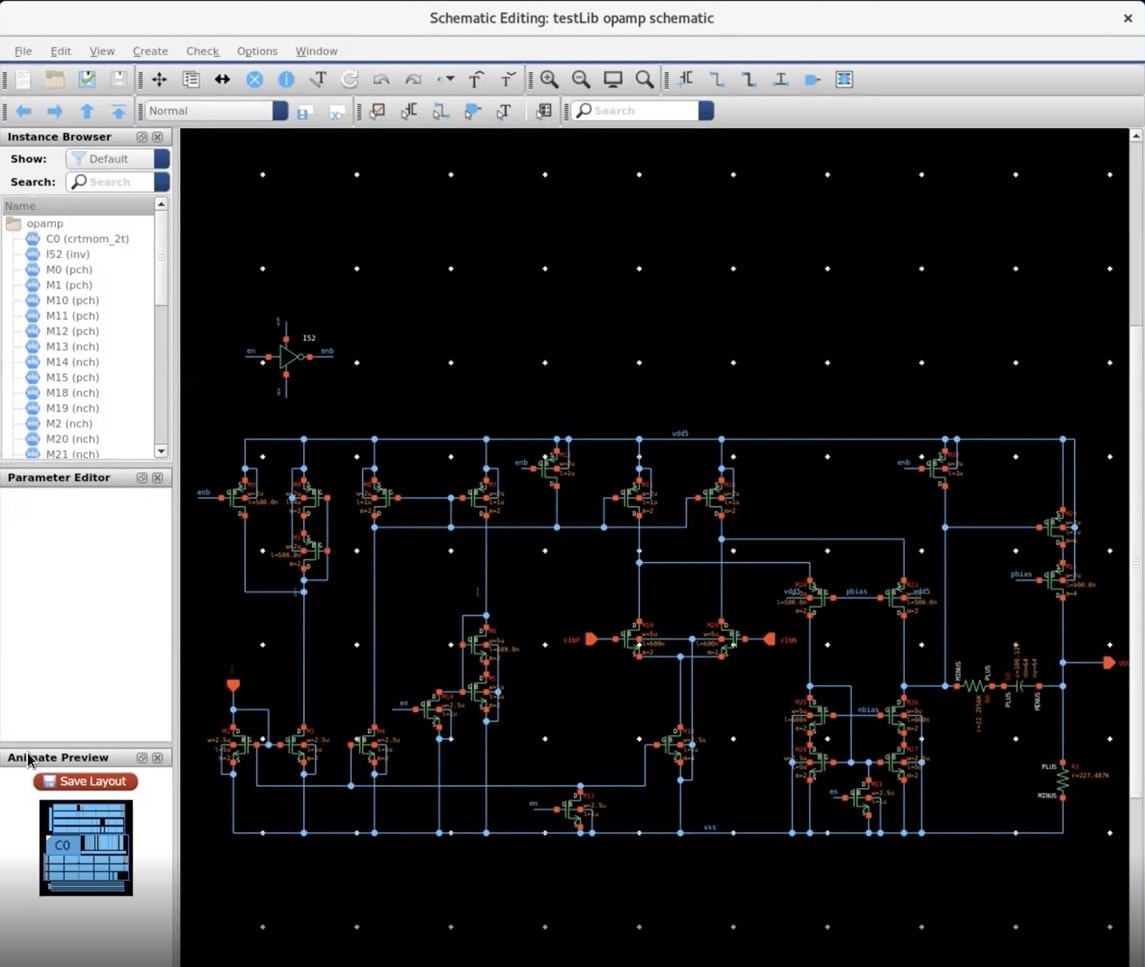
The big idea at Pulsic is that using their software tool called Animate, an analog IC layout designer can then speed up layout times by 60% over traditional, manual layout approaches. In the webinar you’ll see how the Pulsic approach starts within the traditional Virtuoso schematic environment, but with one additional window called Animate Preview activated.

The magic sauce at Pulsic is that their software analyzes the circuit topology from the Virtuoso schematic, identifies analog specific patterns like differential pairs and current mirrors, then automatically generates an IC layout while keeping track of analog IC layout issues like transistor grouping and transistor matching. From what I saw, these new concepts go way beyond earlier methodologies like Schematic Driven Layout (SDL), because there is more embedded intelligence going on with the Animate approach. No longer does the circuit designer have to meticulously mark-up and annotate the schematic with constraints about matching and pairing for the IC layout designer to interpret and hopefully implement correctly, as Animate does this inferencing under the hood.

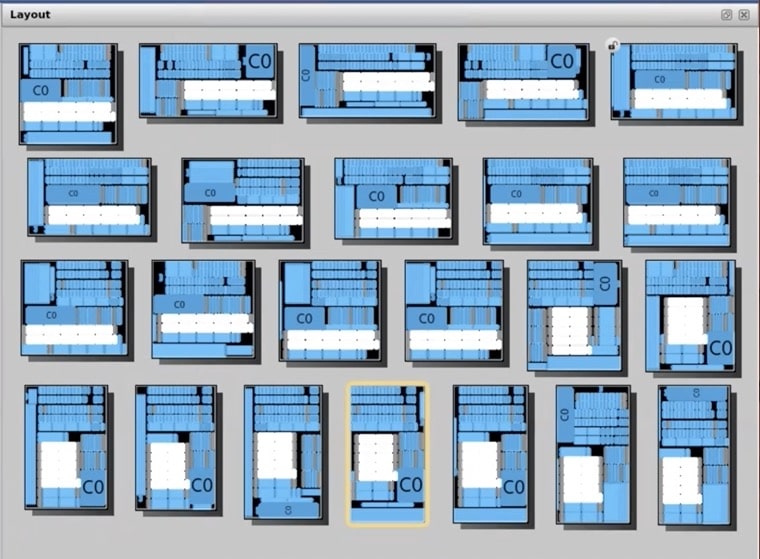
The IC layout designer is the primary user of Animate, and with this new methodology they can get to a first layout quite rapidly, literally within seconds using their favorite editor, like Virtuoso Layout, seeing all of the sized transistors, Pcells and guard ring structures. High-level IC layout changes are best tweaked in the Animate tool, while low-level layout changes are best implemented in the traditional layout editor. Here’s an idea of how many high-level layout options you can simply choose from a selected set of transistors within Animate:

Another way to use Animate is to select schematic transistors and then add your own desired layout constraints, like how many rows each transistor implementation should occupy.

There’s even a floor plan editor in Animate, that allows an experienced layout designer to rapidly move groups of transistors at one time, achieving a more optimized layout with less interconnect congestion and better matching properties.

Summary

So, is analog IC layout 100% push-button automated like digital place and route? No, you still need to have an experienced layout designer operating automation tools like Animate from Pulsic, in order to achieve optimal, robust layouts, in record time. The REPLAY really gives you an idea of how this Animate methodology with higher-level layout operations complements detailed IC layout with traditional tools.

Related Blogs


CDC for MBIST: Who Knew?

CDC for MBIST: Who Knew?
by Bernard Murphy on 11-09-2021 at 6:00 am

CDC for MBIST

Now and again, I enjoy circling back to a topic on which I spent a good deal of time back in my Atrenta days – clock domain crossing analysis (CDC). This is an area that still has opportunity to surprise me at least, in this case looking at CDC analysis around MBIST logic. CDC for MBIST might seem strange. Isn’t everything in test mode synchronous with a single clock? Not quite. JTAG runs on an independent and relatively slow clock whereas MBIST runs on a system speed clock. On the first day of Synopsys Verification Day 2021, Wesley Lee of Samsung gave a nice overview on the details of this unique application of CDC analysis.

Who cares?

CDC is for functional mode problems surely. Who cares if a synchronization error occurs in MBIST testing? Samsung does and good for them. MBIST isn’t just for bring-up testing. High safety level auto electronics now launch periodic inflight testing to check all critical blocks are functioning correctly. MBIST testing would be included in that checklist, but it wouldn’t be very useful if it might be susceptible to synchronization errors. Best case it reports an error on a good memory and your car keeps demanding it be taken in for service. Worst case it fails to report an error on a bad memory…

What’s special about MBIST CDC?

First, Samsung do before and after CDC analyses. “Before” is with master and slave TAP controllers and connections inserted, though with JTAG disabled and without MBIST controllers. “After” is with JTAG enabled and MBIST controllers inserted. Wesley’s rationale for this is that the MBIST logic alone represents a significant addition to the rest of the design. He wants first to flush out problems without MBIST to simplify analysis when MBIST is added.

He mentioned finding value particularly in Machine Learning-based analysis for clustering violations around common root-causes. I remember the early days of combing through thousands of violations, trying to figure out where they all came from. The ML extensions represent a **huge** advance.

Exception analysis

The thing that really stood out for me in Wesley’s talk was optimization of the analysis through quasi static assignments and other constraints. You can be slapdash with these assignments in CDC, but Wesley’s approach is very surgical.

In functional mode, the JTAG interface is obviously static, whereas in MBIST mode, some interface signals can be case analyzed (set to a fixed value). Some signals from slave TAPs to the corresponding MBIST controllers counts as effectively synchronized because they are qualified by an enable signal which is synchronized.

More interesting still, some MBIST signals interface with the slave TAP controller without synchronization or qualification of any kind. You should understand that this design uses a 3rd-party MBIST controller, so Wesley can’t just walk down the hall to ask why. They needed a meeting or two with the supplier to figure out why they considered this approach OK. The supplier explained that the controller knows how long its analysis will take. It counts for that number of clocks, plus a margin and then transmits these signals. In effect the signals are quasi-static until the slave TAP reads these values and again quasi static beyond that point.

Wesley’s summed up by saying that sometimes you must understand programming sequences. Not all quasi-static assignments have no-brainer rationales. Sometimes you really need to dig into the functionality.

A very interesting review of CDC analysis around MBIST. You can learn more from the recorded session. Wesley’s gave his talk on Day 1.

Also Read:

AI and ML for Sanity Regressions

IBM and HPE Keynotes at Synopsys Verification Day

Reliability Analysis for Mission-Critical IC design


A Packet-Based Approach for Optimal Neural Network Acceleration

A Packet-Based Approach for Optimal Neural Network Acceleration
by Kalar Rajendiran on 11-08-2021 at 10:00 am

6 Optimal Work Unit Designed for DLA

The Linley Group held its Fall Processor Conference 2021 last week. There were a number of very informative talks from various companies updating the audience on the latest research and development work happening in the industry. The presentations were categorized as per their focus, under eight different sessions. The sessions topics were, Applying Programmable Logic to AI Inference, SoC Design, Edge-AI Software, High-Performance Processors, Low-Power Sensing & AI, Server Acceleration, Edge-AI Processing, High-Performance Processor Design.

Edge-AI processing has been garnering a lot of attention over the recent years and hardware accelerators are being designed-in for this important function. One of the presentations within the Edge-AI Processing session was titled “A Packet-based Approach for Optimal Neural Network Acceleration.” The talk was given by Sharad Chole, Co-Founder and Chief Scientist at Expedera, Inc. Sharad makes a strong case for rethinking implementation of Deep Learning Acceleration (DLA). He presents details of Expedera’s DLA platform and how their packet-based accelerator solution enables optimal results. The following is what I gathered from Expedera’s presentation at the conference.

Market Needs

As fast as the market for edge processing is growing, the performance, power and cost requirements of these applications are also getting increasingly demanding. And AI adoption is pushing processing requirement more toward data manipulation rather than general purpose computing. Deep learning models are fast evolving and an ideal accelerator solution optimizes for many different metrics. Hardware accelerator solutions are being sought after to meet the needs of a growing number of consumer and commercial applications.

Inefficiencies in Neural Network Acceleration

Traditional DLA architectures breakdown neural networks (NN) into granular work units for execution. This approach directly limits performance as existing hardware cannot directly execute higher level functions. While CPU-centric solutions may offer flexibility and potential for optimization, they are non-deterministic and fall short on power efficiency. Interpreter-centric solutions offer layer-level reordering optimization but they require large amounts of on-chip memory, a resource that is precious, particularly in edge devices. Benchmark studies indicate that current AI inference SoCs are performing at 20-40% utilization levels. Efforts to improve performance efficiency often prove counterproductive. For example, increasing throughput with larger batch sizes adversely impacts latency. Improving accuracy with compute precision consumes additional bandwidth and power. Targeting higher system utilization increases software complexity. Deploying trained models using these solutions is cumbersome and time-consuming.

Packet-based Approach for NN Acceleration

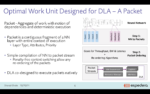
To overcome the above inefficiencies, Expedera breaks down NN into optimal work units designed for its DLA, calling them packets. Packets in this context are defined as contiguous fragments of NN layers, along with the respective contexts and dependencies. Packets allow for simple compilation of the neural network into packet streams. The packet streams are executed natively on the Expedera DLA platform.

This packet-based approach renders lots of benefits. The design is simplified and performance is improved. The amount of memory and bandwidth requirements are drastically reduced, allowing DLA hardware to be better right-sized. For example, using a popular benchmark the packet-based approach was shown to reduce DDR transfers by more than 5x compared to layer-based processing. The packet-based approach provided cascading benefits including fewer intermediate data movement, higher throughput, lower system power requirement, and reduced BOM cost.

Expedera’s Solutions

As edge processing workloads evolve, applications need to support multiple models and increasing data rates. And SoCs need to support a mix of applications. The packet-based DLA codesign approach delivers a high-performance solution that is scalable and power efficient. It allows for parallel use of independent resources. Expedera DLA enables zero-cost context switching and provides for multi-tenant application support.

Expedera’s Compiler achieves out-of-the-box high performance. Its Estimator allows for right-sizing the DLA hardware. The Runtime scheduler orchestrates the best sequence of NN segments based on application requirements, enabling seamless deployments.

Benefits of Expedera’s DLA Platform

  • Best performance per Watt
  • Smaller designs
  • Lower power
  • Determinism

A Deterministic Advantage

As the packets are complete with context and dependencies, the packet-stream approach guarantees cycle-accurate DLA performance. Packet-DLA codesign enables deterministic and high performant compilation. Exact execution cycles as well as memory and bandwidth needs are known ahead of time, leading to a deterministic execution. This is a prized advantage with edge applications where low and consistent latency is important.

Summary

In a nutshell, Expedera’s customers can easily and rapidly implement their AI SoC designs for edge processing to deliver optimal deep learning acceleration for their applications. Achieving optimal AI performance calls for solving a multi-dimensional problem. With a comprehensive SDK built on Apache TVM, Expedera accelerator IP platform enables ideal accelerator configuration selection, accurate NN quantization and seamless deployment.

To learn about how Expedera’s DLA IP performance compares against other DLA IP solutions, refer to a whitepaper published by the Linley Group. The whitepaper titled “Expedera Redefines AI Acceleration for the Edge” can be downloaded from here.

** Apache TVM is an open-source machine learning compiler framework for CPUs, GPUs, and machine learning accelerators.

Also read:

CEO Interview: Da Chaung of Expedera

Expedera Wiki


S2C EDA Delivers on Plan to Scale-Up FPGA Prototyping Platforms to Billions of Gates

S2C EDA Delivers on Plan to Scale-Up FPGA Prototyping Platforms to Billions of Gates
by Daniel Nenni on 11-08-2021 at 6:00 am

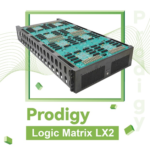
S2C EDA Prodigy Logix Matrix LX2

S2C has been a global leader in FPGA prototyping for nearly two decades now, and its FPGA prototyping platforms have closely tracked the availability of the latest FPGAs – including the latest FPGAs from both Xilinx and Intel.  And they are definitely delivering on the promise to advance their prototyping solutions for hyperscale design prototyping – scaling-up prototyping platform capacities and capabilities to support multi-billion gate designs.

Looking back to early 4Q 2020, S2C announced support for the then-new Xilinx VU19P UltraScale+ FPGAs, offering single, dual, and quad FPGA prototyping platforms.  Then, in December of 2020, S2C followed-up with an announcement of its high-density Prodigy Logic Matrix family of prototyping platforms with 8 FPGAs per Logic Matrix, 8 Logic Matrix per single server rack (64 FPGAs), and the connection of multiple server racks together.  The first iterations of Logic Matrix were delivered with Xilinx VU440 FPGAs (dubbed the LX1) to early customers who couldn’t wait for the VU19P version (dubbed the LX2).

Now, S2C is stepping up its Logic Matrix game with the LX2, which jumps prototyping usable gate capacity by 60% over than the VU440 version!  More usable gates per FPGA means fewer FPGAs, fewer FPGA interconnects, and higher performance for the same prototyped design.  With an estimated gate capacity of 392 million gates per LX2, a fully populated standard server rack with 8 LX2’s enables an estimated prototyping capacity of over 3 billion ASIC gates!

Figure 1: Prodigy Logic Matrix LX2

Prodigy Logic Matrix Family
LX1 LX2
FPGA XCVU440 XCVU19P
Estimated ASIC Gates (M) 240 392
Number of FPGAs 8 8
System Logic Cells (K) 44,328 71,504
FPGA Memory (Mb) 709 1,327.2
DSP Slices 23,040 30,720
External User I/Os 9,216 10,368
 SerDes Transceivers 384 GTH 640 GTY
Prodigy Connectors 64 72
PGT Connectors 8 0
Transceiver Connectors 80 MSAS each with 4 GTH + 8 IOs 160 MCIO each with 4 GTY + 8 IOs
SerDes Performance 16 Gbps 28 Gbps

Figure 2: Logic Matrix Family

Flexible, high-speed interconnect is key to high-density FPGA prototyping, and Logic Matrix supports a hierarchical, 3-level interconnect strategy: ShortBridge for interconnect between neighboring FPGAs; SysLink for high-bandwidth FPGA cable interconnect, and TransLink for longer distance FPGA SerDes interconnect over MCIO cables.  To simplify FPGA interconnect and maximize the value of TransLink, S2C’s partitioning flow supports Xilinx’s newly introduced High-Speed Transceiver Pin Multiplexing (HSTPM), simplifying cycle-accurate signal transfer, pin-multiplexing, and low-latency SerDes FPGA connectivity.

To minimize time-to-prototyping, and maximize prototyping productivity, S2C’s other prototyping productivity tools are designed with Logic Matrix in mind, including Player Pro Runtime software – and add-on S2C prototyping tools including ProtoBridge, MDM Pro, and S2C’s Prototype Ready IP.

Player Pro Runtime software is included with LX2, providing convenient features such as advanced clock management, integrated self-test, automatic board detection, I/O voltage programming, multiple FPGA downloads, and remote system monitoring and management.  Also included is AXEVision, a built-in AXI-over-Ethernet debugging tool to simplify remote debugging of AXI related designs.

ProtoBridge supports high-throughput data transfers (up to 1GB/s) between the host PC and the LX2 – enabling the transfer of large amounts of software-modeled transactions, video streams, or other test stimulus for system validation.

Figure 3: ProtoBridge

MDM Pro features deep trace debugging with cross-triggers for up to eight FPGAs, multi-FPGA signal trace viewing from a single viewing window, 64GB of external trace waveform storage, trace sampling rates up to 125MHz, and supports trigger state machine languages for complex trace captures requirements.

Figure 4: MDM Pro

S2C’s also offers a rich library of Prototype Ready IP for the LX2 – plug-and-play Daughter Cards – that speeds the creation of the prototyping environment around the FPGA prototype.

Figure 5: Prototype Ready IP Daughter Cards

Prodigy Logic Matrix LX2 is available now.  For more information, please contact your local S2C sales representative, or visit www.s2ceda.com.

Also Read:

Successful SoC Debug with FPGA Prototyping – It’s Really All About Planning and Good Judgement

S2C FPGA Prototyping solutions help accelerate 3D visual AI chip

Prototypical II PDF is now available!