







I posted recently on an eye-catching advance in quantum computing, around neutral atom systems which might accelerate the transition to production-grade fault-tolerant quantum computing (QC). There are some further updates on this front, also I listened in on a panel considering quantum-based hacking vulnerability in the grid, something which should concern us all.
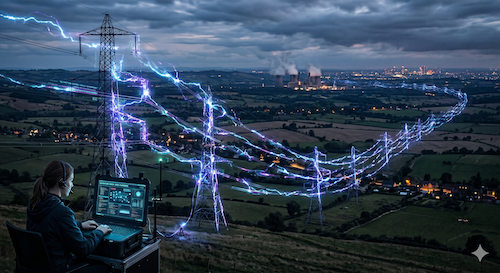
Progress in quantum
To recap, neutral atom qubits can be moved around allowing for tricks like directly superposing or entangling qubits, an operation which in a fixed qubit system (most technologies) would require multiple SWAP gate operations to get necessary qubit values adjacent before applying the desired operation. Direct operation reduces error rates and enables QC functions to be partitioned, not unlike a conventional computer. Also an advance in quantum error correction (QEC) may markedly reduce physical-to-logical qubit counts over current state-of-art surface codes, albeit based on very recent papers (underpinning an equally recent QC startup).
This is encouraging for materials science, quantum chemistry and financial services, though concerning for the day when QC will open the possibility of production-scale cryptography hacking. So far I have taken RSA 2048 as my benchmark for this requirement, in the paper cited above requiring 5-10k logical qubits. ECC-256, the current encryption standard for key exchange, can be cracked in as little as 1500 logical qubits according to the same paper, suggesting this might be the first attack target. Key exchange used to update encryption keys is a perfect backdoor to disrupt every aspect of modern society.
Quantum security in energy infrastructure
The Quantum Insider recently hosted a panel on this topic with speakers from EPRI (Electric Power Research Institute), a venture investor at Constellation Energy, an exec/technical leader in the utility industry from IBM, and a program manager in the resources and energy team from Microsoft.
Early in the panel I heard a telling point. The energy industry may be suffering from innovation fatigue due to increasing digitalization and upgrades which continue throughout the system, necessary upgrades allowing for allowing for further automation. AI is playing an increasing role, I’m guessing to help with load balancing as well as for more mundane operational improvements. On the AI downside, how should the industry manage distorted demand from giant AI-centric datacenters? Distributed generation introduces further complications, legacy power generation plus renewable energy sources with challenges around power storage to balance intermittent supply against demand. Small modular (nuclear) reactors are coming online, maybe fusion reactors somewhat later. Grids must allow for distributed sources and resilience to over-demand, extreme weather and outages. Together representing a much more complex generation and distribution ecosystem which must evolve against slow-moving regulatory requirements.
If you thought the automotive industry was a speed brake on innovation, the energy industry operates on up to 20-to-50-year design life cycles. They have finite budget and expert manpower, just like everyone else, which must be balanced against all these competing demands. Where does that leave quantum security?
Organizations like EPRI and the IBM and Microsoft utilities services organization are developing support services around this area (and around the NIST post-quantum standards) though it seems clear that awareness of post-quantum security in the utilities sector at large is fairly low today. Even more telling, venture investors within the sector still question whether quantum ventures are a leading opportunity to invest, seeing exits still 5-10 years out.
That said, the energy sector won’t care about differentiated quantum implementation so need not invest in hiring quantum experts (unlike, say, the financial services sector). They can buy ready-made solutions and services from suppliers like IBM, Microsoft and others. Still, they have limited funds, many investments already underway, and no directly applicable regulatory requirements to move on post-quantum today. What can they do to start hardening the system under these constraints?
IBM and Microsoft are operating on the assumption that 2030-2035 is a window of increasing risk for security. NSA and NIST are saying that government organizations in general must adapt to post-quantum within that window, which implies to me that utilities must also adapt. But in what way and how can systems be upgraded within limited budgets? I heard a sentiment for incremental upgrades, with post-quantum-enabled gateways bridging between legacy equipment to mitigate risk, while planning to upgrade other equipment on a more extended schedule.
Another important consideration is that post-quantum methods must allow for agile support. Post-quantum security methods available today are classified as “quantum resistant” as opposed to “quantum safe”. Quantum resistant methods are secure against quantum attacks we know of today (principally Shor’s algorithm). They are not guaranteed resistant to quantum attacks that might become possible through future algorithm advances. Post-quantum security must allow for continuing upgrades, a familiar reality in classical security.
Interesting times. As we protest ever-increasing power costs, spare a thought for the challenges faced by energy providers who must ensure reliable supply against ongoing and future security threats.
Also Read:
PQShield unveils ultra-small PQC embedded security breakthroughs at Embedded World 2026
Sensing. A Quantum Tech Ready for Market?
Could Neutral Atoms Take the Lead in Quantum Computing?
Share this post via:



Hyper-NA EUV: The Next Frontier in Chipmaking Could Arrive in 2036