






As of my recent posts on quantum computing (QC), superconducting QC is the leading technology contender, exemplified in systems from IBM, Google, and Fujitsu. Other technologies such as ion trap, neutral atom, photonic and quantum dot have generally been viewed as intriguing but second tier. I just read a very recent paper suggesting that neutral atom methods may have more potential than I thought. The paper is technically very dense and I haven’t yet had a chance to fully digest some of the claims, but what I have read suggests some very interesting shifts in what might be possible through neutral atom-based QC.
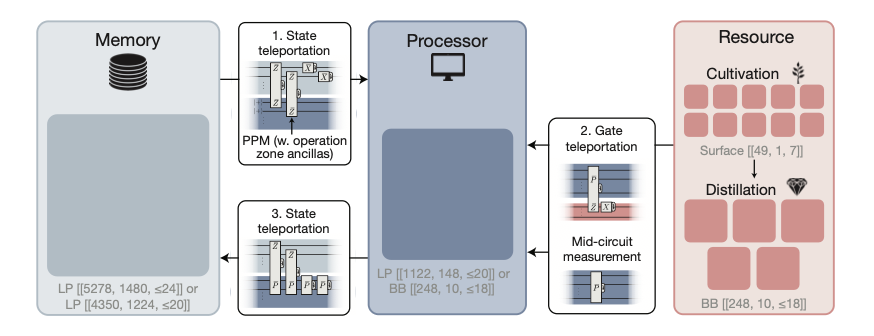
A neutral atom QC architecture. Image courtesy Oratomic, Caltech and Berkeley (in paper referenced above)
Backgrounder on neutral atom QCs
Neutral atom technologies suspend an array of atoms in vacuum, each atom acting as a very pure qubit. Atoms with a single valence electron such as rubidium or cesium allow information to be stored in hyperfine states split by interaction between the valence electron spin and the nuclear magnetic moment. Atoms are held in place using laser-based optical tweezers.
Lasers operating at different frequencies perform multiple functions. Laser cooling minimizes thermal motion and initializes qubit states. Simple gating operations (Clifford gates like X, Hadamard and S) are implemented through targeted laser pulses addressing individual qubits. Two qubit gates are implemented by pumping the control atom/qubit to a highly excited (Rydberg) state with a greatly expanded electron wavefunction. This can interact with neighboring qubits, enabling entanglement. Finally, measurement is accomplished through targeted laser-stimulated resonance fluorescence. Lots of lasers, yet research indicates this complexity is becoming manageable.
Neutral atom methods offer a very intriguing advantage over fixed qubit technologies (most if not all other options). Fixed qubit methods (superconducting for example) only allow for communication between nearest-neighbor qubits. Algorithms which need to superpose or entangle geometrically distant qubits require multiple SWAP gates to cross the gap, amplifying error rates. In neutral atom arrays, optical tweezers can be steered to reconfigure qubits dynamically. If qubit A needs to interact with qubit B and they are not adjacent, steer them to be adjacent, perform the operation then steer those qubits back to their original positions.
A major step forward for quantum architectures
Reconfigurability may not seem like such a big deal, but it opens an important option for QC architectures. An architecture can be partitioned into distinct components (see the figure above): a memory, a processor and a resource for magic states (supporting operations beyond Clifford gates, like T-gates and Toffoli-gates). Communication between these functional units is accomplished through teleportation, a proven method to transfer quantum state from one qubit to another using entanglement (this is different from reconfiguring). Lots of quantum weirdness but now starting to look more familiar as a computer architecture.
There is a second benefit, in quantum error correction (QEC). You may remember that QEC is conceptually similar to classical error correction, using additional (ancilla) qubits to check and correct errors. Except that QEC can require 1000 physical qubits for every logical qubit, which is why it is proving so difficult to get to high logical qubit counts in fault-tolerant systems. It appears that reconfigurability in neutral atom systems can dramatically reduce ancilla qubit demand.
The state of the art for QEC in fixed qubit systems uses a mechanism called “surface codes” which has somewhat reduced the physical to logical qubit threshold but still requires hundreds of physical qubits for every logical qubit. The Oratomic paper suggests a Low-Density Parity Code method offering better than two orders of magnitude reduction over those surface codes in required physical qubits. Further, qubits not currently participating in active processing can be moved to a less noisy storage area (memory) with lower error potential until needed again. Overall, greatly reduced QEC impact in necessary ancilla qubits. Potentially making fault-tolerant QC much closer than we had thought.
Caution and some implications
The paper suggests that a few techniques proposed in support of this technology are still in development. That said, Oratomic launched in March this year, founded and staffed by authors of this paper, to deliver a reconfigurable neutral atom computer along these lines. Given how new they are, we should probably expect the usual teething problems.
Still, if they deliver, Shor’s algorithm may be implementable at cryptographically significant levels (RSA-2048 and ECC-256) sooner that we expected, potentially within this decade. That’s the downside, but the upside is that quantum compute for much more interesting application may also be closer than we thought.
One more thought: compiling to, topologically organizing and simulating these systems will become a lot more interesting. Opportunities for EDA and compiler tech development!
Also Read:
Effective Defense Against Hacks at the Edge
Calibrating Quantum Computing Activity in Financial Services
An Upper Bound on Effective Quantum Computation?
Share this post via:



Rethinking Phase Jitter: An Algorithmic Approach to Signal Integrity