






- This event has passed.
eShard Webinar: Securing Post-Quantum Implementations Against Physical Attacks
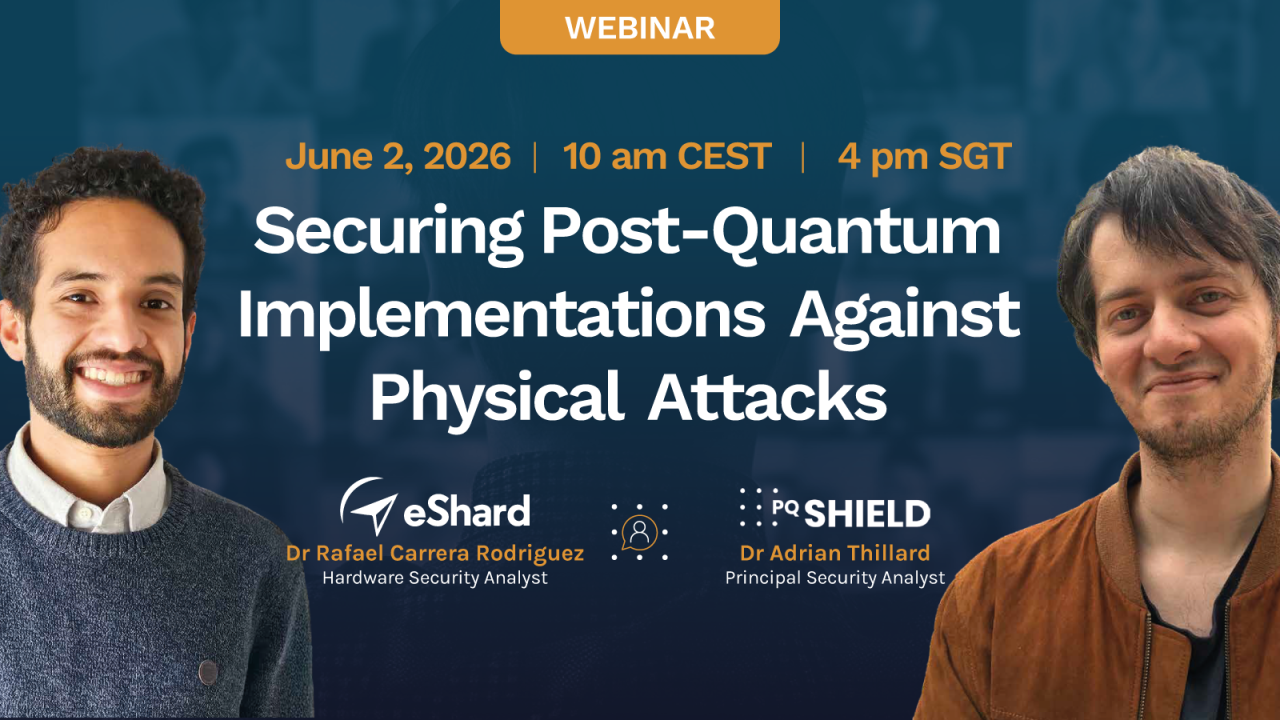
In this webinar with eShard, we dive into one of the most pressing questions in the community: Are physical attacks practical against post-quantum schemes in the real world? If yes, how to harden the code or the hardware? We’ll explore:
- How can cryptographic algorithms and their implementations be targeted by physical attacks?
- Leveraging a novel attack surface and increased complexity of post-quantum schemes for side-channel and fault injection attacks
- A dive into ML-KEM (formerly known as CRYSTALS-Kyber), the first NIST-selected key encapsulation mechanism
- A concrete example: how a CPA attack on NTT-based multiplication reveals secrets using simulated traces
- First steps toward protection: how to shield NTT operations from side-channel leakage
- We’ll wrap up by showing why hardening and validation must go hand-in-hand when deploying post-quantum cryptography in real devices
Rafael Carrera Rodriguez – Hardware Security Analyst
Rafael Carrera Rodriguez received the Master’s degree in Embedded Systems and Cybersecurity from Grenoble INP-Ensimag, France in 2021, and the PhD degree from the University of Montpellier, France in 2025. He is currently working as a Hardware Security Analyst at eShard, Pessac, France. His research interests involve secure embedded implementations of post-quantum cryptography, from both the attacks and countermeasures standpoints.
Dr Adrian Thilliard – Principal Security Analyst
Dr Adrian Thillard has over 12 years of experience in hardware security, with a background in side-channel analysis. Priori to joining PQShield, Adrian was a hardware security engineer in the Donjon team in Ledger and in the French National Security Agency. He holds a PhD degree from ENS Paris. The shift to Post-Quantum Cryptography (PQC) isn’t a distant concern – it’s a critical, near-term imperative for every organisation. As quantum capabilities advance, securing your data today against future decryption is paramount.








Claude as an EDA Tool Wiki