




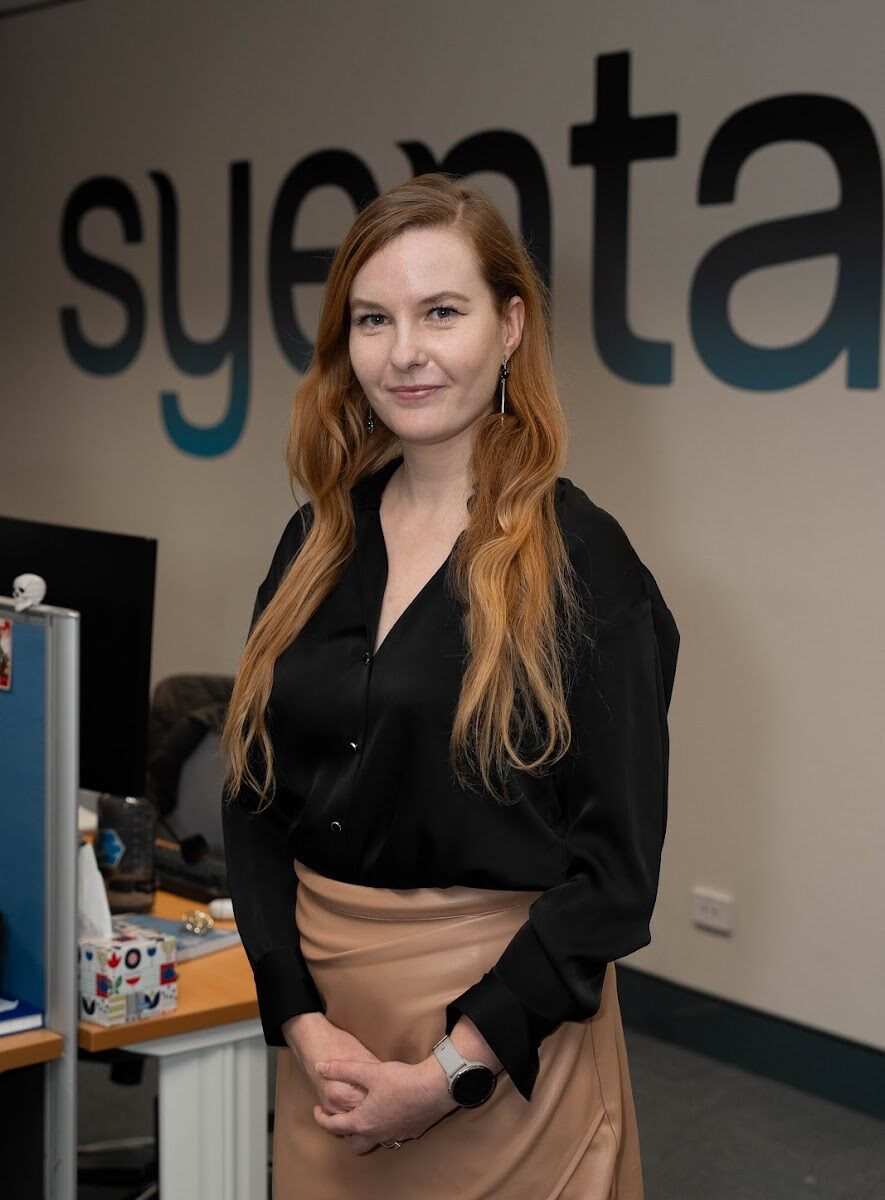



 Dr. Jekaterina (Jeka) Viktorova is the CEO and Co-Founder of Syenta, an Australian deep-tech company developing breakthrough additive manufacturing technology for the semiconductor industry. With a background in chemistry, electrochemistry, and advanced manufacturing, she is the inventor of the core Syenta technology and leads its mission to solve the AI era’s memory bandwidth bottleneck by enabling high-resolution copper interconnects for next-generation advanced packaging.
Tell us about your company
Syenta is a next-generation semiconductor company focused on solving one of the most pressing challenges in AI infrastructure: how chips connect and communicate at scale. As systems move toward chiplet-based architectures, performance is increasingly limited not by compute, but by interconnect density and packaging constraints.
We’ve developed a proprietary manufacturing approach, Localized Electrochemical Manufacturing (LEM), that enables finer-pitch, high-density chip-to-chip connections using existing fabrication infrastructure. Our goal is to unlock higher performance and scalability for AI and high-performance computing systems while making advanced packaging more accessible and manufacturable at scale.
What problems are you solving?
The industry is hitting a fundamental bottleneck in advanced packaging. As AI systems scale, they rely on more chips working together, but current interconnect technologies can’t keep up with the bandwidth and density requirements.
At the same time, advanced packaging capacity is constrained and concentrated in a small number of facilities, making it difficult to scale production globally.
Syenta addresses both challenges. We enable higher-density interconnects to improve system performance, while also reducing manufacturing complexity by eliminating steps and leveraging existing infrastructure. This helps customers scale faster without needing entirely new fabrication approaches.
What application areas are your strongest?
Our strongest applications are in AI and high-performance computing, where system-level performance depends heavily on how efficiently chips are connected.
This includes hyperscale data centers, AI training and inference systems, and emerging architectures built around chiplets and heterogeneous integration. These environments require extremely high bandwidth, low latency, and scalable manufacturing approaches, all of which align directly with what our technology enables.
What keeps your customers up at night?
Customers are increasingly concerned about how to scale AI systems efficiently. They’re running into limits on interconnect density, which directly impacts bandwidth, performance, and power efficiency.
There’s also growing concern around supply chain constraints in advanced packaging. With capacity concentrated in a few regions and facilities, customers face risk when trying to scale production or bring new systems to market quickly.
Ultimately, they’re looking for solutions that improve performance without adding complexity or requiring entirely new manufacturing ecosystems.
What does the competitive landscape look like and how do you differentiate?
The advanced packaging ecosystem includes large foundries, OSATs, and equipment providers, all working to push the limits of interconnect density and system integration.
Where Syenta differentiates is in our approach. Instead of requiring new infrastructure or entirely new process flows, our LEM technology integrates into existing manufacturing environments.
We’re able to achieve micron-scale interconnects with fewer process steps, improving both performance and manufacturability. This combination of higher density and lower complexity is what sets us apart and makes our approach scalable in a way that many alternatives are not.
What new features or technology are you working on?
We’re focused on advancing LEM toward high-volume manufacturing and continuing to push the limits of interconnect density and performance.
At the same time, we’re working closely with partners across the semiconductor ecosystem to ensure our technology aligns with next-generation packaging roadmaps and evolving AI system requirements.
How do customers normally engage with your company?
Customers typically engage with us through early technical collaboration. We work closely with them to understand their system requirements and evaluate how our technology can be integrated into their packaging and manufacturing flows.
As we scale commercialization, we’re building deeper relationships with customers and partners globally, including through our expansion into the U.S., where we can collaborate more closely with leading semiconductor and AI companies.
Also Read:
CEO Interview with Matt Crowley of Scintil Photonics
CEO Interview with Dave Kelf, CEO of Breker Verification Systems
CEO Interview with Geoffrey Rodgers of Chameleon Semiconductor
Share this post via:



Why America’s Semiconductor Manufacturing Capacity Matters