You are currently viewing SemiWiki as a guest which gives you limited access to the site. To view blog comments and experience other SemiWiki features you must be a registered member. Registration is fast, simple, and absolutely free so please,
join our community today!
WP_Term Object
(
    [term_id] => 157
    [name] => EDA
    [slug] => eda
    [term_group] => 0
    [term_taxonomy_id] => 157
    [taxonomy] => category
    [description] => Electronic Design Automation
    [parent] => 0
    [count] => 4380
    [filter] => raw
    [cat_ID] => 157
    [category_count] => 4380
    [category_description] => Electronic Design Automation
    [cat_name] => EDA
    [category_nicename] => eda
    [category_parent] => 0
    [is_post] =>
)
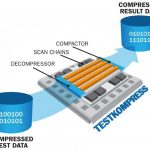
Traditionally ATPG (Automatic Test Pattern Generation) and BIST (Built-In-Self-Test) are the two approaches for testing the whole semiconductor design squeezed on an IC; ATPG requires external test equipment and test vectors to test targeted faults, BIST circuit is implemented on chip along with the functional logic of IC.… Read More
Ever sat around waiting for a time slot on the one piece of big, powerful, expensive engineering equipment everyone in the building wants to use? It’s frustrating for engineers, and a project manager’s nightmare: a tool that can deliver big results, and a lot of schedule juggling.… Read More
Social Media at Silvacoby Daniel Payne on 12-21-2013 at 4:58 pmCategories: EDA
Founded back in 1984, Silvaco has been in business for some 29 years now, focusing on the TCAD and EDA markets.
Browsing their Home page at www.silvaco.com we find four social media links in the footer: Facebook, Twitter, YouTube and LinkedIn.… Read More
SLEC is Not LECby Paul McLellan on 12-20-2013 at 3:00 pmCategories: EDA
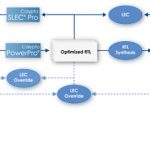
One of the questions that Calypto is asked all the time is what is the difference between sequential logical equivalence checking (SLEC) and logical equivalence checking (LEC).
LEC is the type of equivalence checking that has been around for 20 years, although like all EDA technologies gradually getting more powerful. LEC is … Read More
As I see the semiconductor industry going through significant changes and advances, yet ironically plagued by a growing perception that the pace of scaling is slowing, I was inclined to take a peek into what the industry experts say about the state of the industry and the future of Moore’s Law. Fortunately, at last week’s International… Read More
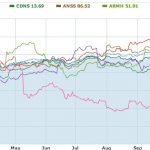
2013 was an up year for the stock markets as both the DJIA and the tech-heavy NASDAQ showed significant growth, so how did EDA and Semi IP companies do in the past 12 months? A quick stock plot from Yahoo Finance shows us that only two of the seven companies beat the NASDAQ: ARMH, MENT.… Read More
I spend about an hour a day reading blogs from EDA companies, foundries, independent bloggers and of course, SemiWiki. Richard Goering at Cadence assembled a top 10 list of the most popular blogs posted on their site in 2013, revealing that engineers were most interested in: FinFETs, 20nm and smaller nodes, memory technology and… Read More
We have posted several blogs related to Cadence IP strategy, or I should say new strategy. Each of these blogs was dealing with a particular product, like PCI Express gen-3 Controller IP, latest DDR4 Memory Controller or Wide I/O. This approach was equivalent to describe trees, one after one, and finally ignoring the forest! It’s… Read More
Yes, it is that time of year again, DAC is coming and it is in San Francisco so you can bet we will break attendance records, absolutely. I would like to call on ALL semiconductor IP companies to exhibit this year. IP is the center of the semiconductor design universe, DAC is the premier semiconductor design event, and San Francisco … Read More
It is that time of year and once again Atrenta has produced a video wishing you all the best for the holiday season. They are so spread around the world it is not just Hanukkah and Christmas but the Asian Lunar New Year (end of January) and probably some more holidays I don’t even know about. Last year there was a competition to name… Read More










Musk’s Orbital Compute Vision: TERAFAB and the End of the Terrestrial Data Center