WP_Term Object
(
    [term_id] => 45
    [name] => Aldec
    [slug] => aldec
    [term_group] => 0
    [term_taxonomy_id] => 45
    [taxonomy] => category
    [description] =>
    [parent] => 157
    [count] => 102
    [filter] => raw
    [cat_ID] => 45
    [category_count] => 102
    [category_description] =>
    [cat_name] => Aldec
    [category_nicename] => aldec
    [category_parent] => 157
    [is_post] =>
)

WP_Term Object
(
    [term_id] => 45
    [name] => Aldec
    [slug] => aldec
    [term_group] => 0
    [term_taxonomy_id] => 45
    [taxonomy] => category
    [description] =>
    [parent] => 157
    [count] => 102
    [filter] => raw
    [cat_ID] => 45
    [category_count] => 102
    [category_description] =>
    [cat_name] => Aldec
    [category_nicename] => aldec
    [category_parent] => 157
    [is_post] =>
)
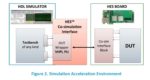
Despite the fact that FPGA based systems make it easy to add ‘hardware in the loop’ for verification, the benefits of HDL and gate level simulation are critical for finding and eliminating issues and bugs. The problem is that software simulators can require enormous amounts of time to run full simulations over sufficient time intervals… Read More
Mike Gianfagna, a fellow SemiWiki blogger and a one-time colleague at Atrenta shared a useful piece of marketing advice. If your company is not the biggest fish in the pond and you want to appear more significant, team up with other companies to put on an event, say a webinar. Pick your partners so that you can jointly offer a larger,… Read More
RISC-V has been trending ever since it landed on SemiWiki in 2016. Even more so now that Arm is in flux with the Nvidia acquisition. Verification is a fast growing EDA challenge with the number of verification engineers steadily outpacing design, so this webinar is a best case scenario for SemiWiki traffic, absolutely.
Two things… Read More
Oh, our semiconductor industry just loves acronyms, and the title of my blog packs three of the most popular acronyms together at once. I attended a webinar hosted by Aldec last week on this topic, “UVM Simulation-based environment for Ibex RISC-V CPU core with Google RISC-V DV“. Verification engineers have been … Read More
These days the verification process starts right when the design process begins, and it keeps going well past the end of the design phase. Simulation is used extensively at every stage of design and can go a long way to help validate a design. However, for many types of designs, especially those that process complex data streams, … Read More
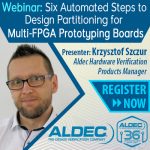
Before starting your next FPGA Prototyping Project you should catch the next SemiWiki webinar – “Six Automated Steps to Design Partitioning for Multi-FPGA Prototyping Boards”, in partnership with Aldec.
A significant portion of my 30+ years in the EDA industry has revolved around design verification with some form of FPGA … Read More
Finite state machines (FSMs) are widely adopted as part of reactive systems to capture their dynamic behaviors using a limited number of modes or states that usually change according to the applied circumstances. Some terminologies are frequently used to describe the FSM characteristics: state, transition, condition and … Read More
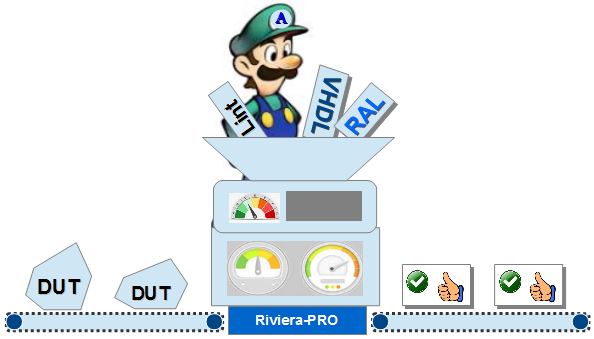
RAL, Lint and VHDL-2018by Alex Tan on 06-11-2018 at 12:00 pmCategories: Aldec, EDA
Functional verification is a very effort intensive and heuristic process which aims at confirming that system functionalities are meeting the given specifications. While pushing cycle-time improvement on the back-end part of this process is closely tied to the compute-box selection (CPU speed, memory capacity, parallelism… Read More
RDC – A Cousin To CDCby Alex Tan on 04-18-2018 at 12:00 pmCategories: Aldec, EDA, FPGA
In a post-silicon bringup, it is customary to bring the design into a known state prior to applying further testing sequences. This is achieved through a Power-on-Reset (POR) or similar reset strategy which translates to initializing all the storage elements to a known state.
During design implementation, varying degrees of… Read More
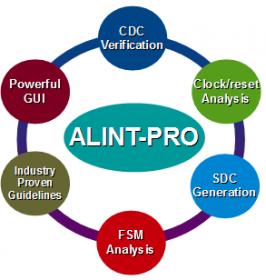
Clock Domain Crossing (CDC) is a common occurrence in a multiple clock design. In the FPGA space, the number of interacting asynchronous clock domains has increased dramatically. It is normal to have not hundreds, but over a thousand clock domains interactions. Let’s assess why CDC is a lingering issue, what its impact and the … Read More