You are currently viewing SemiWiki as a guest which gives you limited access to the site. To view blog comments and experience other SemiWiki features you must be a registered member. Registration is fast, simple, and absolutely free so please,
join our community today!
The NFL has its annual Super Bowl contest each year, EDA vendors attend DAC, then the test folks attend ITCwhich was in Anaheim a few weeks ago. I’ve marketed ATGP, BIST and DFT tools before so I like to keep updated on what’s happening at conferences like ITC. Robert Ruiz from Synopsys spoke with me by phone to provide … Read More
We blog a lot about Moore’s Law, and even “More than Moore” where 3D integration of ICs and systems are used to get lower product costs. One big challenge with 3D integration of ICs is that most EDA software was really intended only for abstracting at 2D or 2.5D structures. Over the past several years there have … Read More
The 53rd DAC (Design Automation Conference) is some 8 months away, however to make this conference and exhibit another success requires planning, people and awareness. That’s where you come in, because you can contribute your expertise in five different areas:
[LIST=1]
Panels – broad interest, interesting, timely,…
Read More
My first job out of college was transistor-level circuit design of DRAMs at Intel, so I’ve continued to be fascinated with both the craft and science of designing, optimizing, verifying and debugging custom ICs. Last October I traveled to Munich, Germany to attend a two day user group meeting for engineers using tools from… Read More
Apple iPhone 6 and 6s users are recent converts to the latest growth trend in smart phones, large screens at 5.5″ in size and aiming even higher each year. I’ve owned a 5.5″ smart phone from Samsung for some 3 years now, so have immensely enjoyed the larger screen size to get my daily work done with: web browsing, … Read More
I’ve lived in Silicon Valley then moved north to the Silicon Forest (aka Portland, Oregon) in 1995, and thankfully we have a lot of high-tech companies here like: Intel, Lam Research (Novellus), Lattice Semi, Qorvo, Synopsys, Mentor, Cadence, Northwest Logic, etc. There’s a global industry organization called… Read More
When I designed DRAM chips at Intel back in the 1970’s we didn’t really know what the die temperature would be before taping out silicon, instead we waited for packaged parts to come back and then did our thermal measurements. IC designers today don’t have that luxury of taping out their new SoC without having … Read More
Battery life is a never-ending battle for me with all of my mobile devices: Laptop, Tablet, Smart phone, bike computer, Kindle Reader, Bluetooth headset, etc. It seems like I’m constantly having to charge up my battery at the most inconvenient times. When I think about the history of batteries for mobile devices I can recall… Read More
My first experience with a wearable device was back in 1978 at college, it was an LED-based watch that had you push a button to read the time of day, saving battery life. Sad to say, but that electronic watch didn’t make it through the January winter at the University of Minnesota, so was promptly returned for a refund. Fast forward… Read More
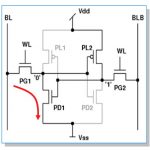
My IC design career started out with DRAM at Intel, and included SRAM embedded in GPUs, so I recall some common questions that face memory IP designers even today, like:
- Does reading a bit flip the stored data?
- Can I write both 0 and 1 into every cell?
- Will read access times be met?
- While lowering the supply voltage does the cell data retain?
…
Read More
















The Invisible Bottleneck Is Costing You Time You Can’t Get Back