





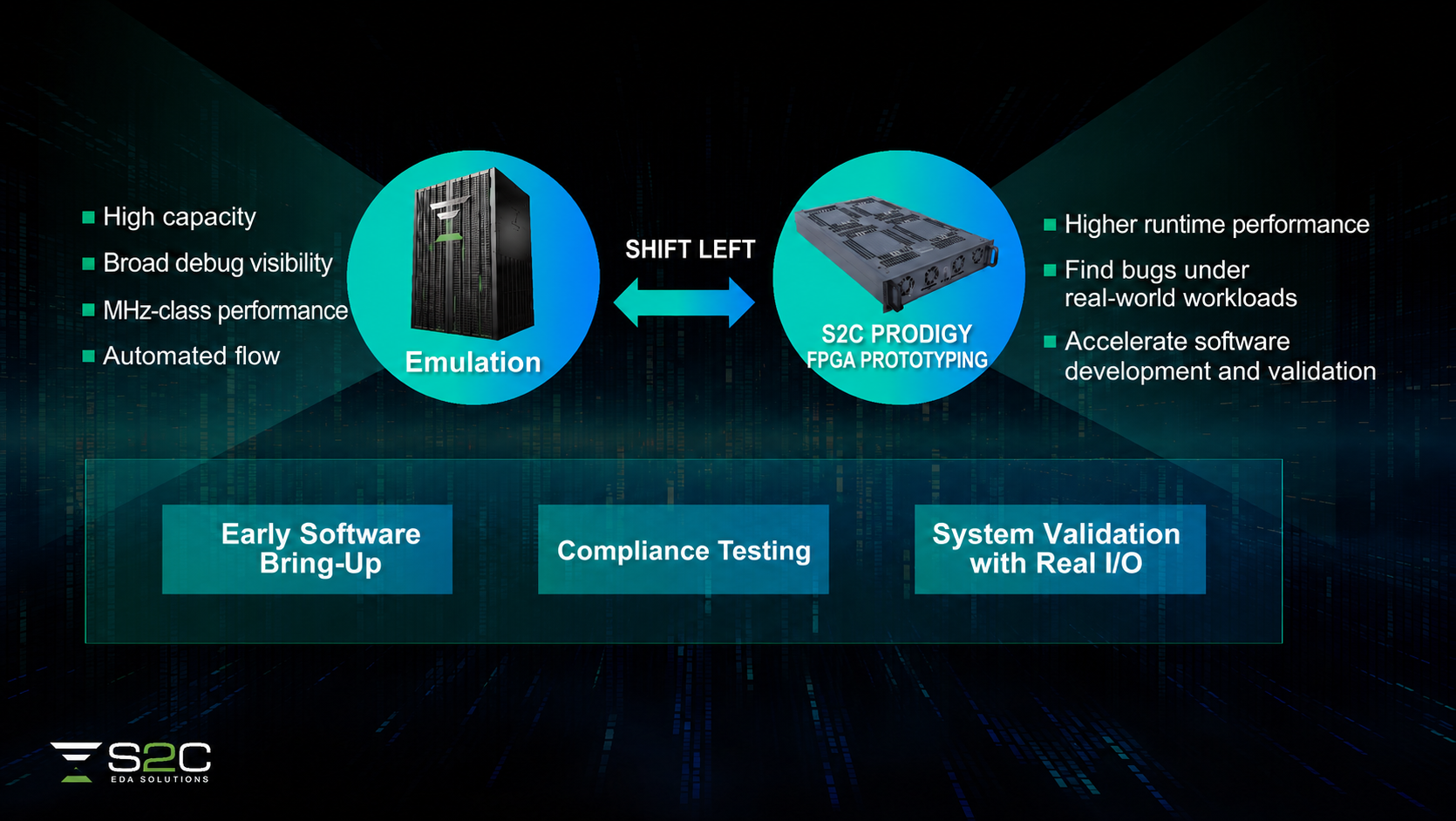
For modern SoC teams, “shift left” no longer means finding a few more RTL bugs before tape-out. It means moving meaningful system validation earlier—far enough left that firmware, operating systems, drivers, applications, and external interfaces can be exercised before first silicon arrives. This change is essential as software content grows, hardware/software interactions become more complex, and late discoveries carry increasingly severe schedule and silicon re-spin costs.
RTL simulation remains the foundation for detailed functional verification. It offers excellent observability, deterministic replay, and precise debug at the block and subsystem levels. However, simulation performance becomes a constraint when verification expands to workloads requiring billions or trillions of cycles. Booting an operating system, running long software regressions, stressing memory subsystems, or generating realistic network traffic can be too slow to execute comprehensively in simulation alone.
Hardware emulation extends verification into larger system-level designs while preserving strong debug capabilities. Yet as RTL matures and the focus shifts from design correctness to product behavior, FPGA prototyping becomes the high-speed bridge between pre-silicon verification and real-world operation. S2C’s Prodigy platform is designed for this transition, combining scalable FPGA-based hardware with automated implementation, system control, debug, host connectivity, and interface expansion.
The key advantage is execution speed. By mapping the SoC design into high-capacity FPGAs, teams can run software workloads at speeds that make operating-system bring-up, driver development, application testing, and extended regressions practical. Engineers are no longer limited to short, synthetic test cases. They can observe how the system behaves over long periods, under realistic traffic, and across complete software stacks. S2C positions its Prodigy systems specifically for early firmware development, software development, and system validation.
Prodigy also helps close the gap between an abstract verification environment and the intended product. Ready-to-use daughter cards and interface solutions allow prototypes to connect with technologies such as PCIe, Ethernet, DDR memory, QSPI, MIPI, and JTAG. This enables validation with real peripherals, physical data streams, and target-system interfaces. Problems involving initialization sequences, protocol behavior, bandwidth, latency, interrupts, and hardware/software synchronization can therefore emerge before silicon—not in the lab after fabrication.
Large SoCs introduce another challenge: fitting, partitioning, and debugging a design across multiple FPGAs. S2C addresses this through the Prodigy toolchain. Player Pro supports the RTL-to-FPGA flow, including automated, timing-driven partitioning and prototype configuration. Multi-FPGA debug capabilities improve visibility across devices, while ProtoBridge provides high-speed communication between host software and the FPGA prototype. Scalable configurations can also support shared prototype resources, parallel software development, and regression farms.
This approach also encourages earlier collaboration. Hardware teams can provide a stable execution platform while the design is still evolving. Firmware developers can validate boot code and device initialization; operating-system teams can test drivers and scheduling behavior; application developers can measure end-to-end functionality; and system architects can compare implementation choices using representative workloads. Defects are discovered within the development stage where they are easier and less expensive to correct.
The prototype’s role therefore changes. It is not merely a faster RTL test platform; it becomes a pre-silicon representation of the product. Hardware engineers can validate architecture and interfaces, software teams can test complete stacks, and system teams can evaluate realistic use cases on the same platform.
Bottom line: The result is a continuous verification strategy. Simulation provides depth, emulation adds system-scale debug, and FPGA prototyping supplies the speed and connectivity needed for software-driven validation. With S2C Prodigy, shifting left becomes more than an earlier verification milestone. It becomes a practical path from RTL confidence to real-world software readiness—reducing integration risk, exposing system issues sooner, and improving the likelihood that first silicon behaves like the product the team intended to build.
Also Read:
ASIC-to-FPGA Turnkey Prototyping Bundle: A Practical Path to Earlier Hardware Validation
COMPUTEX 2026: S2C and Andes Technology Showcase Hardcore “EDA+IP” Synergy for the AI Era
Technical Paper: FPGA Prototyping That Creates Useful PreSilicon Evidence
Share this post via:



Comments
There are no comments yet.
You must register or log in to view/post comments.