



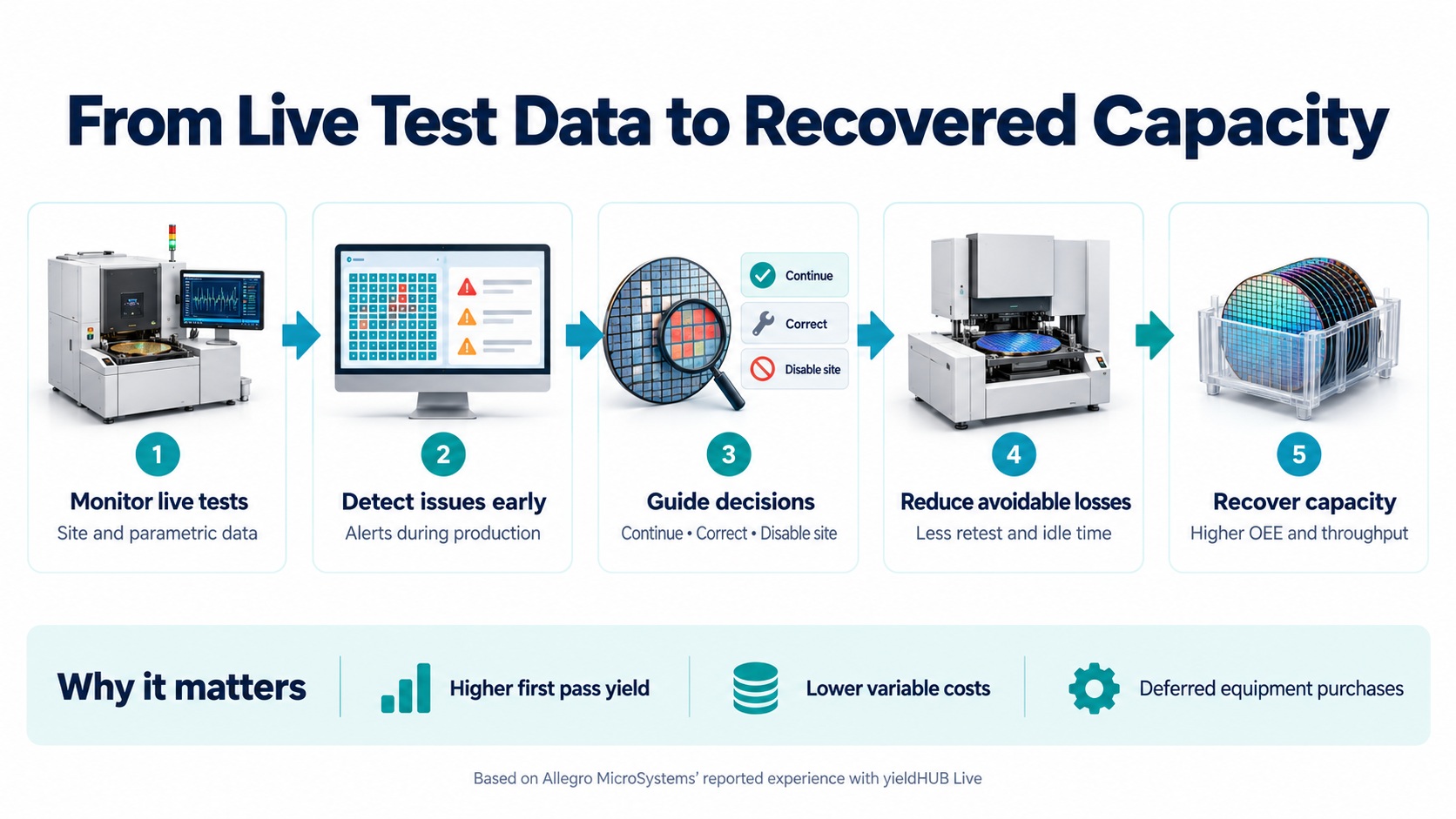
Allegro MicroSystems’ experience with yieldHUB Live shows how better use of production data can translate into measurable manufacturing gains. At its high-volume semiconductor operation in the Philippines, Allegro set out to improve overall equipment effectiveness, or OEE, by one percentage point. According to the customer success story, it achieved an improvement of several percentage points, alongside higher first pass yield, significant variable-cost savings and recovered tester capacity that helped defer equipment purchases.
The starting problem was unnecessary retesting. When devices require another pass through a tester, they consume time that could otherwise support new production. Allegro identified retest as one of its largest sources of equipment utilization losses. Tackling that problem required more than identifying poor yield after a production lot had finished. Engineers and technicians needed evidence to decide what to do while testing was still underway.
This is where yieldHUB Live changed the operating process. The software monitors active production at site and parametric levels, identifies developing issues and provides recommendations informed by production conditions. Technicians can use that information to decide whether to continue testing, take corrective action or disable an individual test site. The goal is to maximize good parts per hour while protecting quality.
That distinction matters because an immediate repair is not always the best production decision. A struggling site may generate avoidable retest, while an intervention may introduce further downtime. By considering the wider operating context, the system helps technicians assess those tradeoffs. Allegro reported that smarter site decisions reduced unnecessary retest and contributed to the improvement in OEE.
The gains also extended to first pass yield. Earlier alerts allowed the team to respond to issues before more units were affected. Allegro evaluated production yield and variable costs before and after deployment, reporting that savings from smart retest exceeded its full-year projection. The calculation excluded its highest-volume devices, making the reported result especially notable.
For management, the recovered capacity was particularly important. Allegro said the improvement enabled it to delay buying additional equipment. This connects a factory performance metric to a concrete investment decision: when existing testers produce more useful output, the business can meet demand with less immediate pressure to expand its equipment fleet. The value therefore reaches beyond the test floor into capital planning.
Engineering productivity improved too. Using the broader yieldHUB platform, Allegro could compare 20 lots in minutes, replacing work that previously occupied an engineer for half a day to a full day. Quality deviation report closure time also fell significantly. Allegro reallocated the time saved to other engineering projects, showing how faster access to connected data can increase the team’s capacity to investigate and improve production.
Deployment adds another reason the story matters. Allegro reported no measurable increase in test time and no required test program changes. The software also delivered parametric mistrim detection without the program development effort that Allegro estimated would otherwise take two to three years for priority testers. Its own team is now extending deployment across dozens of additional testers.
The broader lesson is that manufacturing improvement can come from changing the timing and quality of decisions. Historical analysis remains useful, but live information creates an opportunity to prevent losses before they accumulate. In Allegro’s case, that opportunity supported better yield, lower costs, faster engineering reviews and more productive use of installed equipment. For manufacturers facing similar retest losses, the relevant question is how much productive capacity better decisions could recover from existing assets.
Bottom line: These results are customer-reported. It presents a practical case for evaluating real-time test intelligence against defined production measures. It also shows why sustained use matters: Allegro reported that OEE gains gradually disappear when live monitoring is switched off. The lasting benefit depends on making timely, evidence-based decisions part of everyday operations.
For an in-depth breakdown, listen to SemiWiki Podcast EP373 featuring Gillian O’Donnell, yieldHUB’s Director of Growth, or check out the full Allegro MicroSystems customer success story.
Also Read:
Beyond the Post-Mortem: How yieldHUB Live Turns the Test Floor Into an Open Window
Why Real-Time Intelligence is the Next Differentiator in Semiconductor Test
Optimizing Photonic Integrated Circuit Production with yieldHUB Analytics
Share this post via:


Comments
There are no comments yet.
You must register or log in to view/post comments.