




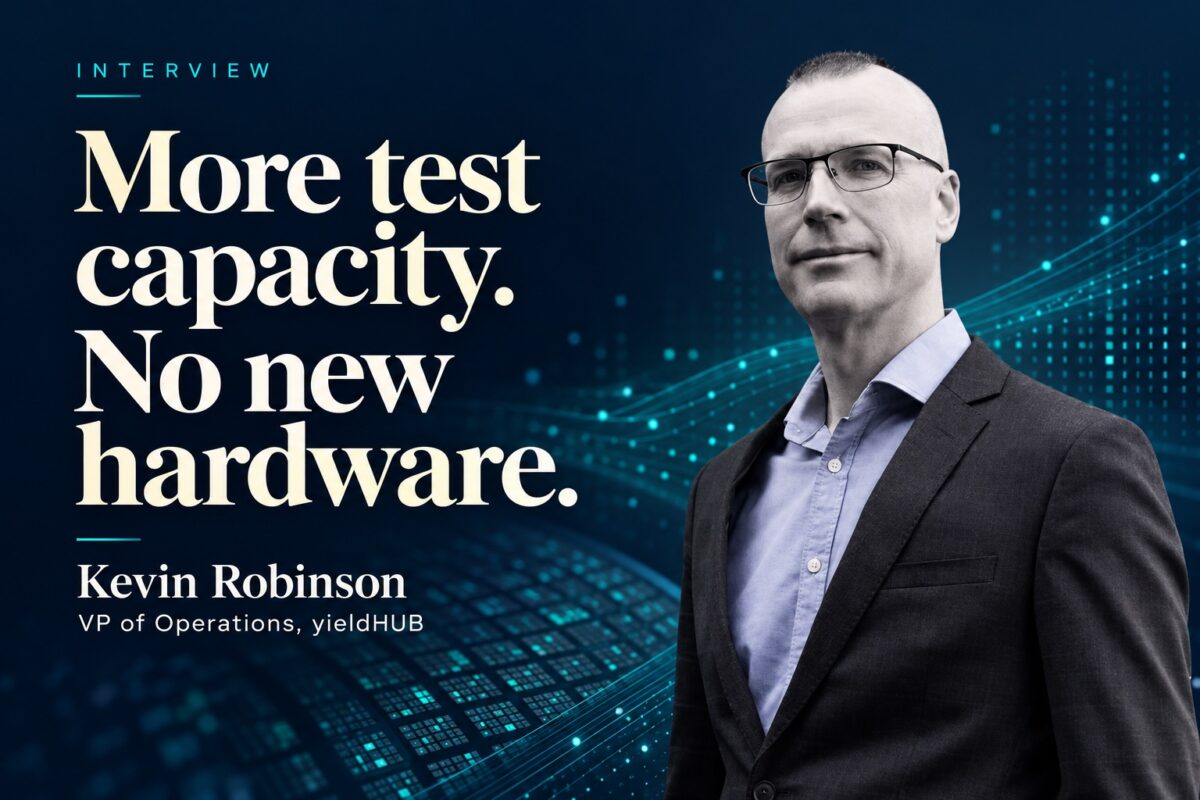
Kevin Robinson is VP of Operations at yieldHUB, where he leads global operations, program delivery, and customer execution. He oversees structured onboarding, customer delivery, and the scalability of yieldHUB’s operations worldwide.
Kevin brings more than 25 years of semiconductor experience across product and test engineering. Before joining yieldHUB, he was a senior leader at Diodes Incorporated and Zetex, where he drove yield improvement and test transformation programs. His expertise spans yield optimization, test strategy, capital efficiency, and production ramp management. Alongside his role at yieldHUB, Kevin serves as co-chair of TechWorks FACTYR, where he contributes to industry-wide collaboration across the semiconductor sector.
What brought you to yieldHUB?
Early in my career, I was lucky enough to be taught the value of data. I was a junior engineer with a failing device and an AT data log. I went to see the designer to ask what additional testing I could do to debug the part and find the root cause of the failure. He sat me down and showed me how we could look through all of the AT data for that particular device, look at the different tests and how they related to each other, and we debugged the root cause without any additional testing. We identified exactly what was going on, which could then simply be verified by failure analysis. That sparked a real passion for data analytics in me. It was almost inevitable that my career would take me to a company like yieldHUB.
What is the biggest challenge your customer is facing?
Customers face many challenges. One of the biggest right now is the capacity of the test floor. With the global AI boom, test floors all over the world are becoming one of the bottlenecks in the supply chain, because they need to get more product out to customers, whether those are AI chips or power management chips going into the service. There is so much demand in the industry that test floors are full, and the equipment they would buy to expand capacity is constrained by the same capacity limits. So the biggest issue they face is that they would like more capacity to get more product out, but the equipment now has longer and longer lead times.
You end up in a really difficult situation where you simply don’t have enough capacity, and the normal way of expanding capacity, which is buying more equipment and testing more product, isn’t open to you right now.
Why is your approach to solving this problem unique?
As I described, the problem is that you have all this equipment running, trying to get as much product out as possible. There are various ways to solve this. You can add more equipment, but that is off the table because it is still part of the supply constraint. Or you can look at the data you already have. What we learned is that there is information about what is actually happening on the test floor that isn’t visible on test floors. The unique thing we have done is interact with the product data in such a way that it can still be deployed across entire test floors without any product-specific knowledge.
Where this works is that if you look at everything from an MES system point of view, you are looking at the way lots move: Is this lot on this station? Has this lot left this station or test cell? But you are not looking at whether the tester is running efficiently with this product. To do that, you need to look at the product data, and someone who runs MES systems generally knows very little, if anything, about product data. Similarly, the tester companies make fantastic pieces of equipment. That equipment runs very efficiently and executes the test programs their customers have written. Those test programs have long qualification cycles, and it is very expensive to make a change to a test program, because you need to re-qualify it and go through all of the QA steps. So we have this unique avenue: using the product data created on the tester to create new data about what is actually happening in test, bringing that out into dashboards, and using it to alert operators when things are starting to go wrong. It is a unique approach, and it has given absolutely fantastic results in helping to increase efficiency on the test floor, and therefore increase capacity, without any new hardware.
What other approaches are being used to solve this problem?
I touched on a couple of other things around MES systems. Of course, they help increase the efficiency of the test floor by loading things in the right way, so you get efficient loading and you aren’t constantly changing products and doing additional setups. The scheduling inside MES systems is absolutely fantastic, and that gets you so far with efficiency. Then, on the tester platforms themselves, you want to make sure the testing itself doesn’t break, and systems like Advantest’s ACS and Teradyne’s keep those testers running and healthy. They are also fantastic and part of the overall picture. There are these different pieces of solutions in the industry, and we found a gap between them: the tester is loaded, it is operational, it has a product, but it is still actually idle and not testing. We are bridging that gap.
Some of these things have been approached over the years by putting additional hardware on the test floor. I’ve explained why we want to minimize introducing extra hardware at this time: it is so difficult to get hold of because of supply constraints. It can also be approached by updating test programs to do very clever things inside the test programs. But, as one of our customers estimated, doing this through the test programs would take two to three years to make the changes and deploy them. On that exact test floor, we were able to deploy this in a couple of weeks, because we ran a three-month pilot there, so obviously we needed to deploy within that window and see results within three months. There are a lot of different ways to approach this, but the uniqueness of our approach brings many advantages and avoids a lot of the disadvantages of the other approaches.
What challenges will your customers face in the near future?
In the near future, everything just keeps going up. They have even more demand, higher equipment costs, longer delivery timescales on equipment, higher energy costs, and higher people costs. With all of these things rising, every percentage point of operational efficiency you can gain on the test floor next year will be more valuable than it is this year, and the year after it will be more valuable still. What isn’t changing is the problem, and the fact that improving efficiency brings significant value. What is changing is the size of the problem and the pressures on it, and the fact that the value of the solution only goes up at the same time.
How has AI changed your business strategy?
One of the great things AI has done here is within this live software. One of the ways we really help improve operational efficiency is by making very nuanced decisions about how to respond to issues that arise during testing. That is done using AI to make automated, real-time recommendations, so the advancement of AI has enabled this fantastic linchpin in our solution. At the same time, the use of AI is also accelerating our speed of development. Alongside the main, almost generic, problem of test floor efficiency and identifying idle time, every customer also has something unique that is different. For this to be truly successful, you need to develop something a little bit different, and AI is helping us speed that up and deliver even more quickly to those customers.
Also Read:
Beyond the Post-Mortem: How yieldHUB Live Turns the Test Floor Into an Open Window
Podcast EP353: What Real-Time Visibility Is and Why it Matters with yieldHUB’s John O’Donnell
Why Real-Time Intelligence is the Next Differentiator in Semiconductor Test
Share this post via:


Comments
There are no comments yet.
You must register or log in to view/post comments.