



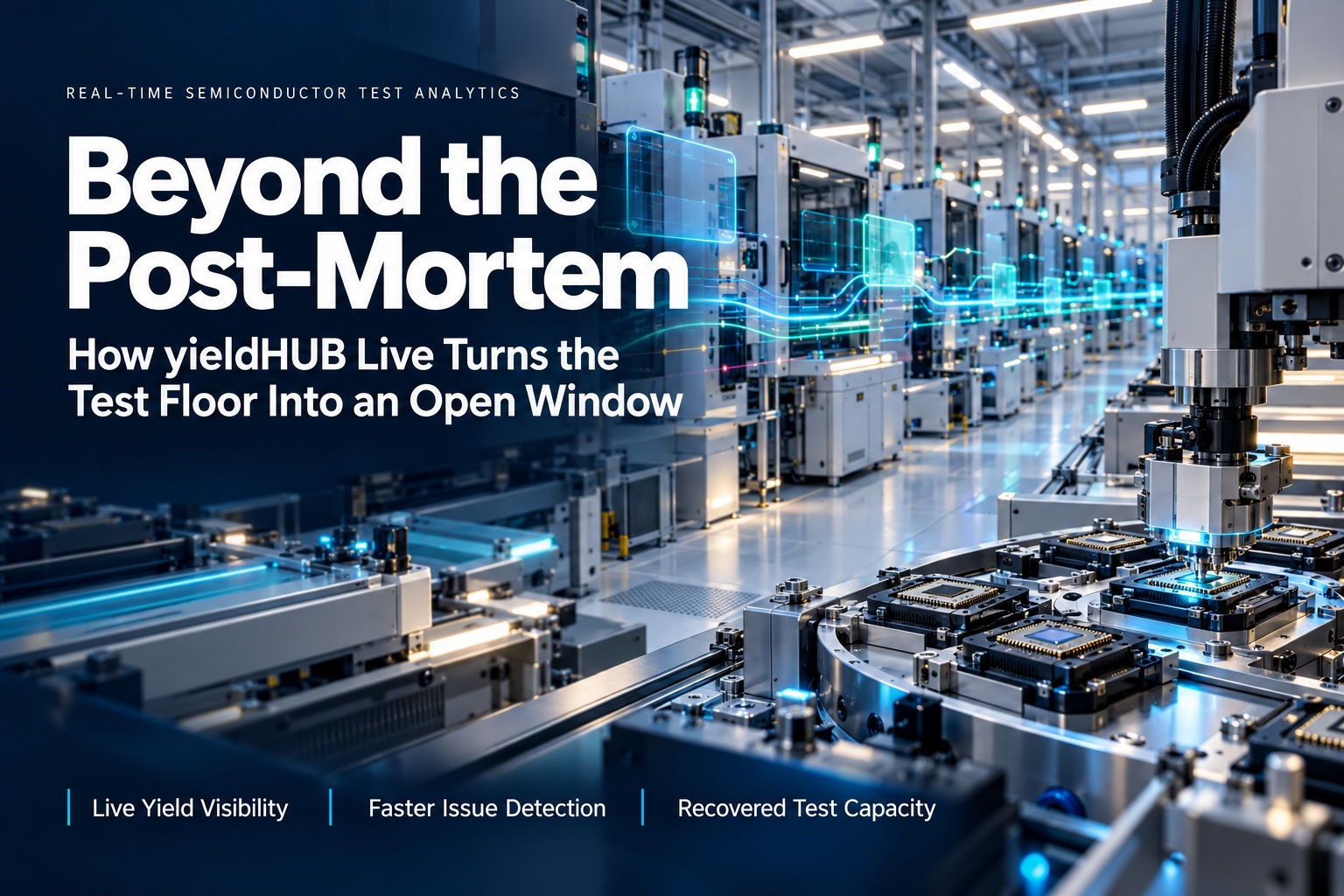
At SEMICON West 2026 I sat down with John O’Donnell, founder and CEO, and Gillian O’Donnell, Director of Growth, to talk about how yieldHUB Live is transforming the semiconductor test floor from a blind spot into a real-time command center.
For decades, semiconductor test floors have operated as high-stakes black boxes. Every test engineer knows the grueling routine: a lot finishes, the STDF (Standard Test Data Format) files finally drop, and someone opens a dense report the next morning, only to discover a drifting parameter, a stuck handler, or a tester that sat idle for half a shift. By the time anyone notices, the scrap is already stacked up and the capacity is gone. What the industry has long labeled as “real-time test analytics” has essentially been a well-formatted post-mortem.
Enter yieldHUB Live, a solution that finally drags test-floor visibility out of the dark ages and into real time.
From Post-Mortem to Real-Time Control
Founded in Limerick in 2005 by ex-Analog Devices test engineer John O’Donnell, yieldHUB spent two decades perfecting the traditional yield management system (YMS). Its core platform is a powerhouse trusted by fabless companies, IDMs, and OSATs (Outsourced Semiconductor Assembly and Test) across 13 countries, analyzing over 60 billion chips a year for giants like Infineon, Microchip, and Raspberry Pi.
While the traditional platform gives engineers an elite suite of tools, from parametric and bin analysis to Cp/Cpk and outlier detection, it still relies on historical data. yieldHUB Live changes the game by shifting the analysis directly onto the test floor while the lot is actively running.
Rather than waiting for end-of-lot files, Live evaluates probe and final test data device by device. It constantly monitors yield, bins, parametric drift, and tester overall equipment effectiveness (OEE), instantly ranking operational issues by severity. It tells operators precisely what actions to take to maximize yield while the wafer is still on the prober or the lot is on the handler. Where enabled, it can even interface directly with handlers and testers to automate the response, while keeping engineers firmly in control of thresholds and automatic stops.
Frictionless Deployment: The Three Golden Rules
Getting new software onto a production floor is usually an uphill battle. yieldHUB designed Live to bypass those roadblocks entirely:
- No New Hardware: Live runs seamlessly alongside your existing testers.
- Zero Test Program Changes: The test flow remains completely untouched, requiring zero added test time.
- Tester-Agnostic: It effortlessly manages both legacy and next-generation testers, including non-STDF data streams.
Once configured, the system can fan out to hundreds of testers in a matter of days, bridging the gap between a sluggish pilot and a rapid, fab-wide deployment.
The Allegro MicroSystems Proof Point
The real measure of any tool is the production floor. At Allegro MicroSystems’ highest-volume manufacturing site in the Philippines, where they produce magnetic sensors and power ICs largely for the automotive sector, every single point of OEE represents serious money.
Allegro set out with a modest target: a 1 percentage point improvement in OEE on their highest-volume test floor. By targeting major utilization losses like phantom idle times and unrecovered retests, yieldHUB Live delivered several percentage points of OEE, alongside boosted first-pass yields, recovered tester capacity, and measurable cost savings.
The biggest surprise wasn’t just the financial return, it was the yield impact. As Eunice Esguerra, Section Manager for Final Test Product Engineering at Allegro Philippines, put it: “The impact on yield was kind of a revelation to us.” The team anticipated a utilization win; the gains in first-pass and final yield were entirely unplanned.
As the saying goes, the proof is in the pudding. On one occasion, a temporary software update inadvertently switched off the yieldHUB Live system, causing an immediate, measurable dip in test performance and OEE metrics. This unintended stress test proved the direct correlation between keeping the system active and achieving continuous improvements in cycle time and OEE. For Allegro, the financial implications are massive, translating into millions of dollars in savings. By unlocking hidden capacity through improved cycle times and OEE, the facility has been able to delay multi-million-dollar capital investments in new test cells, handlers, fixtures, and floor space. In an industry where lead times for equipment can stretch across months, not to mention the added constraints of real estate and facility fit-out, recovering that capacity through software rather than hardware is a game-changer.
The ultimate validation? Allegro’s own internal engineers took the initiative to roll Live out across dozens of additional testers on their own.
Why It Matters Now
Back-end test has historically been the least instrumented part of the semiconductor flow relative to its massive cost. While fabs have enjoyed real-time SPC (Statistical Process Control) and APC (Advanced Process Control) for decades, test floors have traditionally been left in the dark until the lot closes.
As global production volumes surge, especially in automotive and power devices, and as onshoring initiatives in the U.S. and Europe introduce fresh, less-seasoned test capacity, real-time fleet control is no longer a luxury. It is the ultimate lever for protecting both margins and quality.
By building on clean data, applying smart automation, and respecting the realities of the factory floor, yieldHUB Live proves that the test floor no longer needs to be a black box.
For an in-depth breakdown, listen to SemiWiki Podcast EP373 featuring Gillian O’Donnell, yieldHUB’s Director of Growth, or check out the full Allegro MicroSystems customer success story.
Also Read:
Podcast EP353: What Real-Time Visibility Is and Why it Matters with
Why Real-Time Intelligence is the Next Differentiator in Semiconductor Test
Share this post via:


Comments
There are no comments yet.
You must register or log in to view/post comments.