







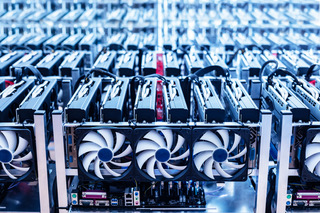
Most crypto forty-niners died broke in a warehouse full of their computing rigs. Former Ethereum miner CoreWeave took its gold to Wall Street. On June 22, 2026, it joined the Nasdaq-100 — fifteen months after its IPO, nine years after its founders assembled their first GPU rig in a New Jersey office.
The people who built the physical foundation of today’s AI compute economy were commodity traders, Ethereum miners, and flared-gas opportunists. They spent years in a business that serious technologists dismissed — and most went the way of the California 49ers of the 1800s: disillusioned and broke. A handful, however, emerged from the 2022 crypto crash holding the one asset the AI boom couldn’t conjure quickly enough: purpose-built, high-density, GPU-ready compute infrastructure with power contracts already in place.
That accident of history is now worth well over $200 billion. It also raises a question the semiconductor and infrastructure industries haven’t fully reckoned with: how did the physical substrate of the AI revolution get financed by speculative faith in a digital currency whose creator may not exist as a single person?
It started with the infrastructure itself: GPU-based GeForce cards built to render imaginary worlds — Quake, World of Warcraft, and later Fortnite — for teenagers and young adults who had no idea they were funding the next computing revolution. The same cards were repurposed for crypto mining by a generation of opportunists chasing digital gold in virtual currency. Then the serious business of AI computation claimed them — yet another virtual world, but this time one that talks back.
The GPU as Accidental Common Denominator
Bitcoin mining split early into two hardware paths. Around 2013 Bitcoin embraced purpose-built ASICs (Application-Specific Integrated Circuits) for SHA-256 hashing (the cryptographic puzzle Bitcoin miners solve billions of times per second, requiring raw computational brute force rather than intelligence). Ethereum deliberately chose a different compute strategy. Its proof-of-work algorithm, Ethash, was engineered to be ASIC-resistant. It required large amounts of fast memory alongside raw computation, a design that kept general-purpose GPUs competitive and prevented any single hardware vendor from dominating the network with custom chips.
That design decision, made for ideological reasons, had enormous unintended benefits for the semiconductor supply chain. It kept Nvidia and AMD in the mining business for nearly a decade, creating a generation of operators who knew how to run GPU clusters at industrial scale — dense racks, aggressive cooling, high sustained power loads — before AI training workloads existed at commercial scale.
The GeForce card’s parallel processing architecture–thousands of small cores designed to render millions of pixels simultaneously–turned out to be exactly what crypto mining required: the ability to run billions of identical hash calculations at the same time. CUDA, Nvidia’s programmable computing platform built on top of that architecture, made it accessible. It also made the same hardware efficient at matrix multiplication–the core operation underlying transformer model training and inference. Mining was an accidental decade-long industrial stress test of hardware AI would later require at massive scale. Nvidia didn’t plan it that way. Neither did the miners. The market found a use for available silicon and optimized aggressively around it..
What Crypto Mining Actually Built
Under intense economic pressure, in remote locations, financed by volatile cryptocurrency revenues, crypto miners built the operational knowledge and physical infrastructure that takes years to replicate.
Mining economics are denominated in electricity. An operation paying $0.04 per kilowatt-hour is profitable where one paying $0.08 is not — forcing miners into power procurement disciplines conventional data center operators rarely develop: long-term power purchase agreements, direct substation access, relationships with grid operators. Crusoe went further, contracting to consume flared natural gas from oil fields that producers were literally burning as waste.
When a handful of well-funded AI startups — OpenAI, Anthropic, Stability AI, Inflection — came looking for large GPU clusters in 2023 and found hyperscaler waitlists stretching months, the former miners had the only non-hyperscaler buildings already engineered for that thermal load.
The hyperscalers were caught flat-footed on infrastructure and on the premise. Google had acquired DeepMind in 2014, employed more AI researchers than anyone on earth, and invented the Transformer architecture — the foundation of every large language model — in 2017. It didn’t ship an aggressive consumer AI product because ChatGPT-style assistants threatened the search business that funded everything. Nobody needs to “Google it” when they can ask Claude.
Meanwhile AWS, Azure, and Google Cloud had spent fifteen years optimizing for CPU-dense web servers, databases, and virtual machines — predictable enterprise demand that grew in straight lines. GPU capacity existed at the margins. When ChatGPT hit and demand went vertical, they committed hundreds of billions to begin building. Data centers don’t materialize on command regardless of how much money you throw at it. The miners had spent five years solving precisely that problem, in exactly the wrong market. When the wave arrived, they were ready to ride it.
Networking and orchestration is where the analogy of “vacant data centers waiting for training software to load” breaks down. Mining rigs run independently — each GPU mines on its own. AI training requires thousands of GPUs communicating continuously across a cluster, coordinating gradient updates via Nvidia’s InfiniBand interconnects at 400 gigabits per second or faster. That network architecture had to be built from scratch. The physical plant was ready. The networking and software stack required months of engineering work, not years. Nevertheless, it gave the miners their 18-month head start.
The Crash Sorted Operators from Speculators
The 2022 crypto collapse sorted the field into three groups: casualties, survivors, and pivots. The casualties borrowed against cryptocurrency prices to fund expansion. Core Scientific filed for bankruptcy in December 2022 with $1.3 billion in debt, its electricity bills exceeding mining revenue. Compute North, which had raised $385 million earlier that year, filed for Chapter 11 in September. Not failures of infrastructure — failures of capital structure. What killed them was leverage against a single volatile commodity price, the same mechanism that has ended every speculative infrastructure boom from railroad bonds to dot-com colocation.
The survivors — Marathon Digital, Riot Platforms, CleanSpark — had balance sheets large enough to absorb the downturn. They waited, accumulated Bitcoin at depressed prices, and rode the 2024 recovery. Today they run hybrid models: mining when Bitcoin economics are favorable, pivoting to AI hosting when they aren’t.
CoreWeave is the clearest example of a miner that saw this coming. Founded as Atlantic Crypto in 2017, it made a deliberate pivot in 2019 — three years before the crash — to exit mining and reposition as a GPU cloud provider. The orchestration layer it built wasn’t a mining byproduct; it was purpose-engineered for collective GPU computation from the moment the founders decided mining was the wrong end of the value chain. When H100s became the most sought-after silicon on earth in 2023, CoreWeave had Nvidia allocation while everyone else was on a waiting list.
The distance traveled became clear in a single 48-hour window in April 2026: CoreWeave announced a multi-year agreement with Anthropic to provide Nvidia GPU capacity for Claude inference workloads and simultaneously closed a $21 billion expansion of its infrastructure partnership with Meta. Three commodity traders who started mining Ethereum in a New Jersey office had become the critical GPU supply chain link between Nvidia and two of the most consequential AI labs on earth.
Crusoe sold its Bitcoin mining business in April 2024 to go all-in on AI, committing to a 1.2 gigawatt data center campus in Texas. Core Scientific, emerging from bankruptcy with restructured debt, signed a $10.2 billion hosting contract with CoreWeave, a bankrupt crypto miner saved by a crypto-miner-turned-AI-cloud. Just as in the oil patch, the infrastructure outlasted the drillers who built it.
Compute Real Estate as an Asset Class
What emerged is a category that didn’t have a name five years ago: compute real estate. It sits at the intersection of semiconductor infrastructure, commercial real estate, and utility operations. The colocation giants are literally structured as REITs — Equinix converted in 2015, Digital Realty has operated as one for years. Blackstone, which acquired QTS for $10 billion, is an infrastructure capital allocator that happens to own data centers.
Every megawatt of compute real estate capacity represents a fixed allocation of GPU silicon — overwhelmingly Nvidia, given CUDA’s lock on AI training workloads. The constraint isn’t land or capital. It’s GPU allocation and power density. CoreWeave’s early advantage was securing H100 allocation ahead of the ChatGPT demand spike through a partnership built during its mining years. The mining business had been, inadvertently, a decade-long audition for preferred customer status with the one supplier who mattered most.
That relationship runs deeper than preferred customer status. The wildcatters are effectively Nvidia’s advanced column — the fast-moving specialized force that gets into territory before the main army arrives. The hyperscalers are simultaneously Nvidia’s largest customers and its most dangerous long-term competitors: Amazon has Trainium, Google has TPUs, Microsoft is developing its own AI chips. Every dollar of compute that runs on custom silicon is a dollar that doesn’t run on an H100 or B200.
The wildcatters have no such ambition. Their entire business model is built on Nvidia silicon, and they have every incentive to make it perform better, deploy faster, and reach customers the hyperscalers won’t serve well. Nvidia understands this. In January 2026 it made a $2 billion private placement investment in CoreWeave and signed a $6.3 billion take-or-pay capacity guarantee through 2032 — agreeing to buy unsold CoreWeave compute because CoreWeave’s existence serves Nvidia’s strategic interests directly. The wildcatters drill the speculative wells. Nvidia, the equipment manufacturer, quietly financing the drilling.
The performance advantage that makes the wildcatters worth financing comes down to one architectural choice: bare-metal versus virtualized compute. Hyperscalers don’t rent customers an actual physical GPU — they rent a software-created abstraction of one, a virtualization layer that enables flexible multi-tenant cloud economics but adds latency to every operation. Training a large language model requires thousands of GPUs synchronizing state millions of times per second; that overhead compounds across the cluster and bleeds performance in ways that more hardware can mask but not eliminate. CoreWeave inherited bare-metal operations from its mining days — miners had no reason to virtualize a rig, so they never did. The hyperscalers built empires on virtualization and now can’t easily remove the foundation. The wildcatters never laid it in the first place.
By late 2025, miners and their AI-pivoted successors had announced $65 billion in contracts with major technology companies. Crypto mining revenue for companies that secured AI contracts is projected to fall from 85% of total revenue in early 2025 to under 20% by end of 2026. AI hosting runs at 80 to 90 percent operating margin. Bitcoin mining near breakeven. The migration isn’t a trend. It’s a structural conclusion.
The Question the Market Is Now Asking
The $200 billion compute real estate ecosystem was substantially financed by a speculative asset whose value rests on collective agreement rather than intrinsic utility. Bitcoin has no earnings, generates no rent, produces nothing. Its value exists because enough participants believe it has value. That belief has been institutionalized. BlackRock offers a Bitcoin ETF, sovereign wealth funds hold positions. Institutionalized faith is still faith.
The AI market is asking a similar question. Nvidia lost $600 billion in market cap in a single session when DeepSeek demonstrated that capable inference could run on a fraction of the compute previously assumed necessary. The hyperscalers have committed to a combined $300 billion-plus in AI capital expenditure in 2025 alone — a number priced for demand that hasn’t fully materialized in revenue. CoreWeave still derived approximately two-thirds of its 2025 revenue from a single customer, Microsoft, whose own Azure infrastructure couldn’t meet AI demand fast enough.
AI is already generating real revenue in ways Ethereum mining never did. The inference market is genuine and growing. But the crypto miners who went broke in 2022 weren’t wrong about GPU infrastructure; they were wrong about capital structure. The AI infrastructure investors of 2025 are not wrong about AI. The question is whether they are wrong about the timeline, the competitive dynamics, or the assumption that Nvidia’s pricing power is permanent. Different mistakes. But they rhyme.
What the Wildcatters Left Behind
The semiconductor and AI industries inherited something from the crypto boom they didn’t build and mostly didn’t fund: operators who know how to run GPU-dense infrastructure at industrial scale, purpose-built facilities with power contracts that took years to negotiate, and proof that non-hyperscaler GPU clouds can win frontier AI customers on performance grounds. CoreWeave’s bare-metal advantage over hyperscaler virtualized GPU offerings is a technical fact. Crusoe’s stranded-energy model produces some of the lowest-cost compute in the market.
The GPU was invented to render imaginary worlds — to make the dragons look like dragons and the racing cars look like they were moving. Crypto miners discovered it could conjure an imaginary commodity: a currency with no physical form, its value existing purely as cryptographic consensus sustained by collective belief. Then AI researchers discovered it could simulate something resembling thought.
The hardware didn’t change. What changed was what humans decided to ask it to do and how abstract the output became with each successive application.
When you talk to an AI and a virtual brain answers your question, the computation running underneath that exchange is happening on direct descendants of the same architecture that once rendered imaginary worlds and mined imaginary money. The forty-niners built the infrastructure. The miners stress-tested it. The AI founders inherited it. Somewhere in a data center that used to house Ethereum mining rigs, a GPU that once chased a cryptographic hash is now deciding what to say to you next.
The 49ers who struck it rich weren’t always the ones panning for gold. More often they were the ones selling picks, shovels, and blue jeans to the ones who were.
Also Read:
The Wedding of the Year: Why AI Infrastructure Financing Is Becoming a Semiconductor Story
Broadcom Told the Truth. The Market Hasn’t Heard the Rest of It Yet.
From the Selfie to Samantha: The Next Trillion-Dollar Behavior
Share this post via:



The silent killer of analog reliability: Why SPICE misses floating net