






Every family has that one wedding where, halfway through the toasts, someone leans over and whispers “wait, who’s paying for all this?” This is that wedding. OpenAI and Broadcom are the happy couple. Apollo Global Management walked the bride down the aisle. Nvidia may have just stood up to offer a toast, a very expensive one, for a second ceremony happening simultaneously in Ohio.
The metaphor is useful for exactly one reason: it captures the strangeness of what is actually happening. Semiconductor companies are no longer just designing chips and collecting purchase orders. They are underwriting deployment. They are co-signing leases. They are guaranteeing that AI infrastructure gets built whether or not the tenant can ultimately pay for it. That is the new story.
What follows sets aside the wedding and focuses on what this financing structure means for the semiconductor industry: which companies are exposed, what volumes are implied, and what the downstream effects look like for foundries, packaging, and memory.
Section 1: What Broadcom Actually Filed
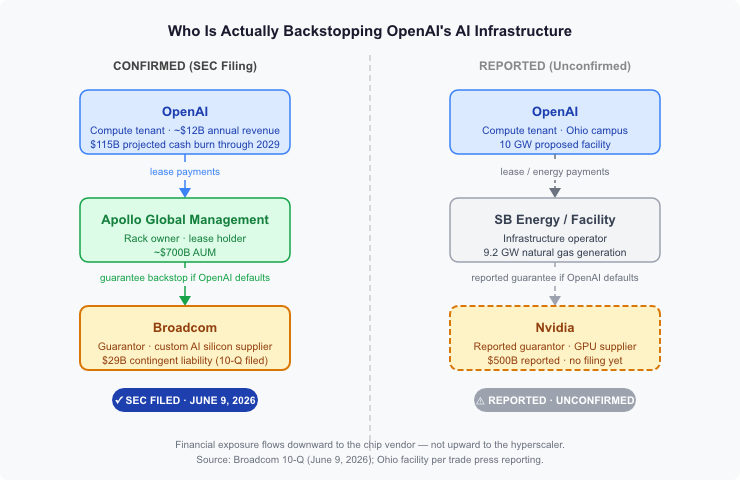
Start with what is in the public record. Broadcom’s Form 10-Q for the fiscal quarter ended May 3, 2026, filed June 9, 2026, discloses in Note 11 (Subsequent Events) that on June 8 an investor partner agreed to purchase AI racks built around Broadcom’s custom chips, with related lease agreements covering compute access. Broadcom guaranteed those lease obligations for up to $29 billion, escalating as racks deploy and decreasing as payments are made.
Item 5 of that same filing identifies the investor partner as Apollo Global Management, which manages approximately $700 billion in assets. Apollo bought the racks. Apollo holds the lease. Broadcom is acting as guarantor to Apollo in the event OpenAI defaults.
The structure is straightforward: OpenAI gets compute access without deploying capital upfront; Apollo gets a yield-bearing infrastructure asset backstopped by Broadcom’s balance sheet; and Broadcom gets a committed customer for its custom AI silicon at a scale that justifies the design services investment. The $29 billion is a contingent liability, real exposure, in its SEC filing.
One additional reported element: according to an internal OpenAI memo cited in trade press, Broadcom originally conditioned the first phase of the chip program on Microsoft agreeing to purchase roughly 40 percent of the packaged silicon, installed in Microsoft’s data centers with compute rented back to OpenAI. OpenAI’s own head of compute reportedly called that arrangement financially unattractive and likely unworkable. Whether Apollo’s entry as investor partner resolved the Microsoft condition is not in any filing. The Microsoft piece remains unconfirmed.
Section 2: Why This Is Unusual
For most of the history of the semiconductor industry, the commercial relationship between chip vendors and customers was relatively clean: a customer needed silicon, a vendor designed and manufactured it, a purchase order changed hands. The vendor’s balance sheet exposure ended when the wafers shipped. Infrastructure financing was the hyperscaler’s problem.
What Broadcom has done here is different. By guaranteeing $29 billion in lease obligations, Broadcom has subordinated its balance sheet to OpenAI’s ability to generate revenue from the compute it is leasing. Broadcom is no longer just supplying the silicon inside the rack; it is now the guarantor for whether the rack gets paid for at all. That may prove to be the most important structural change in the AI hardware industry in this cycle. Semiconductor vendors are no longer merely suppliers. They are becoming financial participants in deployment.
Gil Luria, an analyst at D.A. Davidson, framed the underlying tension plainly in comments to the Financial Times: OpenAI is in no position to make commitments of this magnitude on its own. The company generates approximately $12 billion in annual revenue against projected cumulative cash burn of $115 billion through 2029. OpenAI has signed approximately $1 trillion in infrastructure agreements with Nvidia, Broadcom, AMD, Oracle, and CoreWeave. The math only works if the silicon vendors and alternative asset managers are willing to carry the financing until AI inference revenue scales. That is what Apollo and Broadcom have agreed to do.
This is not how chip companies have historically operated. It may be how they operate going forward.
Section 3: Why Nvidia May Follow; With Important Caveats
Media reporting indicates that Nvidia is in discussions to act as financial guarantor for OpenAI’s lease obligations on a proposed 10-gigawatt AI campus in Ohio; the former Portsmouth uranium enrichment plant in Pike County. If confirmed, Nvidia’s guarantee would cover both the lease obligations and the energy financing for a facility powered by approximately 9.2 gigawatts of planned natural gas generation from SB Energy.
As of this writing, there is no Nvidia 8-K or 10-Q disclosing this commitment. The Ohio information rests entirely on trade press sourcing. Readers should weight it accordingly and wait for a filing before treating it as confirmed.
Nvidia’s financial ability to make such a commitment is not in question. In fiscal Q1 2026, Nvidia generated $81.6 billion in revenue at 75 percent gross margins. Operating cash flow for the quarter exceeded $50 billion. The board approved an additional $80 billion share repurchase authorization on top of $38.5 billion already remaining. A guarantee that catalyzes $500 billion in AI infrastructure buildout; infrastructure that will be filled with Nvidia GPUs; is less a financial risk than a demand-creation mechanism funded by excess cash. The guarantee is the cost of making sure the order gets placed.
To provide a glimpse of the financial landscape, Nvidia’s January 2026 10-Q disclosed that its prior $100 billion commitment to OpenAI carried no assurance of completion. By March, the CEO confirmed the figure had contracted to $30 billion in compute. The Ohio number, reported at $500 billion; should be read in that context. Filings tend to be more conservative than announcements.
Section 4: The Semiconductor Implications
This is what SemiWiki readers actually need to think through. The financial engineering is interesting, but the chip and systems consequences are the story.
Silicon volume implied by $29 billion
The Broadcom guarantee is tied to AI rack procurement. Depending on rack configuration and accelerator density, the guarantee could correspond to thousands of AI racks. Broadcom’s custom AI ASIC, designed in close collaboration with OpenAI’s silicon team, is the primary compute element in those racks. That is meaningful volume for a custom ASIC program that was, until recently, operating below the visibility threshold of most industry analysts.
Does Broadcom become a hyperscaler-scale AI silicon supplier?
Broadcom has historically served hyperscalers with networking ASICs (Tomahawk, Trident series) and custom compute under its Custom Silicon Group. This program represents a qualitative step: Broadcom is now co-designing the primary training and inference compute element, not just the switching fabric. The margin profile of those two businesses is different, and CFO Kirsten Spears addressed it directly on the Q2 call. Guiding consolidated gross margin from approximately 78% in Q2 down to 74% in Q3, she told analysts the decline “does not represent a structural change in semiconductor margin” — it reflects product mix, as lower-margin custom AI accelerators scale faster than the higher-margin communications chip franchise. If the OpenAI program ramps toward the $29 billion guarantee ceiling, that mix shift accelerates.
Custom AI silicon programs require years of engineering investment and billions of dollars of manufacturing capacity commitments before a single rack ships. By helping ensure that deployment actually occurs, Broadcom is protecting not only future chip revenue but also the utilization of the design, packaging, and manufacturing ecosystem built around the program. The guarantee is, in part, a mechanism for making certain that the investment already made in getting to production does not go unrecouped.
Custom silicon versus Nvidia GPU dependence
OpenAI’s dual-path strategy: Broadcom custom ASIC for the longer term, Nvidia GPUs for the Ohio facility in the nearer term reflects the standard hyperscaler logic: own your own silicon roadmap while maintaining merchant silicon optionality. Google, Amazon, and Microsoft have all pursued variants of this. The difference is execution timeline. OpenAI’s custom chip program slipped from a Q2 to a Q3 2026 target. That slip is why Nvidia’s Ohio path, if it materializes, comes online first and generates inference revenue that partially carries the custom silicon program through to completion.
TSMC capacity and packaging implications
Both paths have to go through TSMC. Broadcom’s custom AI ASIC is almost certainly on a leading-edge node; N3 or N2; given the compute density requirements. Nvidia’s Blackwell and next-generation GPU architectures are similarly TSMC N3/N2. A $500 billion Ohio campus filled with Nvidia GPUs implies sustained TSMC CoWoS (Chip-on-Wafer-on-Substrate) demand for the advanced packaging that connects GPU dies to HBM stacks. TSMC has been capacity-constrained on CoWoS for multiple consecutive quarters; OpenAI’s buildout, if it proceeds at reported scale, compounds that constraint further.
HBM demand
High-bandwidth memory is the other constrained variable. Each Nvidia Blackwell GPU ships with HBM3e; each custom AI ASIC of this class requires comparable memory bandwidth. At the rack volumes implied by either guarantee; Broadcom’s $29 billion confirmed, Nvidia’s Ohio reported; the HBM demand increment is meaningful for SK Hynix and Micron, both of which are already operating near HBM capacity limits. OpenAI’s buildout is not the only driver, but it is an incremental one that HBM supply chain planners will need to account for as they set capacity investment priorities through 2027 and 2028.
What this means for AI factory economics
The broader pattern is worth noting. Broadcom’s guarantee and Nvidia’s reported guarantee represent a model where semiconductor vendors effectively become the balance sheet behind AI infrastructure deployment; not by building data centers, but by underwriting the financing structures that allow hyperscalers and AI labs to deploy at a scale their own revenue cannot currently support. If this model spreads, the semiconductor industry’s financial exposure to AI adoption curves becomes structurally deeper than it has ever been. The upside is that chip companies now have a direct financial interest in accelerating deployment. The risk is that balance sheet exposure to a single tenant’s revenue performance is a different kind of risk than the cyclical demand risk chip companies have historically managed.
The Reality of the Toast
Two of the most important hardware companies in the world have independently concluded that the safest way to support OpenAI’s buildout isn’t to hand over cash; it is to co-sign something and hope. Broadcom’s commitment is documented in an SEC filing. Nvidia’s reported commitment awaits similar disclosure.
The semiconductor industry has spent fifty years in the business of designing chips and collecting purchase orders. It is now also, apparently, in the business of underwriting AI infrastructure. The center of gravity has shifted; from silicon design to financial engineering; and the implications for TSMC capacity, HBM supply chains, packaging constraints, and custom silicon economics are only beginning to be visible in the filings.
Watch the next Nvidia 10-Q. That filing will either confirm a new model for how semiconductor vendors participate in AI deployment — or reveal that the reported commitment was never what it appeared to be.
Also Read:
Broadcom Told the Truth. The Market Hasn’t Heard the Rest of It Yet.
From the Selfie to Samantha: The Next Trillion-Dollar Behavior
Is Intel About to Take Flight?
Share this post via:




SEMICON West’s Autonomous Fab Vision Needs a Decision-Escalation Design