





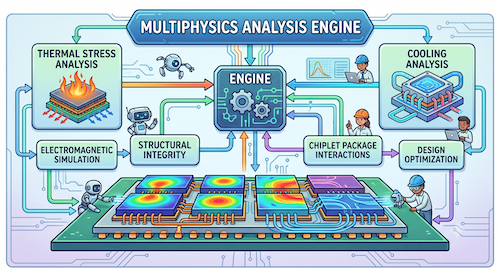
What systems can accomplish by combining semiconductors, AI, and software seems at times boundless. Chiplet-based semiconductors deliver this promise, allowing a myriad of complex digital, memory, analog and photonic functions to be condensed into a single semiconductor package for higher performance, lower power consumption and lower total system cost. Yet we still demand that these systems be reliable, despite challenging physical constraints inevitable in these highly compressed form factors. To meet this need, multiphysics analysis, joint analysis of electrical, thermal, EM, mechanical and power and signal integrity is an essential component of system design. Individual analyses have been important for many years in single-die designs, progressing more recently to coupled evaluations; now chiplet-based systems have amplified the importance of full multiphysics signoff.
The big multi-die consumers
It wasn’t long ago that multi-die designs seemed exotic. Now they have become ubiquitous, perhaps not in low-end consumer electronics but certainly in many leading systems applications. Datacenters are a primary example. An AI system will combine CPUs, GPUs and a high-bandwidth memory (HBM) stack in a single package. GPUs alone are famous power hogs and memory access in such systems is equally demanding. Thermal load generated by this power draw can throttle performance and trigger mechanical failures, die warpage leading to delamination, broken contacts and more. Other concerns are electromigration (causing aging through wear and failure in connections) and power integrity risks resulting in intermittent functional failures.
Electric vehicles (EVs) introduce similar challenges in a very different context. Power switching devices operate at high voltages and high frequencies, with junction temperatures approaching 200oC creating similar thermal challenges. This operation also introduces significant parasitic oscillations and electromagnetic interference which can negatively impact reliability in both drivetrain and body/cabin electronics.
More generally in automotive, multiphysics analyses are essential around electronics throughout the car, compelled by safety requirements. Electronic systems in the drivetrain (EV, hybrid or ICE), body and cabin are held to very high safety standards, in a very hostile environment – high temperatures, vibrations and humidity – requiring even tighter control over physical factors. Modern automotive electronics is required to meet safety standards over 15–20 year lifetimes, significantly longer than expectations for consumer electronics.
The wireless infrastructure (cell-towers) supporting phone calls and all the other clever things we can do over cellular must stretch to 15–20 year lifetimes to justify high capital and maintenance costs. These systems share a mix of challenges with the above examples. Thermal degradation is a big concern, not only thanks to the multiple power amplifiers at radio heads but also in increasingly complex MIMO beam management and added AI functionality. Electromagnetic interference in an obvious concern given the nature of an application simultaneously handling many wireless channels.
Huge industries, driving economic growth worldwide, depend on high-performance, reliability and safety in multi-die systems which can only be assured through robust and efficient multiphysics analysis.
Multiphysics analysis is non-negotiable
Methods to analyze each of these factors standalone are well known: thermal analysis starting from localized heat mapping within a semiconductor together with classical heat diffusion modeling and finite-element methods for cooling (radiative, forced air, liquid); Mechanical behaviors such as warping under heating; Electromagnetic analysis (Maxwell) modeling wave behaviors from sources in complex environments; Signal integrity, power integrity and aging.
But modeling standalone is no longer enough. Thermal profiles are not uniform spatially or in time and affect mechanical, aging and other factors. Electromagnetic interference affects signal integrity and power integrity. Use-cases affect all these factors. The only way to accurately model behavior to ensure device reliability in the intended implementation and across a wide range of use-cases is through full multiphysics analysis, concurrent with design.
Following the acquisition of Ansys, Synopsys has released its first Multiphysics Fusion solutions for chiplets and for Multi-Die Designs. For example, the 3DIC Compiler platform incorporates RedHawk-SC for dynamic power integrity analysis, RedHawk-SC Electrothermal for dynamic thermal analysis, and HFSS-IC for high-frequency electromagnetic simulation, within a unified environment. This integration enables concurrent EMIR, thermal, signal integrity, and electromechanical stress signoff. The full range necessary to ensure reliability in multi-die designs required to deliver long lifetimes.
The benefits aren’t just about guard-banding correct operation over the lifetime of devices. Synopsys’ press release announcing these solutions is supported by quotes from MediaTek, NVIDIA and Samsung indicating up to 3X faster IR-drop-aware STA signoff, while accelerating multiphysics design closure by 10X within individual die and across multi-die designs. Similar improvements apply for analog and photonics components in multi-die systems.
Looks like exactly what we expected from a Synopsys/Ansys merger, advancing systems performance and reliability to the demands of leading-edge multi-die designs. You can read the release HERE, an eBook on the Multiphysics Fusion for Multi-Die Designs HERE and an eBook on optimizing analog design with multiphysics HERE.
Also Read:
Podcast EP351: A Detailed Overview of the Emerging Standards for 400G with Kent Lusted
Customized Foundation IP Enables the Next Generation of Automotive Compute
Share this post via:



Comments
There are no comments yet.
You must register or log in to view/post comments.