





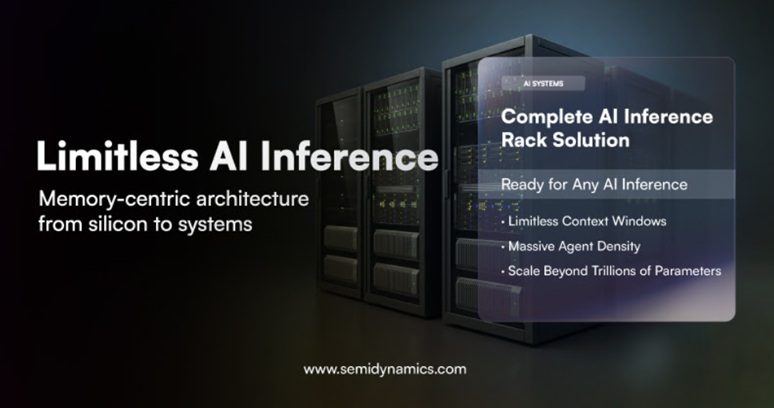
AI inference is quickly becoming the real battleground for next-generation computing. Training still gets the headlines, but inference is where AI becomes a business, a service, and an infrastructure problem. Every chatbot response, agentic workflow, code assistant, scientific model, and enterprise copilot depends on the ability to run large models efficiently, repeatedly, and at scale. That is why Semidynamics’ appearance at ISC High Performance 2026 this week in Hamburg matters.
Semidynamics is bringing a full silicon-to-rack inference stack to the show, positioning itself not merely as a RISC-V IP supplier, but as a systems-level AI infrastructure company. The message is direct: inference performance is no longer defined by peak TOPS alone. It is defined by how much of that compute can actually be used once memory, data movement, latency, model size, and rack-level integration are taken into account.
That distinction is important. Modern AI workloads are increasingly memory-bound. Large language models require massive movement of weights, activations, and KV-cache data. As context windows expand and agentic AI systems maintain longer-running sessions, the memory footprint grows dramatically. A chip can advertise impressive arithmetic throughput, but if the memory subsystem cannot keep the execution units fed, much of that performance remains theoretical. Semidynamics is trying to attack the problem at the architectural level.
The company’s approach starts with RISC-V, but it does not stop at the CPU. Semidynamics has built an “all-in-one” architecture that integrates scalar, vector, and tensor processing more tightly than traditional accelerator approaches. Instead of treating matrix acceleration as a bolt-on block connected through layers of software and data orchestration, Semidynamics is emphasizing programmability, memory efficiency, and tighter coupling across the compute pipeline. Its Gazzillion Misses technology is intended to hide memory latency and keep compute resources active, while its vector and tensor capabilities target the mixed workload profile of real AI inference.
The ISC HPC 2026 story is also about ambition. Semidynamics is talking about 3nm silicon, boards, and liquid-cooled OCP-compliant racks. That is a major shift in posture. The company is not simply selling a core or a block of IP into someone else’s system. It is presenting a full-stack platform aimed at data center inference, from the processor architecture through system packaging and deployment.
Why does this matter? First, AI infrastructure buyers are under pressure to reduce total cost of ownership. Inference is a high-volume workload, and small improvements in utilization, memory efficiency, and power consumption can translate into large economic differences at fleet scale. A memory-centric architecture that improves usable compute could be more valuable than one that simply wins a peak benchmark.
Second, the market needs credible alternatives. The AI hardware ecosystem has been dominated by a small number of large incumbents, and supply, cost, sovereignty, and specialization concerns are pushing customers to look at new architectures. A European RISC-V company showing a complete inference stack at a major HPC event is strategically significant, especially as Europe debates how to participate more directly in the AI compute race.
Third, inference workloads are changing fast. Agentic AI is not just a sequence of isolated prompts. It involves planning, tool use, memory, retrieval, multi-step reasoning, and long-lived sessions. That shifts the bottleneck from raw matrix math toward memory capacity, bandwidth, latency, software flexibility, and system-level orchestration. Semidynamics’ thesis is that the winning architecture for this era will be the one that keeps data close, keeps compute busy, and scales from silicon to rack without excessive overhead.
Bottom line: The company still has to prove itself in silicon, software maturity, ecosystem adoption, and customer deployments. But the direction is notable. At ISC HPC 2026, Semidynamics is making a bigger claim than “RISC-V can do AI.” It is arguing that the next phase of AI inference will be won by architectures designed around memory realities from the start.
That is exactly the conversation HPC needs to have.
Also Read:
Why Europe Needs Its Own AI Supercomputing Platform
Semidynamics Secures a Strategic Investment to Advance Memory-Centric AI Inference Chips
Semidynamics Unveils 3nm AI Inference Silicon and Full-Stack Systems
Share this post via:



Comments
There are no comments yet.
You must register or log in to view/post comments.