


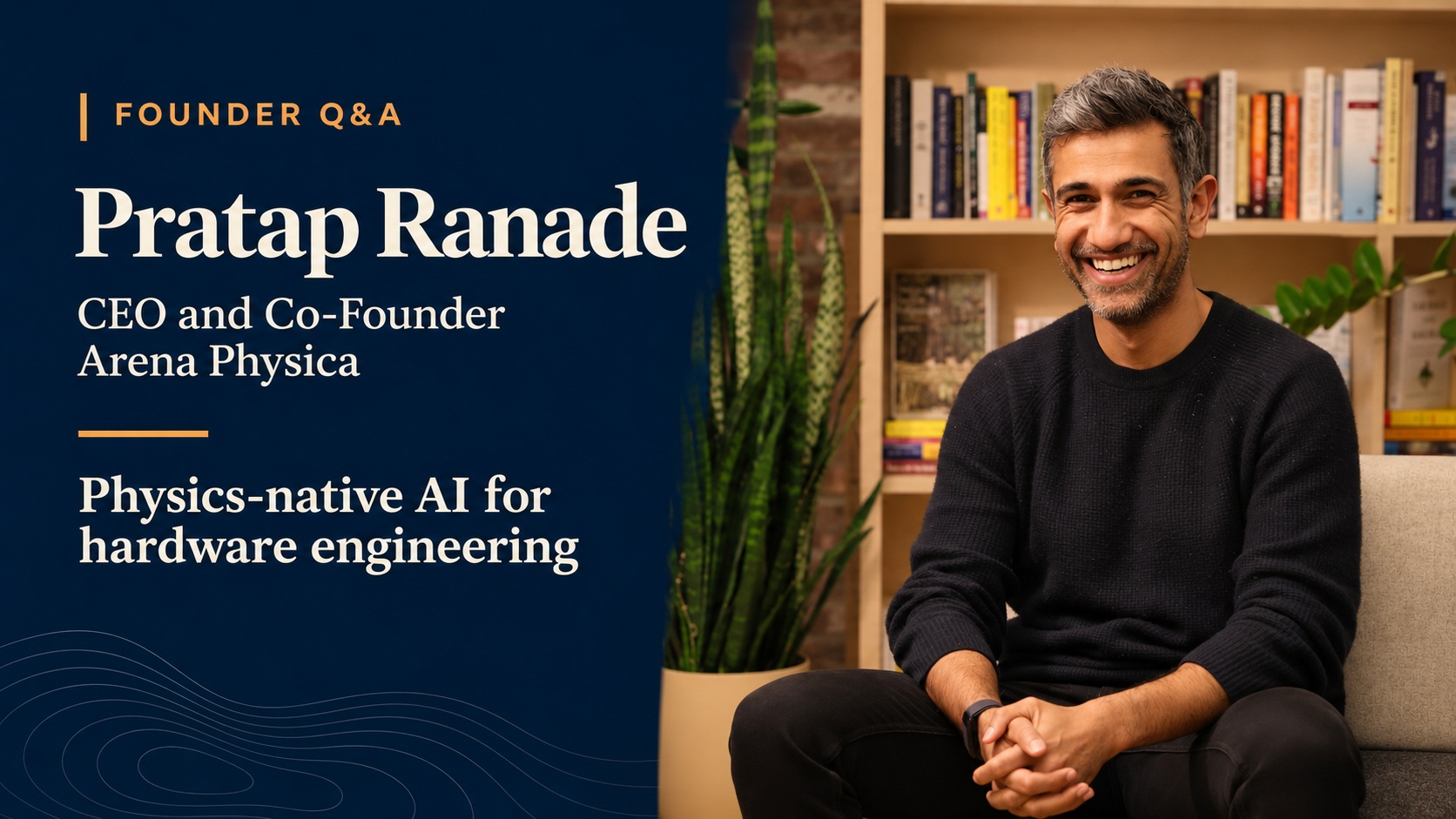




Pratap Ranade is CEO and Co-Founder of Arena Physica. Pratap first trained as a physicist at Stanford and Columbia before joining McKinsey as an Associate Partner advising tech and semiconductor companies. He then founded Kimono Labs, backed by Sam Altman, Peter Thiel and Y-Combinator, which was acquired by Palantir. There, Pratap led Forward Deployed Engineering teams before founding Arena Physica.
Tell us about your company?
Arena Physica is building electromagnetic superintelligence. Our mission is to advance humanity’s rate of hardware innovation, and we build physics-native AI for engineers to design, verify, and optimize frontier hardware. Trusted by the world’s leading hardware institutions, from AMD to Anduril, our 80-plus team includes 10 PhDs, 2 professors, 4 YC founders, and over 280 peer-reviewed publications. We are an artist colony of electrical and RF engineers, physicists, ML researchers, and deep tech operators.
We execute our mission on two fronts: building Heaviside, the world’s first foundation model for EM, and accelerating hardware engineering through Atlas, our agentic harness for hardware engineering. We launched Heaviside-0 and Heaviside-1 earlier this year: trained on electromagnetic fields over text as a primitive, Heaviside represents a new class of intelligence for unlocking superhuman engineering design. Atlas is how we harness this intelligence, alongside other frontier models, to accelerate real engineering workflows.
What problems are you solving?
The first challenge is verification. To learn how a hardware design will behave once it’s built, engineers send its geometry to a full-wave solver, and then wait for hours or even days per run. Simulation is the bottleneck, not human ingenuity or design. Heaviside-1, released this September, is a 350-million-parameter model trained on 250,000 3D field simulations. Given a structure’s geometry, materials, and excitation, it predicts the full 3D field response in milliseconds. That is roughly 100,000x faster than a traditional solver, and within a decibel of commercial accuracy.
The second challenge is fragmentation. Electrical, mechanical, software, and firmware engineering teams work across separate toolchains, siloed from one another. The tools they use are also highly fragmented, spanning multiple, disjointed software and hardware stacks. Atlas builds a deterministic graph across these domains, unifying tribal knowledge and workflows. Atlas is also natively integrated with the tools engineers know and use – from KiCad and Altium to LTSpice and HFSS – to orchestrate, in one loop, across schematic & PCB design, circuit simulation, EM / signal integrity / thermal analysis, mechanical design, and physical lab instruments. The end result: building and closing Hardware REPL, once and for all.
What application areas are your strongest?
Semiconductors are where we started. Since 2023, AMD has used Atlas for Radeon GPU testing and optimization, running tests, and tuning jobs autonomously. In another semiconductor deployment, Atlas ran over a weekend against a farm of newly returned silicon finding a performance-per-watt result beyond what the prior team had reached by hand. Heaviside is now aimed at EM verification for the structures chip teams design today. That includes BGA packaging, SerDes interconnects, signal integrity, and RF and millimeter-wave circuits.
We’re also actively deployed in aerospace and defense, including phased arrays and radar, and in medical devices. What our customers share isn’t an industry: it’s a shared calling to build software-defined hardware at the frontier, in pursuit of our species’ greatest challenges yet. Autonomous flight and sustainment. Life-saving technologies and procedures. We’ve helped our partners cut root-cause analysis time from six hours to thirty minutes, generatively design new specs in ten minutes (versus 23 hours manually), and accelerate time-to-market on their most ambitious projects yet.
What keeps your customers up at night?
The first pain is speed. The build-outs in AI infrastructure and defense put extraordinary demands on hardware teams that were already at their limit. The frontier waits for neither today’s leaders, nor the upstart challengers. Arena Physica and our team of forward deployed engineers and strategists ensure our customers are running at 110% pace, fully embedded to service their needs, resolve critical issues, and plug outstanding gaps.
The second is talent. For the past decade or so, most technical graduates went into software; experienced EE and RF engineers are scarce, which is why we’re so proud to have assembled one of the world’s few colonies of cross-disciplinary, multi-domain engineering and research talent.
The third is trust. The best engineers got where they are by being right, and you can’t move fast and break things when it comes to designing chips, aircraft, and orbital satellites. You cannot vibe-code hardware. Our customers also worry about sensitive IP flowing to a handful of concentrated model providers, and paying for tokens without a clear return. We launched HW-Bench, the world’s first benchmark for hardware engineering, to bring clarity around this exact challenge, and demystify the path to true hardware / software co-design.
What does the competitive landscape look like, and how do you differentiate?
The incumbents in EDA, simulation and test equipment have built legacy tools, and demanding engineers trust them for good reason. We’re not trying to replace them. Our agentic platform works with these tools, in concert with the human-engineer-in-the-loop, and Heaviside is designed to hand off to a full-fidelity solver when a design needs final sign-off. There is a growing cohort of AI-for-engineering startups and general-purpose AI tools, and we differ in three fundamental ways:
Our own data factory. A foundation model for EM needs data that doesn’t exist publicly, so we built it ourselves. Experts seed the designs, we scale them through simulation, and we fabricate and measure the best candidates in our own lab.
All-in-one model, platform, and application. Because we have all three, what we learn in deployments feeds straight back into research, into future deployments, in a virtuous cycle and exponential positive feedback loop.
Engineers forward deployed with customers. Our team has spent years inside our customers’ organizations and stacks, and that is how we earn trust and access to their hardest problems.
What new features/technology are you working on? There are three main efforts we’re most excited about:
The next generation of Heaviside. Heaviside has already reached fully autonomous design of 2.5D RF structures. You specify a target response, such as a 7 GHz bandpass filter, and our model will generate a working geometry. We’re scaling the model and extending it across the spectrum, from RF toward photonics.
HW-Bench. This is the world’s first hardware engineering benchmark, built with founding partners AMD and Anduril. It tests whether AI models can complete real engineering jobs end to end, with the tools engineers actually use, and exhaustively scores them on accuracy, cost, and speed. Software had its AI moment; now it’s hardware’s turn.
How do customers normally engage with your company?
Most enterprise engagements start with one acute problem, such as a component struggling with validation or a failure in production. We first scope it with their engineering team; then, we run a short, focused build called a Protoshop, where our engineers deploy Atlas against the customer’s real data. This leads to a pilot, and then production. Semiconductor teams on Microsoft Discovery can use Heaviside and partners who want to co-design new hardware, Arena Physica Labs works with them from concept to tapeout. We’re introducing even more exciting touchpoints in the upcoming months.
Also Read:
Interview with David Tester VP of Engineering Mach42
CTO Interview with Taylor Barton of Certus Semiconductor
NIST Sets a Clearer Course for tNIST Sets a Clearer Course for the Post-Quantum Security Transitionhe Post-Quantum Security Transition
Share this post via:




The $725 Million Chip Development: Why Execution Risk, Not IP Cost, Now Dictates Advanced-Node Survival