




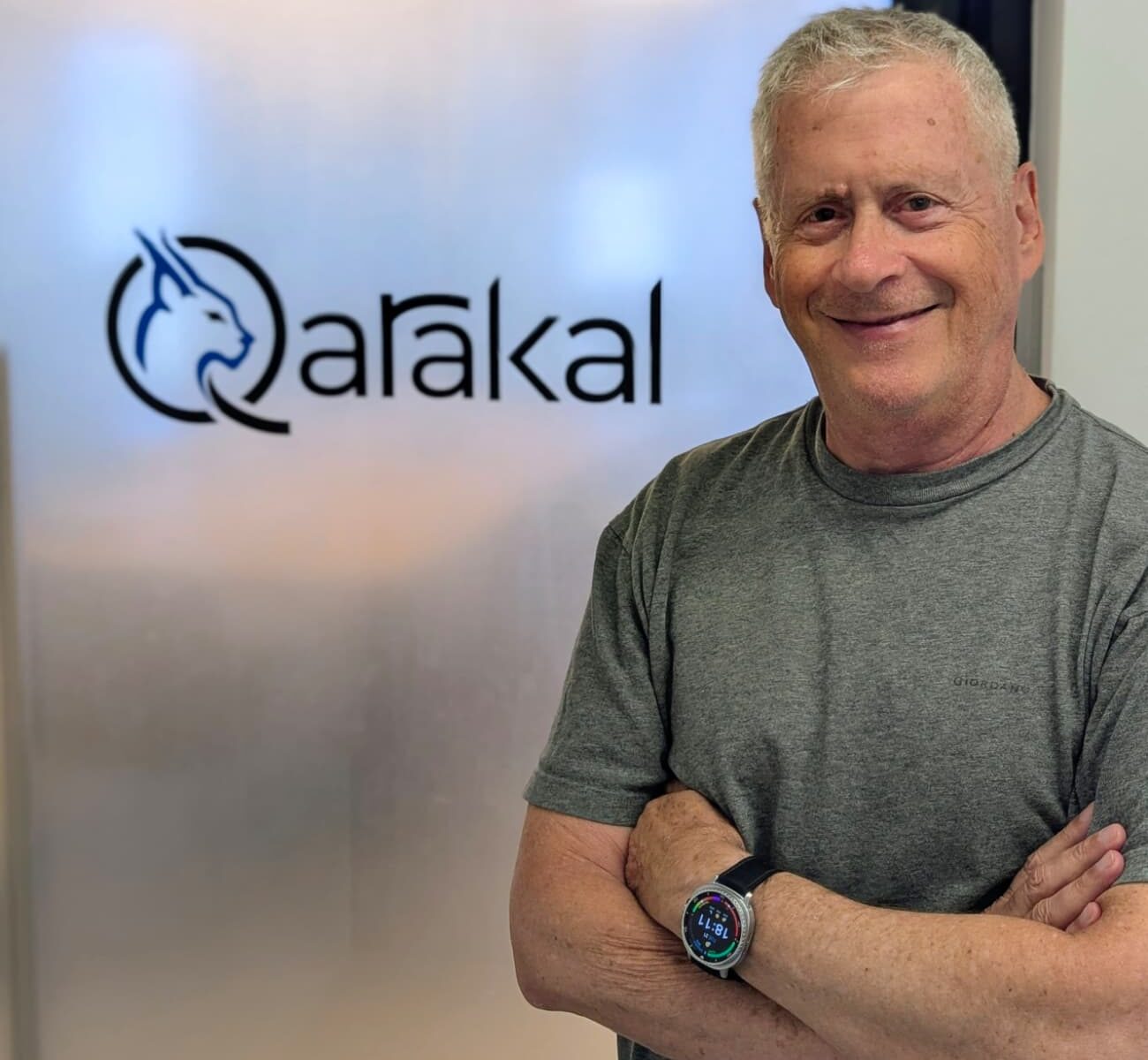



 Nissan Maskil, PhD, is the CEO and co-founder of Qarakal Quantum, established in 2024. Nissan brings 40 years of national technology program experience to Qarakal Quantum, where they’re working to enable researchers and enterprises to run larger and more meaningful quantum computing workloads sooner.
Nissan is a deep-tech builder with a distinguished track record of turning complex R&D into real-world systems. He has led large-scale national programs across cyber, machine learning and quantum technologies. Most recently, Nissan was quantum program manager at Israel Aerospace Industries (IAI)/ELTA Systems. He previously held CTO, VP and other managerial roles at companies and organizations including Logic AGT Naval Department, CONTROP and ELTA Systems. Early in his career, he was co-founder and CEO of Neural MATIC, a startup specializing in neural networks and machine learning.
Tell us about your company.
Qarakal Quantum is building a full-stack, fault-tolerant quantum computer based on superconducting technology.
The quantum industry has largely remained in a Turing-machine mindset: build a QPU, increase the number and quality of its qubits, and demonstrate increasingly complex computations. This is essential research, but it does not by itself produce a scalable computer.
Qarakal is introducing the next architectural step: the transition from a quantum processing unit to a complete quantum-computing system. The historical analogy is the transition from an abstract model of computation to the von Neumann architecture – a practical organization of processing, memory, control and programs that enabled general-purpose computing.
Our system combines quantum processing, control, classical computation, fault tolerance and a quantum operating system within one architecture – Qarakal’s Pangaea architecture. We are not assembling layers around a quantum chip. We are designing and building the complete computer.
What problems are you solving?
Today’s QPUs are not structured as scalable computers.
As monolithic processors grow, their calibration, control, synchronization and error-management requirements become increasingly difficult to coordinate. Complexity can grow faster than useful computational capability. Adding qubits without changing the architecture therefore encounters fundamental system-level limits.
Classical computing did not scale by improving transistors alone. It required an architecture that assigned different roles to processing, memory, control and software.
Quantum computing now needs a comparable transition. Qarakal ‘s quantum bus technology makes this possible.
The quantum bus is designed to mediate interactions between qubits and specialized modules, reducing dependence on direct physical adjacency and unnecessary routing operations compared to conventional approaches. It provides far greater architectural freedom to organize, specialize and scale quantum computing resources.
Why is hardware–software co-design so important?
The history of classical computing shows that foundational software cannot be separated from the machine on which it runs.
C programming language was created in the context of building Unix and was designed with the underlying hardware directly in mind. Operating systems subsequently evolved through continuous optimization of low-level operations such as memory access, scheduling, communication and device control. Linux demonstrates how optimization across the hardware–software boundary can produce a robust and general-purpose system.
Quantum computing requires an even tighter relationship. Physical operations are expensive, imperfect and constrained. Every operation – and every movement or transformation of quantum information – matters.
Qarakal therefore does not treat the operating system as a software layer added after the QPU has been built. The quantum OS and hardware are developed together, with each operation optimized in the context of the complete fault-tolerant system.
Why is quantum error correction an architectural problem?
Classical systems do not use one error-correcting code for every purpose. Communication, short-term memory, long-term storage and high-speed data transfer have different error models and performance requirements. Each uses codes chosen for the required balance of speed, protection, latency, capacity and implementation cost.
We believe the same principle must apply to quantum computing.
A quantum state being stored for a long period does not necessarily require the same code as one undergoing rapid execution. Different operations and system components may require different balances among protection, speed, resource overhead and computational flexibility. Forcing the entire quantum computer into a single code can optimize one objective while imposing unnecessary costs elsewhere.
Qarakal’s Pangaea architecture, enabled by the quantum bus, is our first step toward a quantum system that can combine multiple codes, with each code used for the purpose it handles best. Rather than viewing error correction as a uniform layer applied across a monolithic QPU, Pangaea treats codes as architectural resources.
The operating system coordinates these different regions and their roles within the complete computation. This allows the machine to be organized around the requirements of fault-tolerant execution – not around the assumption that one code must serve every function.
What application areas are your strongest?
We are building a general-purpose quantum computer rather than a machine dedicated to one predefined application.
People do not normally ask what a personal computer is “for.” They use it for anything that can be computed within its available resources. The operating system abstracts the underlying machine and allows users to choose and run applications. We believe a mature quantum computer should operate according to the same principle.
Fault tolerance opens that possibility. Once the system can reliably execute sufficiently long and complex quantum programs, users can choose among the applications enabled by quantum computation without requiring the computer to be redesigned for each application.
What are the major challenges facing the industry?
The challenge is no longer only how to manufacture better qubits. It is how to organize large numbers of imperfect physical components into a reliable, programmable computer.
Fault tolerance is often presented as an error-correction code placed over a QPU or as a target number of logical qubits. We see it as a system problem. Codes, control, decoding, classical feedback, resource management and program execution must work together within demanding timing and resource constraints.
Moreover, fault tolerance should not mean replicating one logical-qubit structure across the entire system. A scalable architecture must assign different resources and codes to different functions and coordinate them efficiently.
What does the competitive landscape look like, and how do you differentiate?
Most quantum-computing companies focus primarily on improving qubits, increasing QPU scale or developing software around existing processors. These efforts are valuable, but they largely preserve the QPU-centric paradigm.
Qarakal is differentiated by its architecture-first approach. Our modular and hierarchical system, linked by a quantum bus, distributes functions across specialized quantum and classical resources. Pangaea extends this principle to quantum error correction by enabling different codes to be used according to their architectural purpose.
The paradigm shift is simple: the industry has been scaling quantum processors; Qarakal is building the quantum computer.
What new features or technologies are you working on?
Our current focus is Pangaea: a modular fault-tolerant architecture designed to combine quantum error-correcting codes within one coordinated system.
We are developing the hardware, control and operating-system capabilities needed to assign codes to different functions, manage interactions between them and optimize execution across the hardware–software boundary. Qarakal overcomes quantum’s scaling limitations, requiring fewer qubits, fewer operations and less noise accumulation, reduced wiring and control complexity, and lower energy consumption.
Pangaea is an initial implementation of our broader architectural vision: a quantum computer composed of specialized resources, each optimized for its purpose, operating together as one programmable system.
How do customers normally engage with your company?
Customers and partners engage with Qarakal at the system level through architectural evaluation, joint technology development, integration programs and strategic collaboration.
As the platform matures, the engagement model becomes familiar: Qarakal delivers the fault-tolerant quantum computer as a complete system, while users and developers choose the applications they want to build and run.
Also Read:
CEO Interview with Sander den Hoedt of Delmic
CEO Interview with Timothy Regan of IN2FAB
CEO Interview with Phillip Stanley-Marbell of Signaloid
Share this post via:



SEMICON West’s Autonomous Fab Vision Needs a Decision-Escalation Design