You are currently viewing SemiWiki as a guest which gives you limited access to the site. To view blog comments and experience other SemiWiki features you must be a registered member. Registration is fast, simple, and absolutely free so please,
join our community today!
WP_Term Object
(
    [term_id] => 178
    [name] => IP
    [slug] => ip
    [term_group] => 0
    [term_taxonomy_id] => 178
    [taxonomy] => category
    [description] => Semiconductor Intellectual Property
    [parent] => 0
    [count] => 2091
    [filter] => raw
    [cat_ID] => 178
    [category_count] => 2091
    [category_description] => Semiconductor Intellectual Property
    [cat_name] => IP
    [category_nicename] => ip
    [category_parent] => 0
    [is_post] =>
)
At the 2026 OIP Ecosystem Forum, the industry narrative shifted from incremental scaling to what TSMC defines as the “Intelligence Revolution.” Akin to the 18th-century Industrial Revolution which transitioned human physical labor to mechanical power, the current era is augmenting human ingenuity through … Read More
Weebit Nano’s FY26 ESG Report shows how sustainability, governance and operational resilience are becoming integrated into the company’s commercialisation of resistive random-access memory (ReRAM). This integration matters because Weebit’s value is not derived from manufacturing and selling finished chips directly.… Read More
Analog Bits is expanding its role in advanced semiconductor design with new intellectual property aimed at one of the industry’s most difficult problems: delivering, monitoring, and managing power inside increasingly complex chips.
The company announced that its IP will be included in an upcoming customer test-chip tapeout… Read More
Charlie Cheng is CEO of TeRAM, with four decades of technology experience focused on microprocessor architecture and semiconductor memory. Before TeRAM, he worked on several AI processors, including multiple generations of Meta’s MTIA accelerators beginning in 2019. Previously, he served as CEO of Kilopass, a semiconductor… Read More
Arm is expanding its computing platform for an era in which artificial intelligence does more than respond to individual prompts. The company expects AI agents to operate continuously across phones, data centers, vehicles, robots and other physical systems—perceiving their surroundings, reasoning about objectives and … Read More
Ceva and LG Electronics have joined forces to remove one of the biggest obstacles to ultra-wideband adoption: integrating a complete radio, baseband and software stack into a production system-on-chip. Their joint platform combines Ceva-Waves UWB baseband intellectual property and software with an RF front end developed… Read More
By Tim Messegee, Senior Director of Solutions Marketing at Rambus
PCI Express (PCIe), PCIe switches, Time Division Multiplexing (TDM), Network Interface Cards (NICs), and SmartNICs are all well-established technologies that have formed the backbone of computing and networking systems for years. More recently, SuperNICs… Read More
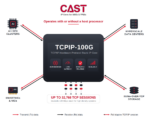
CAST has introduced TCPIP-100G, a synthesizable intellectual-property core that implements a complete TCP/IP stack in hardware for ASICs and FPGAs. The core is designed to transmit and receive at up to 100 Gbps without depending on a host processor. That distinction is important: this is not simply a checksum engine or a network-interface… Read More
The 2026 Ceva Edge Symposium will bring together engineers, technology leaders, ecosystem partners, and innovators to explore a major shift in computing: moving artificial intelligence from distant cloud infrastructure into the devices that interact directly with the physical world. Scheduled for November 2 in Hsinchu,… Read More
As vehicles evolve into software-defined, increasingly autonomous platforms, video processing is becoming part of the safety-critical computing chain. Camera feeds support functions ranging from surround-view monitoring and driver assistance to object detection and automated driving. If the hardware processing those… Read More














The silent killer of analog reliability: Why SPICE misses floating net