





In my 45 years experience in the semiconductor industry, 43 of that in EDA and IP, I have never seen such a meteoric rise of an EDA company. I do remember money being raised for EDA in the early days but never have I seen such a customer success in such a short amount of time.
I first met ChipAgents at DVCon Silicon Valley in 2025. It was an interesting meeting since they had very little chip design experience but a whole lot of University level AI experience. I remember Bernard Murphy and myself shaking our heads after the meeting and wondering where this company would be next year at DVCon.
Needless to say 18 months later ChipAgents has an impressive customer list of companies I was very familiar with, some of which I spoke to. I also know people on their advisory board and these are world class semiconductor professionals. Three of which I know personally so I am speaking from first hand experience.
The meteoric rise continued at #DAC2026, which was the perfect place to announce the next funding round. ChipAgents added $60 million in Series A2 financing, expanding its Series A round to a reported $134 million only six months after the initial close. B Capital led the extension, with participation from existing investors including Bessemer Venture Partners, Micron, MediaTek, Ericsson and ScOp.
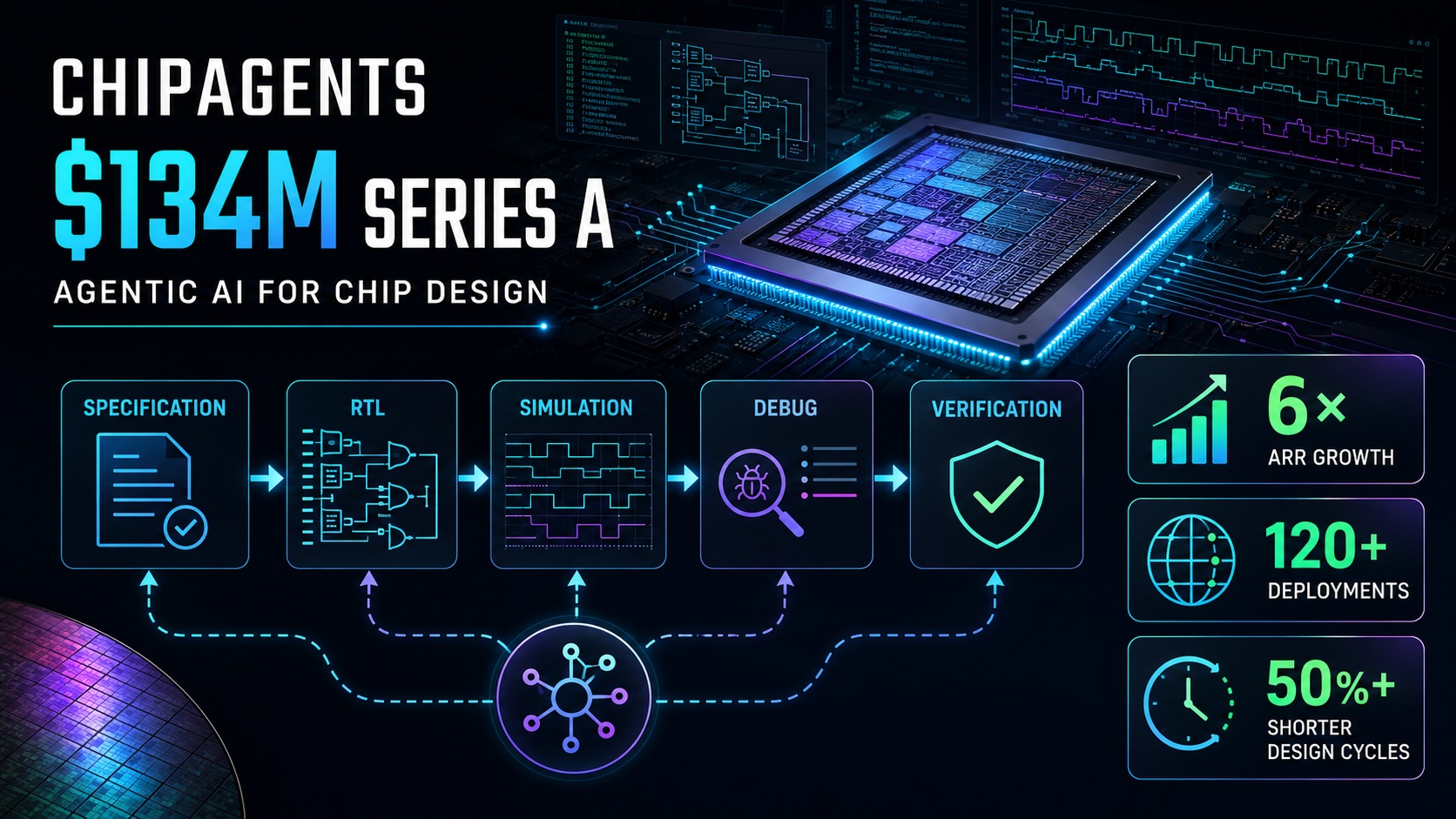
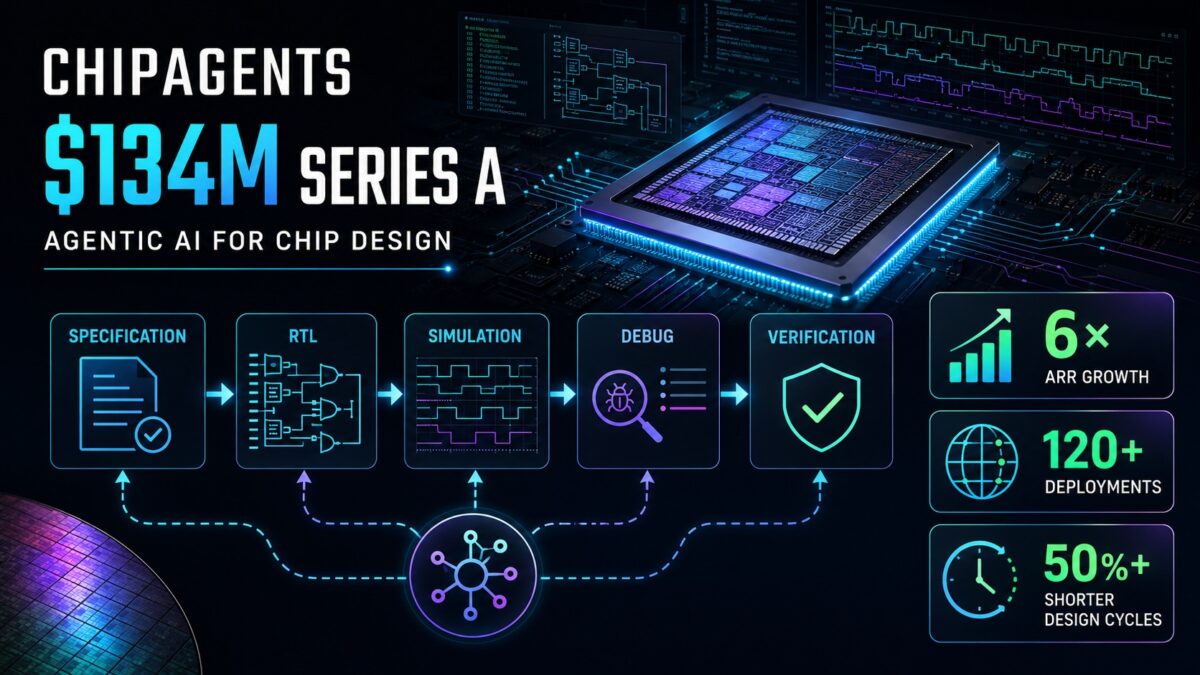
The unusually large early-stage financing follows a claimed sixfold increase in annual recurring revenue during the first half of 2026 and deployment of the company’s platform at more than 120 semiconductor groups at some of the top 10 semiconductor companies. This massive funding separates ChipAgent from the dozen or so other AI EDA companies that exhibited at DAC 2026. It is a very different EDA funding strategy that we have seen and been apart of over the last 40 years. Rather than limit funding in hopes of an early exit, ChipAgents is in it to win it so watch out Synopsys, Cadence and Siemens EDA, absolutely.
The financing matters because semiconductor development is becoming constrained less by transistor manufacturing than by design complexity and engineering capacity. A modern system-on-chip can integrate processor cores, accelerators, interconnects, memory controllers and third-party intellectual property containing billions of transistors. Before tape-out, engineering teams must establish that the register-transfer-level design satisfies its specification across enormous state spaces. They construct testbenches, write assertions, execute simulations, inspect waveforms, analyze coverage and isolate the root causes of failures. Verification can consume more time and engineering effort than the original RTL implementation.
Conventional generative-AI assistants can explain code or suggest a SystemVerilog fragment, but an agentic system is intended to perform a multistep workflow. It may interpret a design specification, inspect RTL and verification collateral, invoke electronic-design-automation tools, examine compiler or simulator output, revise a hypothesis and rerun the relevant test. The important distinction is tool use combined with persistent reasoning: the agent does not merely produce text but operates within an iterative engineering loop.
ChipAgents platform can automate complex design, verification and debugging processes and reduce design cycles by more than 50%. That figure is a company claim rather than an independently standardized benchmark. Nevertheless, the mechanism is credible for selected tasks. Debugging often requires correlating logs, source code, waveforms, assertions and previous failures—an information-intensive process suited to models that can retrieve project context and orchestrate established EDA tools. ChipAgents has separately reported reducing some root-cause investigations from days to 15–60 minutes.
The investment represents a bet on an orchestration layer above the traditional EDA stack. Cadence and Synopsys already apply machine learning to implementation, verification-space optimization and power-performance-area exploration. ChipAgents is entering the market through workflow-level autonomy: connecting engineering intent to existing simulators, formal-verification engines, code repositories and issue systems. Its opportunity is not necessarily to replace sign-off tools, whose deterministic algorithms and qualified flows remain essential, but to reduce the human labor required to configure them, interpret their output and determine the next action.
Strategic participation from Micron and MediaTek is particularly relevant. Semiconductor companies are simultaneously investors, prospective customers and sources of domain feedback. Access to realistic design environments can help ChipAgents improve model behavior around hardware-description languages, verification methodologies and proprietary toolchains. The company is also collaborating with Nvidia on a specialized model for chip design. Domain specialization could be necessary because general-purpose models frequently struggle with cycle-accurate behavior, concurrency, timing semantics and the distinction between synthesizable and simulation-only constructs.
Bottom line: The $134 million round gives ChipAgents resources to expand engineering, customer deployment and product development before the AI EDA market consolidates. More broadly, its commercial momentum suggests that agentic AI is moving from experimental code generation into production semiconductor workflows. If these systems can reliably shorten verification and debug cycles without weakening sign-off discipline, their principal effect will be economic: more design iterations, better utilization of scarce engineers and faster time to tape-out. That could materially lower the cost of developing specialized silicon—and broaden the number of organizations capable of building it.
Also Read:
Rethinking Formal Verification in the AI Era
Whalechip Uses ChipAgents to Compress Root Cause Analysis into Minutes
Share this post via:




Comments
There are no comments yet.
You must register or log in to view/post comments.