RVN! 26 Banner revised (800 x 100 px) (600 x 100 px)

Tower Semi Buyout Tips Intel’s Hand

Tower Semi Buyout Tips Intel’s Hand
by Doug O'Laughlin on 02-17-2022 at 2:00 pm

Tower Semiconductor Fabs 2022

The rationale behind the Tower Semi acquisition and things to watch out for at Intel’s investor day.

Intel bids for Tower Semi
First I have to quote myself because Tower was an error of omission. In November in a piece that was likely too long for its own good, I mentioned that trailing edge fabs are in a huge position of strength and even called out Tower Semi.

A name that I think is worth looking into, but I don’t really have the bandwidth for at this moment, is Tower Semi. It screams like a strategic asset, and all they’ve been doing for the last 10 years is buying lagging-edge fabs. Keep an eye on that, but for now I still think these aren’t as attractive as just metrology companies in Semicap.

First I think it’s funny because semicap has only gone down since then, and Tower Semi of course got a nearly 50% premium bid. So let’s dive a bit deeper into why Tower Semi is such a strategic asset and why Intel is buying them right now. Let’s start with a brief history of Tower Semi.

Tower Semi – The Fab Partner
Tower Semiconductor’s (formerly TowerJazz) history is a storied one. The beginning of Tower starts in 1993 with National Semiconductor’s divestiture of its Israeli fab in Migdal Haemek, Israel. Tower expanded its Israeli footprint with Fab 2 alongside Fab 1 in 2001.

The real transformational deal that made Tower into who they are today was an all-stock merger with Jazz semiconductor in 2008. Jazz semiconductor actually started as a subsidiary of Conexant and was funded by the Carlyle group. Jazz was taken public by a blank check company (SPAC!) and their fab is the Newport Beach fab.

The next big win was a Panasonic JV that enabled Tower to launch 3 Japanese fabs with Panasonic as the main customer and 49% owner. This JV helped Tower offer 65nm CMOS and 300mm technologies for the first time.

In 2016 they acquired another fab with the purchase of Maxim Integrated’s San Antonio fab. This was a way to offload the Maxim fab to transition to a fab-lite model and helped expand production of 200mm wafers for Tower.

Last but not least is the Agrate Italy fab. Tower Semi partnered with STMicroelectronics in 2021 to share the cleanroom of this fab. Tower has 1/3rd of the cleanroom and helps ramp the cleanroom to higher utilization faster.

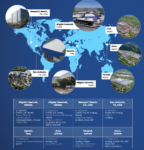
A simplified graphic of their fab footprint is below.

Notice the types of deals Tower pursues, they are primarily JVs. Tower is the fab partner for many larger IDMs, and by acquiring Tower, Intel now has a new customer opportunity given the tight integration of JVs. Panasonic is Tower’s largest customer at ~25% of revenue, but there are 5 additional customers that account for 4-11% of sales. Then a long tail after that. The tail in particular is Intel’s opportunity.

I want to last talk about some of the niche products Tower has. They seem to be the leading Silicon Germanium (SiGe) manufacturer in the world, a specialty process that is useful for RF (radio frequency) front end. Tower is also a leader in silicon photonics fabrication.

In Tower’s own words their biggest drivers are RF CMOS, industrial sensors, RF mobile, and RF Infrastructure (datacom photonics). In particular, some amount of power ICs fabbing capability for Intel makes sense, RF CMOS likely is just nice to have, and RF infrastructure aligns almost directly with Intel’s future ambitions.

Notice the technology, the majority of their capacity is at the 200mm wafer sizing. While these fabs are “specialty” products, their 6-inch and 8-inch power capacity is not particularly special. I would say there is a good mix of leading specialties like the 300mm CMOS and SiGe (Silicon-Germanium), but the 150mm and 200mm power is relatively commoditized capacity. So now let’s discuss why Tower is a good fit for Intel.

Intel Foundry Service’s Jump Start
A reminder that Intel is not letting go of its Fab, but rather amplifying its fab capabilities in its “IDM 2.0” strategy. This is a renewed commitment to fabbing Intel’s own products, as well as opening up their fab and PDK (Process Design Kit) to other companies and customers. The thought here is that they can further leverage their large fab footprint and offer highly desired leading-edge foundry services to their customers in a time when companies desperately want more leading-edge capabilities. But where does Tower fit into that given their mostly lagging edge capacity?

I think Tower completes the fab footprint in a holistic sense. Imagine you want to fab something completely custom at Intel. It’s a whole unit of data center compute not just a CPU, with connected custom fabric, some silicon photonics, and of course, its power-hungry (PMICs).

In the current Intel world you could just get the leading edge chip and packaging, but not the rest of the silicon, photonics, or power IC that composes a total system. Imagine trying to buy a car and only being sold the engine and the ability to attach the engine to a car (packaging), that is the current scope of Intel Foundry Service (IFS).

Tower expands this. Now we have a full-service shop. And it’s no surprise actually if you look at their peer Taiwan Semiconductor, which is known for its leading-edge logic. But a closer look shows that 37% of TSMC’s revenue consists of geometries larger than 28nm. So in the case of TSMC, you can go to them and get the full solution. If IFS is to compete for head to head, they need Tower to complete their full solution.

This was discussed on their M&A call:

This combination of leading edge and specialty technologies will position us as a truly global end-to-end foundry. When we launched IFS last March, our customers were overwhelmingly excited to work with us. One of the things that consistently asked me was to add specialty and mature nodes to our portfolio. With Tower, we can honor that request and more broadly serve key market segments.

You can’t have a compelling IFS without making it full service. But more than that I think one of the biggest benefits is adding a new culture that is actually customer-centric. Some of the past critiques of Intel’s foundry plans were inflexibility and non-standard workflows.

Working with Intel in the past was like showing up at someone else’s garage and being forced to use their wacky tools and blueprints not being given much insight into how things were made. Tower has standard workflows and a more customer-centric fab culture, and this could be a huge kickstart to creating a standard workflow at IFS.

Yes. And while some of this is premature to talk about it too much detail, given the regulatory process, my expectation is that we will fully merge IFS and Tower into a single foundry business for Intel going forward. And part of the value and the synergy of the acquisition as the question suggest, is to fully benefit from that decades of experience that Tower brings and how to run a global foundry customer-centric business for our customers for the future. So overall, we’ll lay out more of that integration strategy as we get to the time of deal closure. But this will become one foundry business that will be the full integration of IFS today with Tower today.

So assuming IFS and Tower are all one unit, I am now warming up to a foundry spin. It was directly in opposition to what Pat Gelsinger has said before, but let’s examine it from the perspective of Gelsinger’s history and what he knows, aka the Dell corporate structure.

Intel Might Spin Foundry Now
I have followed the Dell complex (for lack of better words) at a surface level for a few years now. Michael Dell, the founder of the PC giant Dell, took Dell private in an audacious LBO with Silverlake. Pat Gelsinger worked at one of the subsidiaries at the time, and the subsequent corporate structure is likely familiar to Pat. While I don’t think Pat Gelsinger is going to take the Dell route it’s good to look at the corporate patterns and behaviors he knows best.

For context, Pat Gelsinger joined EMC as COO in 2009 and has watched the entire Dell structure emerge. This included the EMC collapse into Dell and the spinout of VMWare back to public markets. I’m sure he’s well versed in the logic of spin-offs and tracking stocks that were used at Dell. In fact, you can argue that the partial spin of Mobileye looks a lot like something Dell did with Vmware originally. I now think that this is what will happen in some capacity with Intel Foundry Services.

I don’t think this happens immediately because of the huge capital requirements of IFS, but I do think that post Mobileye spin, the promise of an IFS will be a carrot held over investors’ heads. IFS will be a completely separate unit, and now it has a history of financials and some kind of internal structure that it will inherit from Tower. It’s primed to spin.

I think that it will be mentioned as a “strategic option given market conditions” and broken out segment-wise. This will force investors to start to consider Intel as a SOTP valuation first and foremost. I know that this seems like a headache but Pat’s primary focus is likely on the technology side of things, and it’s easy to slip into what he knows corporate structure-wise. Especially when it enriched the Dell CEO so much. And having that potential option is going to be a valuable card to play in my opinion.

Intel would become a quasi holding company in this scenario, with partial stakes in faster-growing businesses (MBLY, IFS) while its core fabless business itself would be likely a slower growth entity that gets to benefit from its partial stakes in these tracking stocks. This sounds frankly the future of Intel. Now let’s move on to what to expect from Investor day.

Subscribe to Fabricated Knowledge

Intel’s Investor Day
I am for one excited for Investor day. Here are a few of the things I expect:

Resegments and new long term models for each segment

An absolute kitchen sinking of FY22 numbers

Guide up revenue marginally

Gross margins sub 52%

Guide down earnings

Some kind of FCF guide

An aggressive Capex plan, possibly matching TSMC

Mobileye discussion, and the hint of spinning IFS eventually

Progress reports on their catch up plan

They will promise performance parity in 2023

I’m almost certain I will be surprised by something they have. I expect some kind of product announcement, and in particular, I would love to hear more about their DPU.

I wanted to make a bingo sheet but didn’t have exactly enough time. I’ll be watching and live-tweeting the whole event on @_fabknowledge_

I will of course be drinking every time Pat says something horny, e.g. “puberty” at Intel, or “lusts” for fabs. But I’m excited about a good show and have to say, I am the most bullish I have been on Intel in a while. I think there is a chance they can really surprise us, and while I know that the FY22 numbers are about to get brought down, I believe that most investors already know this. Everyone knows that, and in recent days every expected miss has been reversed. I expect that to happen at Intel.

Also Read:

The Rising Tide of Semiconductor Cost

How France’s Largest Semiconductor Company Got Stolen in Plain Sight
TSMC Earnings – The Handoff from Mobile to HPC


CEVA Fortrix™ SecureD2D IP: Securing Communications between Heterogeneous Chiplets

CEVA Fortrix™ SecureD2D IP: Securing Communications between Heterogeneous Chiplets
by Kalar Rajendiran on 02-17-2022 at 10:00 am

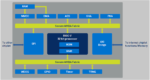
Fortrix Controller Block Diagram

Discussions of chiplets has been on the rise, ever since the slowdown of Moore’s law benefits. Gartner Research projects semiconductor revenue from systems using chiplets to grow from $3.3 billion in 2020, to $50.5 billion in 2024. With any market opportunity, there are always challenges to overcome in order to realize the full potential. The chiplets market opportunity is no exception. Consequentially, a lot of development is happening to successfully support chiplets based design, methodology and integration.

First things first. What are chiplets? Chiplets are the multiple smaller dies we end up with after architecturally disintegrating a large integrated circuit or a SoC. Conceptually a chiplets-based design resembles a Silicon-In-Package (SiP) based design. SiP-based approach was historically adopted primarily for faster time to market by mixing and matching dies of pre-existing chips. And, typically the pre-existing chips are from the same vendor. While the mixing and matching part is true with chiplets too, the full market opportunity lies with heterogenous chiplets integration. Heterogeneous in this context means chiplets from different vendors. This aspect in itself raises lots of concerns with adoption, system security being one of them.

CEVA’s recently announced Fortrix SecureD2D IP addresses the above concern by securing die-to-die communications between chiplets in a heterogeneous SoC (HSoC). CEVA is well known for its technologies in wireless connectivity, smart sensing and sensor fusion, AI & Deep Learning, computer vision and audio processing. The Fortrix IP expands CEVA’s offerings into the system and IP platform space.

Before we diving into the details of the Fortrix IP, there is an interesting story to share about the early origins of this IP.

Over the recent past, the slowdown of Moore’s law benefits has been limiting the adoption of SoCs by the defense sector too. Realizing this, the Department of Defense (DoD) had launched the CHIPS program a few years ago. CHIPS stands for Common Heterogeneous Integration and Intellectual Property Reuse Strategies. The vision for this program was to conceive an ecosystem of discrete, modular, reusable IP which can be assembled into a secure system. For example, with a chiplets implementation, how to ensure die-to-die communications are safe and secure? How to guarantee a secure boot and protect against counterfeit chiplets? How to protect against firmware tampering? With the semiconductor supply chain distributed across the globe, possible breach of security and trust is a real concern. On the successful completion of the CHIPS program, DoD launched the SHIP program. SHIP stands for State-of-the-art Heterogeneous Integration Prototype.

Intrinsix (now a wholly-owned subsidiary of CEVA) customized the Fortrix SecureD2D IP for the SHIP program. If there is one industry that literally lives and breathes security and trust, that would be the defense industry. The Fortrix IP is now available for both commercial and defense oriented applications.  

CEVA Fortrix SecureD2D IP Solution

The CEVA FortrixTM is a hardware/software platform for developing secure chiplet based systems. The Fortrix SecureD2D IP offers secure authentication and firmware boot/code load between chiplets, and ensures system level security in a HSoC. The solution consists of a controller communicating over a secure fabric to hardware-based crypto accelerators. The accelerators support rapid encryption and decryption of functions including ECDSA, SHA2, and AES. The controller is embedded in all the chiplets within the HSoC.

Fortrix Controller Block Diagram

The chiplet containing the system host can be either an ASIC or an FPGA. The firmware for the companion chiplets is stored in a protected area of the host chiplet. A dedicated SPI bus connects the chiplets for establishing a crypto-secure channel. After authentication of the companion chiplet, the encrypted firmware is sent from the host to the companion chiplet. The Fortrix IP platform comes with a low-level API and a sample application for quick and easy customization of the IP.

Refer to the following block diagram to see how the chiplets are integrated within a HSoC.

HSoC Architecture Block Diagram

Benefits of Fortrix IP Platform

  • Protects against various security threats
  • Allows for threat protection expansion as threats evolve
  • Ease of incorporation into a HSoC
  • Efficient Crypto engines are very efficient in terms of compute cycles and power consumption

IP Availability

Fortrix SecureD2D IP is available for licensing today. Deliverables include RTL, SDC constraints, firmware and documentation. Customers desiring integration services can tap into CEVA’s design services offering for a full HSoC design and delivery.

You can read the full press release about the Fortrix IP here. You can learn more about it at the product page.

Also read:

AI at the Edge No Longer Means Dumbed-Down AI

RedCap Will Accelerate 5G for IoT

Ultra-Wide Band Finds New Relevance


Semiconductor Growth Moderating

Semiconductor Growth Moderating
by Bill Jewell on 02-17-2022 at 6:00 am

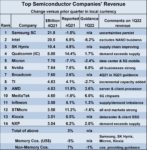
Top Semiconductor Company Revenue 2022

The global semiconductor market in 2021 was $555.9 billion, according to WSTS data released by the Semiconductor Industry Association (SIA). 2021 increased 26.2% from 2020, the largest annual increase since 31.8% in 2010, eleven years ago. We at Semiconductor Intelligence track publicly available semiconductor market forecasts and award a virtual prize for the most accurate forecast for the year. The criteria are a forecast publicly released anytime between November of the prior year and the release of January data from WSTS (generally in early March). The winner for 2021 is Future Horizons with an 18% forecast released in January 2021. Malcolm Penn of Future Horizons is a perennial optimist, usually calling for higher growth rates than other forecasters. For 2021 he was closest to being right. Runner-ups are 14% forecasts by us at Semiconductor Intelligence and by Evercore LSI. Most forecasts for 2021 made prior to March 2021 were in the range of 8% to 14%.

What is the outlook for 2022? Who will win the virtual forecasting prize next year? Recent forecasts for 2022 semiconductor market growth range from 9% from WSTS to 15% from us at Semiconductor Intelligence. Future Horizons is less optimistic for 2022 than for 2021, with a 10% projection based on a downturn beginning in 4Q 2022.

Revenues of the top semiconductor companies were generally strong in 4Q 2021. Non-memory companies grew revenues 7% in 4Q 2021 versus 3Q 2021. The strongest growth was from Qualcomm at 14%, AMD at 12% and STMicroelectronics at 11%. All other non-memory companies had revenue increases ranging from 3% to 8%. The weighted average guidance for 1Q 2022 for the non-memory companies is a 1% decline from 4Q 2021. Excluding Intel, which is expecting a 6% decline, the non-memory companies expect 2% growth in 1Q 2022 versus 4Q 2021. Most companies indicate continuing supply chain problems, with overall demand still exceeding supply.

The memory companies (Samsung, SK Hynix, Micron Technology and Kioxia) collectively had a 5% decline in revenue in 4Q 2021 versus 3Q 2021. SK Hynix and Kioxia had revenue gains while Samsung and Micron had revenue declines. The memory companies generally see strong demand, but shortages of other components are hampering the production of some electronic equipment and the demand for memory in these products.

The first quarter of the year typically shows a revenue decline from the fourth quarter of the prior year. Over the last ten years, 1Q has declined from 0.5% to 15% from 4Q – except for 1Q 2021 which was up 3.8% from 4Q 2020. With many companies guiding growth in revenue in 1Q 2022, the outlook for the year 2022 is healthy. We are projecting 1Q 2022 will be flat to down slightly from 4Q 2021. Growth in 2Q 2022 through 4Q 2022 should be moderately healthy as capacity shortages continue to be worked out. Thus, we at Semiconductor Intelligence feel reasonably confident with our 15% forecast for 2022.

Looking beyond 2022, many factors come into play. Most semiconductor shortages are expected to be resolved by 2023, leading to a more balanced market. Global economies should be back on track by 2023, with either the end of the COVID-19 pandemic or the world learning to manage COVID-19 while maintaining relatively normal economic activity.

The International Monetary Fund (IMF) January forecast calls for 4.4% global GDP growth in 2022. Global GDP grew 5.9% in 2021 in a bounce back from a pandemic driven downturn in 2020. The IMF expects global GDP growth to moderate to 3.8% in 2023 – close to the long-term trend – as economies return to more normal activity. IDC projects smartphones growth will moderate from 5.3% in 2021 to the 3% to 4% range in 2022 to 2024. IDC forecasts PCs will decline 1.1% in 2022 following pandemic-driven boom growth of 14.8% in 2021. PCs are expected to grow in the 1% to 2% range in 2023 to 2024, again close to the long-term trend.

The automotive market has been hard hit by parts shortages in the last year. Statista estimated 2021 light vehicle production growth of 8% in 2021, but growth would have been higher if more parts had been available. Parts shortages should persist into 2022 with some easing by 2023. Statista projects strong growth of 9% in 2022 and 11% in 2023 as automotive suppliers respond to pent-up demand. Growth is pegged at 6% in 2024, returning closer to normal trends

IC-Insights predicts the semiconductor market will return to recent long term growth trends, with a compound annual growth of 7.1% from 2021 to 2026. At Semiconductor Intelligence, we expect 2023 semiconductor market growth in the high single digits – in line with historical trends.

Also Read:

COVID Still Impacting Electronics

2021 Finishing Strong with 2022 Moderating

Semiconductor CapEx too strong?


Podcast EP62: Exploring the VSORA architecture

Podcast EP62: Exploring the VSORA architecture
by Daniel Nenni on 02-16-2022 at 10:00 am

Dan is joined by Jan Pantzar, VP sales and marketing of VSORA, a provider of high-performance silicon intellectual property (IP) and chip solutions for artificial intelligence, digital communications and advanced driver-assistance systems (ADAS) applications based in France.

Dan and Jan explore the VSORA architecture that uniquely combines DSP with machine learning acceleration and high-bandwidth memory-on-chip. Current and future use in applications such as self-driving cars are explored.

https://www.vsora.com/

The views, thoughts, and opinions expressed in these podcasts belong solely to the speaker, and not to the speaker’s employer, organization, committee or any other group or individual.


Dynamic Coherence Verification. Innovation in Verification

Dynamic Coherence Verification. Innovation in Verification
by Bernard Murphy on 02-16-2022 at 6:00 am

Innovation New

We know about formal methods for cache coherence state machines. What sorts of tests are possible using dynamic coherence verification? Paul Cunningham (GM, Verification at Cadence), Raúl Camposano (Silicon Catalyst, entrepreneur, former Synopsys CTO) and I continue our series on research ideas. As always, feedback welcome.

The Innovation

This month’s pick is McVerSi: A Test Generation Framework for Fast Memory Consistency Verification in Simulation. The paper was published in the 2016 IEEE HPCA The authors are from the University of Edinburgh.

This is a slightly dated paper but is well cited in an important area of verification not widely covered. The authors’ goal is to automatically generate tests for multicore systems which will preferentially trigger consistency errors. Their focus is on homogenous designs using Gem5 as the simulator. Modeling is cycle accurate; in similar work CPU models may be fast/virtual and coherent network/caches and pipelines are modeled in RTL running on an emulator.

The method generates tests as software threads, one per CPU, each a sequence of loads, modifies, stores and barrier instructions. Initial generation is random. Tests aim to find races between threads where values differ between iterations, i.e. exhibit non-determinism. The authors argue that such cases are more likely to trigger consistency errors.

The authors then use genetic programming to combine such non-deterministic test components from sequences. From these they build new sequences to strengthen the likelihood of races which are likely to fail consistency tests. Where they find inconsistencies, they run a check to classify these as valid or invalid per the memory consistency model. They have a mechanism to measure coverage to guide the genetic algorithm and to determine when they should stop testing.

The authors describe bugs that such a system should find in a cache coherent network and their method performs well. The authors note limitations of formal methods to early and significantly abstracted models. In contrast this method is suitable for full system dynamic coherence verification.

Paul’s view

Memory consistency verification is hard, especially in pre-silicon. But it is a very important topic that we find increasingly center stage in our discussions with many customers.

The heart of this paper is a genetic algorithm for mutating randomized CPU instruction tests to make them have more and more race conditions on memory writes and reads. The authors achieve this using a clever scoring system to rank memory addresses based on how many read or write race conditions there are on that address in a given test. Read or write instructions on addresses scoring high (which they call “racey”) are targeted by the genetic algorithm for splicing and recombination with other tests to “evolve” more and more racey tests. It’s a neat idea, and it really works, which is probably why this paper is so well cited!

The authors benchmark their algorithm on a popular open-source architecture simulator, Gem5, using the Ruby memory subsystem and GARNET interconnect fabric. They are able to identify two previously unreported corner case bugs in Gem5, and also show that their clever scoring system is necessary to create tests racy enough to catch these previously unreported bugs. Also, the authors show that their algorithm is able to find all other previously reported bugs much faster than other methods.

Overall, I found this a thought-provoking paper with a lot of detail. I had to read it a few times to fully appreciate the depth of its contributions, but it was worth it!

Raúl’s view

Our October 2021 article, RTLCheck: Verifying the Memory Consistency of RTL Designs addressed memory consistency by generating assertions and then checking them. This is a different approach which modifies the well-known constrained random test pattern generation by generating the tests using a genetic algorithm with a particularly clever “selective crossover”.

They run experiments for the x86-64 ISA running Linux across 8 cores. The cores they model as simple out-of-order processors, with L1 and L2 caches. Tests run in 512MB of memory with either 1KB or 8KB of address range. Each test runs 10 times. Three experiments run: pseudo randomly generated tests, genetic without selective crossover, and genetic with selective crossover. The evaluation detected 11 bugs, 9 already known and 2 newly discovered. Within 24 hours only the full algorithm (at 8KB) finds all 11 bugs, the other approaches find 5-9 bugs. The full algorithm also beats other approaches in terms of coverage for MESI and TSO-CC (cache-coherence protocols). However this is by a small margin.

The paper is highly instructive although a challenging read unless you’re an expert in MCM. The authors provide their software in GitHub, which no doubt encouraged subsequent papers which cite this work 😀. Given enough expertise, this is certainly one arrow in the quiver to tackle full system memory consistency verification!

My view

As Raúl says, this is a challenging read. I have trimmed out many important details such as memory range and stride. Also I skipped runtime optimization, simply to keep this short summary easily digestible. Methods like this have an objective to automatically concentrate coherency suspects in a relatively bounded testplan. I believe this will be essential to dynamic coherence verification methods to catch  long-cycle coherence problems.

Also read:

How System Companies are Re-shaping the Requirements for EDA

2021 Retrospective. Innovation in Verification

Methodology for Aging-Aware Static Timing Analysis


Intel buys Tower – Best way to become foundry is to buy one

Intel buys Tower – Best way to become foundry is to buy one
by Robert Maire on 02-15-2022 at 10:00 am

Intel Tower Semiconductor Acquisition

-Intel jumpstarts foundry model with Tower semi buy @$54B Gets complementary tech to round out offerings
-Approval based on satisfying China’s needs as well
-Margin concerns overblown- Will it be allowed to flourish?

Intel pays up to get foundry and technology….

Intel announced a $5.4B acquisition of Tower Semiconductor in Israel. This amounts to $53 per share for a company whose last trade was $33 per share or a whopping 60% premium.

Intel is getting a very well run company that has been a foundry for a long time as well as technology that it currently does not offer that will add to a broader foundry offering other than just bulk CMOS.

In addition the company gets more China business as well as military business both of which are needed to support Intel’s strategic direction. In essence this deal covers multiple birds with one stone which likely accounts for the premium.

Margin concern is overblown and wrong way to look at it

On the conference call a number of analysts seemed to be negative on the acquisition due to Towers lower margins. Most any company acquired by Intel is going to have lower margins and being a smaller player of older technology in the land of giant TSMC is not easy on margins.

We don’t think Intel is buying the business for its margins or financials or as a “bolt on” but obviously for its current positioning as a foundry with complementary technology to Intel. If Tower can help Intel’s core become a more competent foundry than that is more than worth the acquisition price alone.

Will Intel let it succeed?

The main reason Intel previously failed in the foundry business was that the upstart foundry group was smothered by the larger IDM corporate mentality. The current foundry effort is relatively weak as Randhir Thakur has never run a foundry or anything close. Our hope is that the management of Tower becomes the more dominant partner rather than being suppressed. In this way Intel can try to get what it paid for… expertise.

Corporate antibodies are strong in this one and Pat Gelsinger may have to take steps to make it so.

We like Tower and its management

We view Tower as a tough, smart, scrappy company in the model of many other Israeli companies. It has been cobbled together over the years out of a string of deals and acquisitions for little to no money that has followed a much different model.

We have known the CEO, Russell Ellwanger since his days at Applied Materials and think he has done a great job. If Tower’s mentality and methods can be set loose in a much larger company with large resources they might get a lot done.

A limited commodity

There aren’t that many foundries in the world that Intel could buy that would potentially make a difference and make sense.

We view Tower as a somewhat smaller but better, and more profitable version of Global Foundries. Global was cobbled together through a number of acquisitions and stumbled badly in mainstream CMOS and is now also trying to avoid the big dogs (like TSMC) by doing “specialty” silicon. AbuDhabi poured a ton of money into GloFo which is barely break even where Tower was more of a bootstrap operation that is solidly profitable. We think that Intel might have been interested in GloFo until its IPO priced it out of that possibility (but Intel could get a second chance)

Could China have been in the mix?

We would certainly have not been surprised if China was taking a hard look at Tower. China has been sniffing around a number Israeli based technology companies because of its concern about being cut off from US technology as well as CFIUS restrictions on foreign investment/acquisition which makes Israeli acquisitions much easier.

The very high premium could also be signs of a behind the scenes bidding war or wishing to avoid someone else (like China) coming in to outbid Intel after the deal was announced.

Technology is needed and complementary

The technology side should be a no brainer for Intel….just let it run and don’t screw with it. Most of the processes that Tower runs harken back to Gelsingers earlier stint at Intel and most of those Intel people took the buy out long ago, so Tower knows the tech better than Intel does.
Intel can likely help with some older equipment and fabs it has lying around and Tower could easily contribute to equipment reuse. Tower could likely get a ton of benefit from what Intel has written off.

The stock

While we view this deal very positively and a step in the right direction, it has to be approved first, which will likely take at least a full year and then be integrated (or not).

For Intel we think its a great trade to sell off the crummy memory business and get a foundry business in trade…it just makes sense.

We don’t see this as a reason however to run out and buy the stock of Intel as the impact will take years but we do see it supporting the longer term strategy.
We will likely hear more at Intel’s investor day this Thursday… In the presentation “Goliath buys David”.

About Semiconductor Advisors LLC
Semiconductor Advisors is an RIA (a Registered Investment Advisor),
specializing in technology companies with particular emphasis on semiconductor and semiconductor equipment companies.
We have been covering the space longer and been involved with more transactions than any other financial professional in the space.
We provide research, consulting and advisory services on strategic and financial matters to both industry participants as well as investors.
We offer expert, intelligent, balanced research and advice. Our opinions are very direct and honest and offer an unbiased view as compared to other sources.


About Semiwatch
Semiconductor Advisors provides this subscription based research newsletter, Semiwatch, about the semiconductor and semiconductor equipment industries. We also provide custom research and expert consulting services for both investors and industry participants on a wide range of topics from financial to technology and tactical to strategic projects. Please contact us for these services as well as for a subscription to Semiwatch.

Also read:

The Intel Foundry Ecosystem Explained

Intel Embraces the RISC-V Ecosystem: Implications as the Other Shoe Drops

The Semiconductor Ecosystem Explained


The Intel Foundry Ecosystem Explained

The Intel Foundry Ecosystem Explained
by Daniel Nenni on 02-15-2022 at 5:00 am

Intel Tower Semiconductor Acquisition

Exciting times for the semiconductor industry! Last week Intel announced a billion dollar fund to build a foundry ecosystem and today Intel announced they are acquiring foundry Tower Semiconductor for $5.6 billion dollars, WOW! Some people doubted Intel’s commitment to the foundry market this time. I think we can now put that to rest. Intel is in the foundry business, period.

First let’s talk about the billion dollar ecosystem investment:

How It Works: As a key part of its IDM 2.0 strategy, Intel recently established IFS to help meet the growing global demand for advanced semiconductor manufacturing. In addition to providing leading-edge packaging and process technology and committed capacity in the U.S. and Europe, IFS is positioned to offer the foundry industry’s broadest portfolio of differentiated IP, including all of the leading ISAs.

A robust ecosystem is critical to helping foundry customers bring their designs to life using IFS technologies. The new innovation fund was created to strengthen the ecosystem in three ways:

  • Equity investments in disruptive startups.
  • Strategic investments to accelerate partner scale-up.
  • Ecosystem investments to develop disruptive capabilities supporting IFS customers.

Who’s Involved: The IFS Accelerator features innovative partner companies across each of the three pillars of the program:

  • EDA Alliance: Ansys, Cadence, Siemens EDA, Synopsys
  • IP Alliance: Alphawave, Analog Bits, Andes, Arm, Cadence, eMemory, M31, SiFive, Silicon Creations, Synopsys, Vidatronic
  • Design Services Alliance: Capgemini, Tech Mahindra, Wipro

Richard  Wawrzyniak did a nice explanation of the RISC-V investment (Intel Embraces the RISC-V Ecosystem: Implications as the Other Shoe Drops) so let’s continue with the EDA, IP, and Design Services sections.

EDA is an easy one for Intel as they are the biggest consumer of EDA tools. In fact, Intel is one of Synopsys’ largest customers, if not THE largest. And since Synopsys is also the largest IP vendor this relationship is critical. So, EDA is important but not a big challenge since Intel is already tight with the EDA community.

IP is a similar situation for Intel. There are already relationships with the commercial IP vendors through the TSMC based business. Remember, Intel historically uses TSMC for 20% of their production soon to be increased to more than 50% with N3 so there is a lot of TSMC based commercial IP floating around Intel already. Opening that up to Intel specific processes should not be a hard thing to do and that is where the billion dollars is going, to get that IP silicon proven on Intel processes and packaged up for foundry customers. According to the IP ecosystem, they are already gearing up to port military grade IP to Intel processes.

The big weakness I saw in the announcement is the Design Services Partners. Design services plays an important role inside the foundry ecosystem. I had once suggested that Intel buy a big ASIC company to closely partner with like TSMC and GUC, UMC and Faraday, or SMIC and VeriSilicon.

Of course, now that Intel is buying Tower Semiconductor for $5.6B that disrupts the ecosystem quite a bit:

Tower’s expertise in specialty technologies, such as radio frequency (RF), power, silicon-germanium (SiGe) and industrial sensors, extensive IP and electronic design automation (EDA) partnerships, and established foundry footprint will provide broad coverage to both Intel and Tower’s customers globally. Tower serves high-growth markets such as mobile, automotive and power. Tower operates a geographically complementary foundry presence with facilities in the U.S. and Asia serving fabless companies as well as IDMs and offers more than 2 million wafer starts per year of capacity – including growth opportunities in Texas, Israel, Italy and Japan. Tower also brings a foundry-first customer approach with an industry-leading customer support portal and IP storefront, as well as design services and capabilities.

What isn’t mentioned is military embedded systems. Tower is perfectly positioned for US military aerospace and defense contracts and I can assure you that is part of the Intel strategy. Jazz Semiconductor, formerly Rockwell, is a key part of this transaction, More leverage for CHIPs Act money, absolutely.

Jazz Semiconductor Trusted Foundry (JSTF), a wholly owned subsidiary of Tower Semiconductor Newport Beach, Inc., was created and accredited as a Category 1A Trusted Supplier by the United States Department of Defense’s (DoD’s) Defense Microelectronics Activity (DMEA) as a manufacturer of semiconductors that may be used in trusted applications. In addition, as of October 2014, JSTF has been accredited with Category 1B.

JSTF joins a small list of companies accredited by the DoD Trusted Program, established to ensure the integrity of the people and processes used to deliver national security critical microelectronic components, and administered by the DoD’s Defense Microelectronics Activity (DMEA). JSTF is proud to join the DoD Trusted Program to enable trusted access to a broad range of on-shore technologies and manufacturing capabilities.

The Intel investor call is getting ready to start. I will add more thoughts in the comments section.

Also read:

Intel Discusses Scaling Innovations at IEDM

Intel Architecture Day – Part 1: CPUs

Intel Architecture Day – Part 2: GPUs, IPUs, XeSS, OpenAPI


Intel Embraces the RISC-V Ecosystem: Implications as the Other Shoe Drops

Intel Embraces the RISC-V Ecosystem: Implications as the Other Shoe Drops
by Richard Wawrzyniak on 02-14-2022 at 6:00 am

Intel Foundry Ecosystem

On Monday, February 7, 2022, Intel Foundry Services (IFS), made a series of major announcements regarding the RISC-V architecture and ecosystem:

  • Intel will be joining the RISC-V International association with a Premier Membership, and Bob Brennan, Vice President of Customer Solutions Engineering for Intel Foundry Services, will be joining both the RISC-V Board of Directors and Technical Steering Committee.
  • Intel has created a $1B strategic innovation investment fund as a collaboration between Intel’s venture capital group and IFS to support established companies and the slew of early-stage start-ups that are looking to create disruptive technologies and to foster further build-out of the RISC-V architecture and ecosystem.
  • IFS launched Accelerator, a foundry ecosystem alliance with three specific areas of focus:
    • The IFS Accelerator – EDA Alliance includes: Ansys, Cadence, Siemens EDA and Synopsys.
    • The Accelerator – IP Alliance includes IP vendors as well as SoC silicon vendors, chiplet vendors, board vendors and accelerator manufacturers.  RISC-V vendor members include Andes Technology and SiFive.  Other partners in the IP Alliance: include AwaveIP, Analog Bits, Arm, Cadence, eMemory, M31, Silicon Creations, Synopsys and Vidatronic.
    • The Accelerator – Design Services Alliance includes design service providers as well as cloud service providers, and the three partners are Capgemini, Tech Mahindra and Wipro.
  • Finally, Intel announced that IFS is working with several cloud providers to develop an open chiplet platform for creating products with multiple types of computing processor modules aboard.

All these announcements taken together indicate just how serious Intel is in restarting their silicon foundry business and their intent to become a major player. Intel was already supporting the x86 and Arm architectures, but the addition of RISC-V indicates a serious commitment to the silicon foundry customer base and a desire to be open to new innovations going forward. In fact, Intel has already developed a RISC-V CPU as a soft processor for use in its FPGA product lines. The Nios V is based on RISC-V; the RV32IA architecture is designed for performance, with atomic extensions, 5-stage pipeline, and AXI4 interfaces. However, the current set of announcements go far beyond this soft CPU offering.

Intel’s support in these announcements of the RISC-V architecture and its evolving ecosystem further validates RISC-V as a viable counter to Arm CPUs in the marketplace and adds even more credibility to the growing momentum behind RISC-V.

The creation of an open chiplet platform is especially notable since it could mean platforms using x86, Arm and RISC-V processors all in the same product. This would be very interesting to many companies looking to accelerate their product introductions and also reduce development costs. A standard created around this concept would go far in influencing future production commitments from prospective customers looking for foundry capacity and wafer starts. Since Intel would be responsible for developing such a standard, they would likely figure prominently in the decisions reached on where to engage such technologies.

The four RISC-V IP vendors partnering with IFS – Andes Technology, Esperanto Technology, SiFive and Ventana Micro Systems – are all poised to benefit from this announcement. Their IP will be used by future IFS customers to optimize RISC-V CPU cores, chiplets and packaged products. In addition, they would likely gain access to Intel foundry capacity for their own silicon products at advanced nodes at some future point, although the current announcement does not discuss this.

All in all, this series of announcements, adding 16 founding companies to the IFS Alliance, paint a picture of a company – Intel – that is looking to establish a serious presence in the silicon foundry business, to once again be not only a market leader (they are currently #2 behind Samsung in the 2021 revenue rankings), but to also resume their position as a thought leader in our industry. This is reminiscent of the Intel from the 1980s and 90s when Intel was driving the industry with new products and concepts. Truthfully, much of this was initially driven by the rise of the PC market and then later the rise of the internet, but there was no shortage of innovative ideas and concepts.

Today, the semiconductor market is long past being solely driven by the PC market and the internet, but new horizons beckon with AI, 5G, IoT, IIoT and automotive all poised to become the new drivers of our industry. Intel seems poised to assume a leadership position once again, and their recent commitments in terms of new fabs and capital expenditures underline these commitments. Adding support for the emerging RISC-V architecture and ecosystem back up these commitments in a very meaningful way!

However, there are other areas of the semiconductor market that are impacted by these announcements beyond the silicon foundry market.

Implications and Possibilities

The EDA Market

IFS named several EDA vendors to their Accelerator EDA Alliance – Ansys, Cadence, Siemens EDA and Synopsys. Each of these companies has a range of design tools that can be applied to silicon designs using the RISC-V architecture. Semico expects these companies will see an increased usage for their tools now that Intel is seeking new customers for its foundry services.

An added benefit to these companies is having early access to process and advanced IC packaging roadmaps, process design kits (PDKs) and technical training. This allows the EDA vendors’ R&D teams to fine-tune EDA tools and IP for the Intel portfolio of process and packaging technologies so customers can meet power, performance and area requirements.

SoC Design

SoC designs are growing around 5% – 6% per year – and this in an environment where wafer starts are constrained due to high demand. With Intel’s signal of investing in several new fabs over the next few years, and with TSMC and Samsung also committing to higher capex expenditures over the short term, Semico believes the industry can expect to see more companies undertake new design activity. Although design starts are not tied directly to wafer capacity, it does help to have a reasonable expectation that your just-completed design will find a home at one of the leading silicon foundries and have a hope of being produced in a reasonable timeframe!

The SoC Market

Creation of an open standard around a chiplet platform that embodies heterogenous CPU architectures offers the possibility of establishing new criteria for performance and flexibility in SoC silicon solutions. The emerging chiplet market already has a great deal of interest in it and momentum behind it, and the commitment to drive its evolution further will create even more support for it.

The SIP Market

More designs and more SoC silicon mean more IP being created and licensed. The chiplet phenomena is going to be one of the main drivers of the growth in this market in the coming years. With any SoC solution, IP is used in its creation, and chiplets will be no exception. As we have seen previously, designs that start out small will grow in performance and complexity over time due to evolving market requirements, requiring even more IP to accomplish. The prospect of heterogenous CPU designs based on the chiplet standard and platform Intel is looking to create could enable another uptick in IP market growth and revenue generation. Increasing complexity and performance levels usually mean more IP usage and the IP market is well-positioned to deliver on those requirements.

RISC-V International

We would be remiss if we didn’t also mention the great job the RISC-V International association has done in shepherding and guiding the organization to this point. By their steady guidance, they have enabled a new CPU architecture to take center stage in an amazingly short period of time. Their leadership should be commended for its vision and service to the semiconductor industry. Good job everyone!

The Other Shoe

“Synchronicity – describes circumstances that appear meaningfully related yet lack a causal connection.” C.G Jung.  Or, nothing ever happens in a vacuum!

On Tuesday, February 8, 2022, Softbank and NVIDIA officially terminated their agreement for  NVIDIA to acquire Arm. Softbank will revisit the plan to IPO Arm as a US-headquartered company set to occur sometime within their 2023 fiscal year, ending March 31, 2023.

Simon Segars has stepped down as Arm CEO and will be replaced by Rene Haas, who will oversee Arm’s IPO. Segars will “support the leadership transition in an advisory role for Arm.”

In the initial deal execution of the Purchase Agreement between SoftBank and NVIDIA, NVIDIA paid Softbank a total of $2.0B. Here is a direct quote from SoftBank’s 2021 annual report.

“Upon the execution of the Purchase Agreement on September 13, 2020, SBGC and Arm received cash totaling $2.0 billion. Of this amount, $1.25 billion was received as a deposit for part of the consideration in the Transaction (refundable to NVIDIA subject to certain conditions until the closing of the Transaction, after which such amount will become non-refundable) and $0.75 billion was received by Arm as consideration for a license agreement that Arm and NVIDIA entered into concurrently with the execution of the Purchase Agreement.”

Arm-NVIDIA acquisition, SoftBank 2021 Annual Report, page 78

The official ending of the purchase agreement is a recognition of the regulatory headwinds that were aligned against the deal and signal it is time to move to the next phase of this story – the successful IPO of Arm as an independent entity once again.

In this context, the ‘other shoe’ refers to the Intel announcements and now the Softbank-NVIDIA announcement in conjunction with each other. As far as I can see, no one has yet commented on these two events taken together. While coincidences do happen, I suspect many people will take these two events as being tied together; they very well may be, although they don’t appear to be on the surface.

Could Intel have orchestrated these announcements at this time to take advantage of the difficulties being encountered by Arm and NVIDIA? It is possible, but unlikely. The deal was either going to gain approval or not based on its own merits, and the timing of these announcements, while very interesting, is probably not connected to the approval process.

Arm–NVIDIA

Now that the acquisition is officially terminated, what is next for Arm and NVIDIA? Arm has received the $750M from NVIDIA presumably to account for licensing all of Arm’s IP in a long-term licensing arrangement and to partially offset the costs of collaboration before the two companies became one. Now that this is no longer happening, what are the likely next steps for both?

  • One of the arguments Arm put forth in favor of approval was the thought that if Softbank tried to pursue an IPO for Arm, Softbank would not be able to attain the desired revenue from the IPO.
  • Arm would not be able to attract the level of investment they feel is necessary to fund their future R&D efforts as an independent company.

While both these statements may be true to a degree, it seems highly unlikely that an IPO of Arm would not generate a reasonable amount of revenue. Would this be enough to satisfy Softbank? They did originally acquire Arm for $32B and would definitely want to recoup at least that sum again. The question is: can they?

Arm is the largest IP vendor today by far, and one could assume that any IPO would take that into account. Both the SoC market and the IP market are growing nicely, and as outlined above, the Intel chiplet initiative will likely add to that growth. It is likely that Softbank would garner a reasonable amount of cash from the IPO—although probably not the $32B+ they are looking for—and they could take the rest in stock in the new company. Over the long term, this would provide them the amount of money they think Arm is worth—it would just take longer than Softbank would want.

Is it unlikely that Arm, in its IPO, would not be able to generate adequate amounts of capital to fund their R&D efforts? This is more problematic. When Arm was a standalone company, they did have this problem to some degree. But that was several years ago, when Wall Street was not as in tune with the SoC, IP and AI markets as it is today. Things have changed with the rise of AI, which Arm is at the heart of with their Neoverse CPU architecture. They now have a competitor who is about to become more capable with new investments to its ecosystem. Arm will have its work cut out for it, but the company is still the market leader by a wide margin!

With the termination of the acquisition, NVIDIA’s efforts to commercialize their IP into licensable form using ARM’s expertise is going to be more difficult, but not impossible. Their efforts to move their GPU architecture SIP into SoC silicon and obtain access to some of the markets Arm serves needs to be intelligently orchestrated and managed.

Can NVIDIA still successfully commercialize its GPU as licensable IP? It is hard to believe they will be unable to do so. They could always commission Arm to do the commercialization and not need to pay $40B+ for the privilege. They already have a very tight partnership with Arm. Why not give them another $1B–$2B to complete the task if NVIDIA truly believes this is a must-have for their business going forward? It will be more difficult now, but still mostly doable.

This brings up an interesting point: Arm and NVIDIA have been working on this collaboration for approximately 18 months—how close were they to completed? Even if not fully finished, now that the deal is over, some of the IP being worked on must be close to completion even if it still needs some work. What happens to that IP? I’m sure they can’t simply abandon it – too much money and time invested. Once it is finally completed, we could see a cross-licensing deal between the two companies which would still get the NVIDIA IP into the market with some sort of revenue sharing arrangement. After all, one of the reasons NVIDIA wanted Arm was also to gain their marketing prowess and contacts to market the IP. That can still be done, but as a partnership, not as an acquisition.

It is likely that a larger loss to NVIDIA would be the lack of access to Arm’s markets—the ones that NVIDIA cannot access today. NVIDIA was looking for Arm’s expertise to take the NVIDIA GPU architecture and pare the power requirements down to something more palatable to use in the mobile market. This is probably still possible, but needs to be carefully done. Not every application requires hundreds of GPU cores, and a judicious scaling of the architecture will probably yield results that will fit into most applications as IP. Also, now that Arm and NVIDIA will remain separate companies, and NVIDIA does not absolutely need to exclusively use Arm, the door is partially open to them using one of the RISC-V CPU cores that are coming onto the market. At the end of the day, its all about fitting the right solution to the right application and a RISC-V CPU core might be one of those solutions in the future.

Conclusions

With these announcements, Intel has acted both strategically and tactically:

  • Strategically, in aiding and empowering a competing architecture to Arm
  • Tactically, in lining up 16 companies to support its foundry initiative

Intel satisfied many needs all at one time and have adroitly given themselves momentum for reentrance into the silicon foundry market. Now they need to execute on this vision. Given how they have handled the process so far, Semico thinks it likely they can do so!

Also read:

The Intel Foundry Ecosystem Explained

The Rising Tide of Semiconductor Cost

Podcast EP61: A deep dive on Intel and semiconductors with Stacy Rasgon


The Rising Tide of Semiconductor Cost

The Rising Tide of Semiconductor Cost
by Doug O'Laughlin on 02-13-2022 at 6:00 am

Moores Law Slowing Down

It Isn’t Transistory

There’s a quiet upheaval happening in the semiconductor industry. The rules that have always governed the industry are fraying, undoing assumptions that we took for granted, that was pounded into us in school. The irreproachable Moore’s Law, that exponential progress will make things cheaper, better, and faster over time, is dead.

People are starting to appreciate that making a chip is not easy. Shortages and the geopolitical concentration of TSMC and ASML have awakened the popular imagination and have highlighted the science-fiction-like process of chipmaking. The road ahead has obstacles that aren’t widely appreciated. Making a semiconductor is going to get even harder, more expensive, and more technical. In other words, the challenges are going to accelerate.

To operate in the future, chipmakers will need more scale, more talent, and more money. I’ve written about this before, but I want to dive deeper into what’s driving the rising costs of making a semiconductor. It affects the entire range of chips, from the most advanced chips to the most basic. The trend is not new, it’s already been happening, but I believe now it will start to pick up speed. And the price increases will likely impact every person on earth. This inflationary cost is not transitory.

To understand how we got here, I want to first refresh you on the death of Moore’s Law. We’ve topped out the growth in transistor-energy scaling, frequency scaling, and we’re starting to hit the end of multi-core scaling in transistor-density increases. But more important than the end of those trends, cost scaling has ended. While we continue to improve transistor density through new techniques, each one layers additional costs.

ASML, in its investor day, made a bold statement that Moore’s Law will continue with system-level scaling. Another name for this is advanced packaging. But these costs are additive to the already escalating costs of making a smaller transistor.

While I believe Advanced Packaging is going to solve the transistor-density problem, I don’t believe it will make chips cheaper. In fact, transistors per dollar have gotten more expensive since the early 2010s.

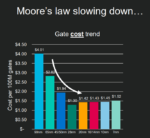
I want to focus not just on the technological headwinds, but the cost headwinds. One of the major historical assumptions of Moore’s Law is that not only would your transistors double every two years, but the cost of the transistors would decline. No longer. The chart below is from Marvell’s 2020 investor day. The bar for 28nm was approximately 2011-2012.

What’s interesting is that a qualitative change happened around 28nm, as it was one of the last planar nodes. Planar in plain language is a two-dimensional surface (plane), while FinFET – the technology that replaced planar – introduced a “fin” into the transistor to jut upwards, creating a 3D structure instead of a 2D structure. We are now on the verge of yet another gate transition – gate-all-around (GAA), which is an even more 3D-intensive structure. As we switch to GAA or the next iteration of gate technology, I believe that the cost increases per 100m gates will continue to increase, just like they did for FinFET over planar. This is driven by the increased complexity of making these chips — namely, the added number of steps in manufacturing.

It isn’t just this transition that’s pushing costs higher. The lagging edge — older chips — is starting to get more expensive, too. The story here is not technological, but rather economic, and what was once ample capacity with commodity-like returns is starting to become in-demand. Businesses are not willing to add capacity unless subsequent price increases follow. This is another key driver, not just on the most advanced but in the older chips as well.

Finally, not just old chips and new chips, but the companies that make the chips (semiconductor fabs) are becoming more consolidated and more strategic. There really isn’t a lot of room at the leading edge, where the most advanced chips are made. This is the third driver of semiconductor costs, that fabs that offer a one-of-a-kind product are passing their rising costs on to customers. TSMC is not a price-taker, and the world is reliant on its products. Despite the increasing costs, they’re are starting to extract larger profits. Fabless companies have no choice but to pay more.

Each of these themes deserves a deeper dive. I’ll start first with my favorite topic: Semicap – or the tools that are required to make a chip.

Industry Consensus: Semicap Cost Intensity Will Go Up

One of the universal themes this earnings season was the higher cost of tools to make semiconductors. The real warning shot was this slide that Tokyo Electron presented at its investor day.

The drastic price increase is broad-based and is across DRAM, NAND, and Logic. Given that 5nm is in production today, this is not a prediction, but a trend that’s going to continue. The primary driver is not only the rising costs of tools such as EUV, but the rising number of steps to make a chip. Below is a graphic that shows the increase of steps over time.

It’s just not Tokyo Electron making the call for higher intensity alone. This most recent earnings season, TSMC, Lam Research, KLAC, and other Semicap companies called out rising intensity. I think all else being equal, the cost of 100K wafer starts should start to rise low- to mid-single digits per chip at the leading edge. Another way to look at this is from the top-down perspective. I compared the total capacity shipped in Million Square Inches (MSI) and compared this to wafer-fab equipment growth. Think of this as total volume versus the spending to make more wafers.

Excuse the 5-year averages, the numbers year to year are much bumpier. The workbook is attached at the end of this post, by the way.

The relationship used to be that spending on new fab equipment under paced the expansion of MSI, as each tool purchased would give more capacity. I want to highlight that if you squint, you can see that the relationship of WFE and MSI seemed to have flipped somewhere around 2012. This coincides with the 28nm node or the crucial node where cost increases started. Going forward I think that we should expect WFE to increase faster than historical averages.

From 2012 to 2020, MSI increased at a compound annual growth rate of 3.6%, and WFE increased at a compound annual growth rate of 8.0%. This is roughly double capacity additions. If demand for semiconductor devices continues to increase, then MSI should grow faster, and thus WFE at a higher multiplier. I am unsure if WFE’s relationship holds at 2x of MSI growth, but it should be a multiplier higher – say, 1.5x-2x MSI. That’s acceleration compared to its historical rate, and what’s driving that is the demand for semiconductors and the technological headwinds we’re facing.

I want to move now to another trend that got called out repeatedly this last earnings season that frankly surprised me but is surprisingly logical: old chips are more expensive.

Old Chips Cost More

It’s not just the newest, fastest, and most expensive chips that are costing more because of technological problems. The most interesting trend recently is that old chips are starting to drive price increases. The recent inflection in Automotive semiconductors is driving demand, not for the latest and greatest, but older and more mature technologies. The problem is that there never has been meaningful capacity added for older technologies, and most of the time fabs would just become “hand-me-downs” as the leading edge pushed forward and the fab equipment would continue to be used and depreciated. Using fully depreciated fab equipment meaningfully lowered the cost to make a semiconductor, especially after 10+ years.

That’s been an important aspect of pricing. A fab being maintained without much incremental capital, yet still producing chips, is what has driven down the price of older chips so much over time. Often there would even be improvements in yield, which further lowered costs. The thinking went that a leading-edge chip that cost hundreds of dollars in 2000 would cost pennies in 2021 because the fab would be fully depreciated.

But there’s a problem with that. We have a situation that’s never happened before. Historically, demand was clustered toward the leading edge. Today, we have demanded at the lagging edge, too. In fact, the demand for older chips is starting to rise sharply. This is driven by automotive and IoT production, as most of these applications are older, more mature technologies, which have better yield, cost, and, importantly, reliability. And even though demand has spiked, no capacity has been added. It’s very rare to add to lagging-edge production.

Up until very recently, there was ample capacity at the lagging edge. It would have been unheard of to add capacity to the lagging edge. A fab was considered “full” if it was running at 80%. Now, trailing-edge fabs are running at close to 100%. Something must change.

This is one of the drivers of the automotive semiconductor shortage: higher demand and no supply or incentives to add more supply. Most semiconductor firms and fabs are obsessed with the leading edge because they can make higher profits. Now firms are waking up to maintaining the lagging edge. The “old” chips are becoming just as important as new chips, and to add capacity, firms had to start making large capital additions again.

There are obvious pricing problems in this scenario. With a new fab, a company can’t turn a profit selling a lagging-edge chip at the price that was previously dictated by a fully depreciated fab. Prices have to go up. This dynamic was discussed by Silicon Lab’s CEO last quarter:

just in terms of the cost increases and the durability of that, I think that we are going into kind of a new phase of the semiconductor industry, where we’ve got Moore’s Law and advanced nodes becoming more and more expensive and you’ve got mainstream technology now full. And it used to be that the digital guys would move out and the N minus 1, N minus 2, N minus 3 nodes would be fully depreciated fabs that you would move into. We have now reached a point where the mix, the ratio between advanced and mainstream is causing fabs TSMC and others to build new mainstream technology, and that means that those fabs are not fully depreciated. So a large element of the cost increases that the industry is seeing right now is because of the additional CapEx that’s having to be put in to build new capacity across the nodes, not just at the advanced nodes, but across.

And so if you look at the cost increases that we’re seeing in other — it’s across the industry, there is a certain element of that, that’s durable over time. And so this is a step function in terms of the cost structure of the industry to match the demand that we’re seeing and the increasing content of electronics throughout the economy and the acceleration of demand that we’ve seen through the pandemic has really pushed that forward and driven us into the supply constraints. We’ll work through that, but to work through that is requiring a lot of CapEx, and that’s got to be recouped. And that’s got to flow upstream from our suppliers to us, to our customers and that’s what you’re seeing right now.

What’s great is that this wasn’t a single company saying this in a vacuum. On Semi, NXP Semiconductors, Microchip, and other “mainstream” or lagging-edge semiconductor companies affirmed that this is going to continue because demand at the lagging edge is higher than supply. This is completely new territory for the industry, and not only a confirmation of the strategic importance of semiconductors, but a confirmation of the broad-based demand. There is really only one solution — adding capacity — but fabs are uncertain they could make a profit adding greenfield lagging edge without raising prices. In turn, they’re concerned about the demand for these “new” lagging-edge chips.

It’s a standoff. Fabs and semiconductor companies are uncertain that this will last, but Auto OEMs and the like seem to have insatiable demand. For a fab, it’s hard to change your behavior in one year against a trend that has lasted decades. Even harder is to go through those difficult changes and expect customers to accept higher prices. UMC put it well in its Q2 2021 call:

But for any greenfield capacity expansion, for the mature node, you are competing with a fully — most likely, you’re going to be competing with a fully depreciated capacity. Unless the demand is significantly important to the customer, but the economics — if the economics stay the same, it will be very difficult to have a justified ROI. However, if the customer is willing to face those challenges together with us, we will definitely explore those opportunities.

Put differently, pay up or continue the shortage. And given that the lead times aren’t really improving, I think that paying up marginally will be the outcome. There has to be some kind of compromise here, and right now it’s coming in the form of non-cancelable, non-returnable orders (NCNR). Fabs are not going to expand trailing-edge capacity unless their customers truly commit to orders that cannot be canceled or returned. It’s uncertain how much double ordering is going on, but NCNRs are a pretty strong commitment to adding long-lived demand.

While the addition of capacity should eventually smooth out price increases over time, this will take multiple years, especially if the demand from automotive and IoT devices continues. I don’t think that prices will rise forever in lagging edge, but I think that we should expect the relationship of historical price decreases to not be as large as they used to be. Lastly, that leaves me with the 800-pound gorilla — Taiwan Semiconductor Manufacturing Company.

TSMC Is Not Lowering Its Prices

Tool prices for leading-edge products are increasing, and this should hurt the margins of TSMC and other leading-edge fabs. While we can gross margin contraction at Intel, this is more a function of company-specific investment to catch up to TSMC. But at TSMC, the exact opposite is happening. TSMC is convinced that it can improve its margin with smaller nodes. The company reiterated this multiple times on its calls, and given TSMC’s one-of-a-kind product, the higher gross margin is very justified. The reality is that TSMC is not a price-taker, but a price-setter. The primary reason: It has a stranglehold on all leading-edge manufacturing.

100% of sub-10nm logic in the world was made at TSMC in 2019. It’s likely that Samsung has caught up, but in terms of the leading edge, it’s just TSMC leading the pack. Given the concentration of fabrication power at TSMC, customers really don’t have another option. If a fabless company wants to sell its latest and greatest chips at a higher margin, they must go to TSMC. Meanwhile, TSMC’s gross margin has slowly drifted higher over the years.

Despite intense CapEx increases which flow through to the Cost of Goods sold as Depreciation, their gross margin is still high and the company believes it will stay that way.

TSMC put it this way on its most recent call and given its absolutely staggering outright capital expenditures, I believe it’s justified:

Even as we shoulder a greater burden of the investment for the industry, by taking such actions, we believe we can achieve a proper return that enables us to invest to support our customers’ growth and deliver long-term profitable growth with 50% and higher gross margin for our shareholders.

Right now in order to shoulder the higher CapEx burden, the company is passing on prices meaningfully. It recently hiked chip prices by 20%, and it can and will raise prices more if the continued cost of making an advanced semiconductor continues. Until the situation changes, there’s no other meaningful competition in town. If Samsung and Intel get their act together in foundry, maybe they will be willing to take lower gross margins, but until then it’s TSMC’s world we’re living in. It’s going to raise prices on the back of higher capital costs.

The Price of a Semiconductor is Rising and It’s Not Transitory

Each of these factors on its own would be a tailwind to rising prices. Together, it’s a certainty that prices are going to rise from here. Between more steps leading to higher tool costs, the declining economic benefit of Moore’s Law, and lagging-edge capacity problems, I believe that the historical cost declines we have seen in semiconductors will start to slow. In some places, I believe the price increases in the trailing edge will be here to stay. Before you go wild with inflation speculation, I want to reiterate that semiconductors are only a ~$530 billion industry or half of a percent of global GDP. This is not going to cause rampant inflation everywhere.

The demand side of the equation doesn’t seem to be slowing in the slightest. The higher demand is coming from the highest number of verticals, with PC, Mobile, Data center, Automotive, and IoT each as a credible and large growing end market. Certain applications are more compute-intensive going forward, such as machine learning. As software ate everything in our lives, silicon made the meal possible. All this is happening as Moore’s Law is screeching to a halt. In simple terms: higher demand + lower supply improvements = price goes up.

I’m going to dive into who I think benefits in the paid-only section. Thanks for reading this far.

Become a paying subscriber of Fabricated Knowledge to get access to this post and other subscriber-only content. Subscribe

Also read:

Podcast EP61: A deep dive on Intel and semiconductors with Stacy Rasgon

Podcast EP61: A deep dive on Intel and semiconductors with Stacy Rasgon
by Daniel Nenni on 02-11-2022 at 10:00 am

Dan is again joined by  Stacy Rasgon, Managing Director and Senior Analyst, U.S. Semiconductors at Bernstein Research. Stacy is an unusual semiconductor analyst as he holds a Ph.D. in chemical engineering from MIT. His substantial technical knowledge allows for a deep dive on Intel and other semiconductor topics that you will find refreshing and quite interesting.

Podcast EP12: A Close Look at Intel with Stacy Rasgon

The views, thoughts, and opinions expressed in these podcasts belong solely to the speaker, and not to the speaker’s employer, organization, committee or any other group or individual.