




Very recently, I was seeing intense discussions on the need for agile hardware development just like agile software and ideas were being sought from experts as well as individuals. While in software world it has already evolved, in hardware world it’s yet to see the shift in paradigm. My point is that the end goal of agile hardware… Read More

Tag: uvm
Design & EDA Collaboration Advances Mixed-Signal Verification through VCS AMS
Last week it was a rare opportunity for me to attend a webinar where an SoC design house, a leading IP provider and a leading EDA tool provider joined together to present on how the tool capabilities are being used for advanced mixed-signal simulation of large designs, faster with accuracy. It’s always been a struggle to combine design… Read More
Vlang – Opportunities Galore for Productivity & Performance
Yes, verification technologies are open to innovation for improved productivity and performance in the face of ever growing SoC/IP design sizes and complexities. There is not much scope left in processor speed to improve, other than multi-core processors in servers which again need software properly architected to be thread-able… Read More
Analog Model Equivalence Checking Accelerates SoC Verification
In the race to reduce verification time for ever growing sizes of SoCs, various techniques are being adopted at different levels in the design chain, functional verification being of utmost priority. In an analog-digital mixed design, which is the case with most of the SoCs, the Spice simulation of analog components is the limiting… Read More
Then, Python walked in for verification

Go ahead – type “open source” into the SemiWiki search box. Lots of recent articles on the IoT, not so many on EDA tools. Change takes a while. It has only been about five years since the Big Three plus Aldec sat down at the same table to work on UVM. Since then, Aldec has also gotten behind OS-VVM, and is now linked to a relatively new open… Read More
Accelerating SoC Verification Through HLS
Once upon a time there was a struggle for verification completion of semiconductor designs at gate level. Today, beyond imagination, there is a struggle to verify a design with billions of gates at the RTL level which may never complete. The designs are large SoCs with complex architectures and several constraints of area, performance,… Read More
So Easy To Learn VIP Integration into UVM Environment

It goes without saying that VIPs really play a Very Important Part in SoC verification today. It has created a significant semiconductor market segment in the fabless world of SoC and IP design & verification. In order to meet the aggressive time-to-market for IPs and SoCs, it’s imperative that readymade VIPs which are proven… Read More
Now even I can spot bad UVM

Most programmers can read a code snippet and spot errors, given enough hours in the day, sufficient caffeine, and the right lens prescription. As lines of code run rampant, with more unfamiliar third-party code in the mix, interprocedural and data flow issues become more important – and harder to spot.
Verification IP particularly… Read More
Effective Verification Coverage through UVM & MDV

In the current semiconductor design landscape, the design size and complexity of SoCs has grown to large extent with stable tools and technologies that can take care of integrating several IPs together. With that mammoth growth in designs, verification flows are evolving continuously to tackle the verification challenges … Read More
SoC Verification Closure Pushes New Paradigms
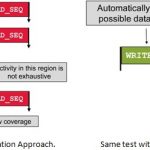
In the current decade of SoCs, semiconductor design size and complexity has grown by unprecedented scale in terms of gate density, number of IPs, memory blocks, analog and digital content and so on; and yet expected to increase further by many folds. Given that level of design, it’s imperative that SoC verification challenge has… Read More