You are currently viewing SemiWiki as a guest which gives you limited access to the site. To view blog comments and experience other SemiWiki features you must be a registered member. Registration is fast, simple, and absolutely free so please,
join our community today!
The term von Neumann bottleneck is used to denote the issue with the efficiency of the architecture that separates computational resources from data memory. The transfer of data from memory to the CPU contributes substantially to the latency, and dissipates a significant percentage of the overall energy associated with … Read More
Resistive RAM (ReRAM) technology has emerged as an attractive alternative to embedded flash memory storage at advanced nodes. Indeed, multiple foundries are offering ReRAM IP arrays at 40nm nodes, and below.
ReRAM has very attractive characteristics, with one significant limitation:
- nonvolatile
- long retention time
- extremely
…
Read More
“AI is the new electricity.”, according to Andrew Ng, Professor at Stanford University. The potential applications for machine learning classification are vast. Yet, current ML inference techniques are limited by the high power dissipation associated with traditional architectures. The figure below highlights the … Read More
Our friends at Threshold Systems have a new class that may be of interest to you. It’s an updated version of the Advanced CMOS Technology class held last May. As part of the previous class we did a five part series on The Evolution of the Extension Implant which you can see on the Threshold Systems SemiWiki landing page HERE. And… Read More
Non-volatile memory (NVM) is finding new roles in datacenters, not currently so much in “cold storage” as a replacement for hard disk drives, but definitely in “warm storage”. Warm storage applications target an increasing number of functions requiring access to databases with much lower latency than is possible through paths… Read More
ReRAM Revisitedby Bernard Murphy on 11-06-2019 at 6:00 amCategories: AI, IP
I met with Sylvain Dubois (VP BizDev and Marketing of Crossbar) at TechCon to get an update on his views on ReRAM technology. I’m really not a semiconductor process guy so I’m sure I’m slower than the experts to revelations in this area. But I do care about applications so I hope I can add an app spin on the topic, also Sylvain’s views on… Read More
Tuesday July 9th was the first day the show floor was open at Semicon. The following is a summary of some announcements I attended and general observations.
AMAT Announcement
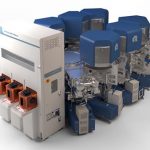
My day started with an Applied Materials (AMAT) briefing for press and analysts where they announced “the most sophisticated system they have ever released”.… Read More
Last week, TSMC held their 23rd annual technical symposium in Santa Clara. In the Fall, TSMC conducts the OIP updates from EDA/IP partners and customers. The theme of the Spring symposium is solely on TSMC’s technology development status and the future roadmap. Indirectly, the presentations also provide insight into … Read More
Each year the Sunday before IEDM two short courses are offered. This year I attended Memory Technologies for Future Systems held on Sunday, December 6[SUP]th[/SUP]. I have been to several of these short courses over the years and they are a great way to keep up to date on the latest technology.… Read More
In previous posts, we discussed the growing set of challenges and threats faced by the semiconductor industry. From saturating & stagnant systems markets to the gears starting to seize up in that engine of growth we’ve been calling Moore’s Law, chip revenues are – with the exception of memory price boosts from supply… Read More