





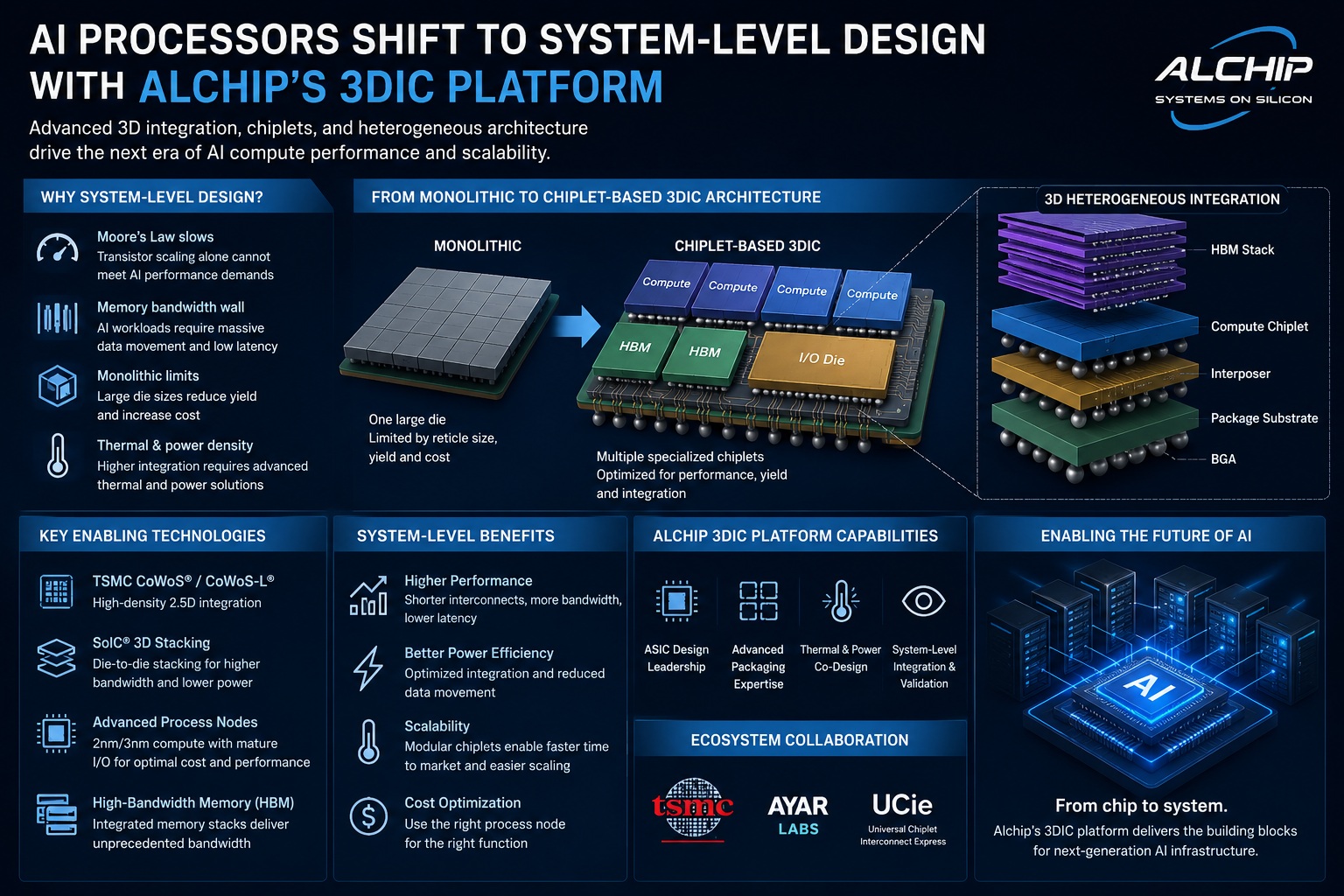
Artificial intelligence processors are entering a new era. For more than two decades, semiconductor innovation was driven primarily by transistor scaling and process node shrinks. Today, however, AI infrastructure demands are growing faster than traditional Moore’s Law improvements can sustain. The industry is now shifting from chip-centric optimization toward full system-level design, where compute, memory, interconnect, packaging, thermal management, and power delivery are engineered together as a unified architecture.
This transition is particularly visible in the rise of advanced packaging and chiplet-based integration. Companies developing AI accelerators increasingly rely on heterogeneous integration technologies such as 2.5D and 3D integrated circuits (3DICs) to overcome the physical and economic limits of monolithic silicon. Alchip Technologies has emerged as one of the key ASIC providers enabling this transition through its advanced 3DIC platform targeting hyperscale AI and high-performance computing (HPC) applications.
The challenge facing AI chip developers is no longer simply building faster compute engines. Large language models, generative AI systems, and hyperscale inference workloads require enormous memory bandwidth, low-latency communication, and scalable interconnect architectures. Traditional monolithic dies have become increasingly difficult to manufacture economically because reticle limits constrain die size while advanced nodes significantly reduce yield as chips grow larger.
The semiconductor industry’s answer has been chiplet architecture. Instead of building one massive processor, designers partition functionality into multiple smaller dies optimized for different tasks and manufacturing nodes. Compute chiplets may use advanced 3nm or future 2nm technologies, while I/O dies and controllers can remain on mature process nodes to reduce cost and improve yield. These chiplets are then integrated within a single package using advanced interconnect technologies.
Alchip’s 3DIC platform reflects this broader architectural transformation. The company combines advanced ASIC design with TSMC packaging technologies such as CoWoS and SoIC to create scalable AI processor subsystems rather than standalone chips. According to Alchip, a typical AI configuration may include multiple compute chiplets, HBM memory stacks, and separate I/O dies integrated into a unified package capable of supporting multi-kilowatt power levels.
This shift toward system-level integration is essential because memory bandwidth has become one of the primary bottlenecks in AI computing. Modern AI accelerators require rapid movement of data between processors and high-bandwidth memory (HBM). Traditional packaging technologies cannot efficiently deliver the required interconnect density or energy efficiency. Advanced 2.5D and 3D packaging architectures solve this problem by dramatically shortening communication distances between dies and enabling thousands of parallel connections.
Industry analysts increasingly view packaging technology as strategically important as transistor scaling itself. CoWoS packaging has become central to nearly all leading AI accelerators, creating intense demand across the semiconductor supply chain. Alchip’s expertise in CoWoS integration and manufacturing management therefore positions the company within one of the fastest-growing segments of AI semiconductor infrastructure.
Another important trend driving system-level design is thermal management. AI systems are now reaching unprecedented power densities. As more compute elements and HBM stacks are integrated into single packages, heat dissipation becomes a first-order architectural problem. This requires co-design across silicon, packaging, substrate engineering, and cooling systems.
Alchip’s 2nm platform demonstrates how future AI processors will increasingly rely on heterogeneous integration. The platform supports combining 2nm compute dies with 3nm or 5nm I/O chiplets using multiple forms of advanced packaging, including CoWoS-L and SoIC stacking. This reflects an industry-wide realization that optimal AI systems will not be built using one process node alone, but rather through intelligent combinations of specialized dies.
The emergence of UCIe (Universal Chiplet Interconnect Express) standards is also accelerating the move toward modular AI systems. Standardized die-to-die interconnects enable more flexible ecosystems where chiplets from different vendors can theoretically interoperate. Companies such as Global Unichip are already demonstrating high-speed UCIe implementations for advanced AI packaging environments.
Beyond electrical integration, the next frontier may be optical connectivity. Alchip has partnered with Ayar Labs to develop co-packaged optical solutions designed for rack-scale AI clusters. These systems integrate photonic interconnect engines directly within AI processor packages to provide ultra-high-bandwidth communication while reducing latency and energy consumption. As AI models continue scaling across thousands of accelerators, optical interconnects may become essential for maintaining system efficiency.
The broader implication is that AI semiconductor competition is evolving beyond pure silicon leadership. Success increasingly depends on mastering system integration, advanced packaging, software optimization, memory architecture, and power efficiency simultaneously. The AI processor is becoming less a standalone chip and more a tightly integrated computing platform.
Bottom line: Alchip’s 3DIC strategy highlights this transformation clearly. Rather than focusing solely on transistor-level performance, the company is enabling modular, heterogeneous, and scalable AI infrastructure architectures. This approach aligns with where the semiconductor industry is heading: toward system-level engineering where packaging, interconnect, and architecture are as critical as the processor core itself.
Also Read:
Alchip’s Leadership in ASIC Innovation: Advancing Toward 2nm Semiconductor Technology
2026 Outlook with Dave Hwang of Alchip
Share this post via:



Comments
There are no comments yet.
You must register or log in to view/post comments.