





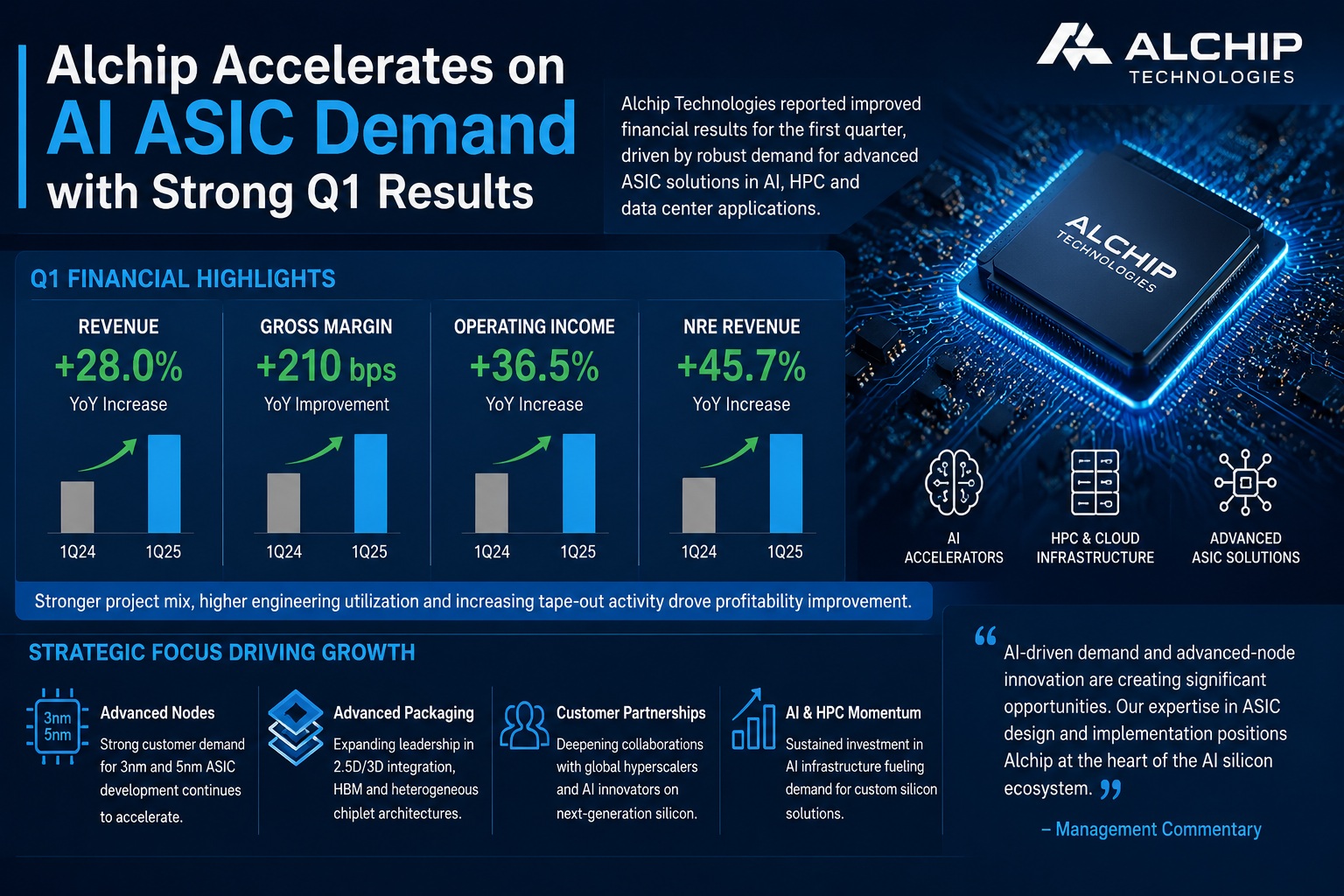
Alchip Technologies reported improved financial results for the first quarter, reflecting continued momentum in advanced artificial intelligence (AI), high-performance computing (HPC), and custom ASIC demand. The company cited stronger customer engagement in leading-edge semiconductor designs and accelerating tape-out activity driven by hyperscale AI infrastructure deployments.
First quarter revenue increased sequentially and year-over-year as customers expanded investments in custom silicon solutions optimized for AI training, inference acceleration, networking, and data center applications. Management noted that demand for advanced-node ASIC development remains robust, particularly for 5nm and 3nm technologies, where Alchip continues to strengthen its engineering and backend integration capabilities.
The company’s gross margin improved during the quarter due to a more favorable product mix and higher contributions from advanced-node projects. Operating income also increased as engineering utilization rates improved and customers accelerated program execution schedules. Alchip indicated that stronger project visibility and increasing non-recurring engineering (NRE) revenue contributed positively to profitability.
Management emphasized that the AI semiconductor market continues to evolve rapidly, creating opportunities for specialized ASIC providers capable of delivering optimized power efficiency, memory bandwidth, and system-level integration. Unlike merchant silicon solutions, custom ASIC platforms enable hyperscale cloud providers and AI system developers to tailor architectures for specific workloads while reducing total cost of ownership and improving performance per watt.
During the quarter, Alchip expanded collaboration with several customers targeting AI accelerators, networking processors, and advanced packaging implementations. The company highlighted increasing adoption of chiplet architectures and high-bandwidth memory (HBM) integration as major technology trends influencing next-generation ASIC development. These technologies are becoming increasingly important as semiconductor designers seek to overcome scaling limitations and improve compute density for large AI models.
Alchip also continued to invest in advanced packaging and backend design services, including support for 2.5D and 3D integration technologies. Management stated that complex heterogeneous integration is now a central requirement for many HPC and AI applications due to escalating compute demands and memory bandwidth requirements. The company believes its expertise in design implementation and manufacturing coordination positions it well within the rapidly growing AI silicon ecosystem.
From a regional perspective, North American customers remained the largest contributor to revenue, driven primarily by cloud infrastructure and AI-related programs. The company also reported increased engagement from Asian customers pursuing custom accelerators and networking devices for enterprise and telecommunications applications.
Industry-wide semiconductor inventory normalization also contributed to improved operating conditions compared to prior quarters. While some consumer-oriented semiconductor markets remain mixed, AI infrastructure spending continues to support strong investment across advanced foundry nodes and packaging technologies. Alchip noted that long development cycles and increasing complexity in advanced semiconductor programs are creating higher barriers to entry, favoring companies with proven execution capabilities at leading-edge process technologies.
The company reaffirmed its long-term strategy focused on advanced ASIC design, backend implementation, and turnkey manufacturing support. Management expects AI-driven semiconductor demand to remain a primary growth catalyst throughout the year, particularly as hyperscale operators expand deployment of generative AI infrastructure. Increased capital spending on AI servers, networking, and accelerator platforms is expected to sustain demand for customized silicon solutions.
Alchip further indicated that customer interest in 3nm development programs continues to increase as advanced process economics improve and performance requirements intensify. The transition toward smaller process geometries enables higher transistor density, lower power consumption, and improved compute performance, all of which are critical for modern AI workloads.
Looking ahead, the company expects continued growth in tape-out activity and engineering engagements tied to AI and HPC applications. Management acknowledged that geopolitical uncertainty and semiconductor supply chain dynamics remain factors to monitor; however, demand visibility for advanced-node programs remains strong.
With AI infrastructure investment accelerating globally, Alchip believes the semiconductor industry is entering a sustained period of demand for custom silicon innovation. The company’s improved first quarter results underscore the growing importance of ASIC providers in enabling next-generation AI compute architectures and advanced data center deployments.
Also Read:
AI Chip Design Moves Beyond Monolithic Silicon with Alchip 3DIC
Alchip’s Leadership in ASIC Innovation: Advancing Toward 2nm Semiconductor Technology
2026 Outlook with Dave Hwang of Alchip
Share this post via:



Comments
There are no comments yet.
You must register or log in to view/post comments.