




George Hotz, founder of Comma.ai told the world at TechCrunch that he was going to ship a $999 aftermarket autopilot system – the Comma One. The smartphone-sized device was designed to replace the rearview mirror enabling an automated driving experience in appropriately equipped cars – initially certain Acura and Honda models.… Read More
 SEMICON West's Autonomous Fab Vision Needs a Decision-Escalation DesignBy Gleb Tsipursky SEMICON West 2026's smart-manufacturing agenda…Read More
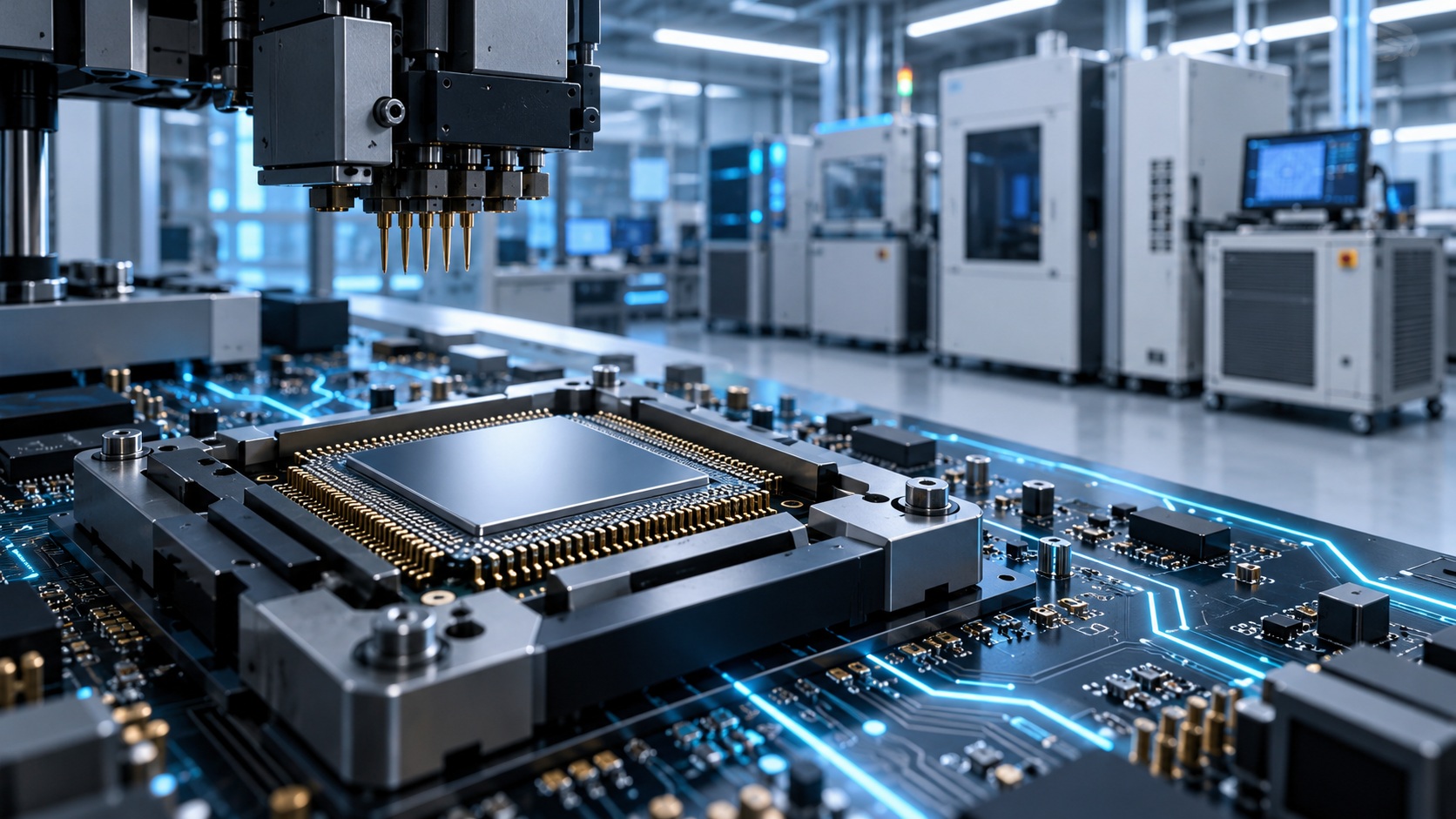 Teradyne Targets Edge AI Test Costs With UltraFLEXplus S SeriesTeradyne has introduced the UltraFLEXplus S series, extending…Read More
 Beyond the Post-Mortem: How yieldHUB Live Turns the Test Floor Into an Open WindowAt SEMICON West 2026 I sat down with…Read More
 Why America’s Semiconductor Manufacturing Capacity MattersAmerica’s semiconductor future will be shaped by its…Read More
DDoS Attack: A Wake-Up Call for IoT

Welcome to the world of Internet of Things wherein a glut of devices are connected to the internet which emanates massive amounts of data. Analysis and use of this data will have real positive impact on our lives. But we have many hoops to jump before we can claim that crown starting with a huge number of devices lacking unified platform… Read More
The Ramifications of Not Accepting Industry 4.0
In the last couple of years, Industry 4.0 has significantly affected manufacturing on a global scale. With a heavy focus on the Internet of Things, the use of smart machines and other devices has become a critical part of Industry 4.0. With new networks of intelligence on the horizon, there is no doubt that Industry 4.0 will continue… Read More
Free Pivotal Semiconductor Books!
Just as a reminder, there are three semiconductor books in PDF format available for free on SemiWiki.com. The only hitch is that you must be a registered SemiWiki member to download them. If you are not currently a member please join here as my guest:… Read More
Dolphin Webinar “The proven recipe for uLP SoC”
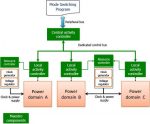
Dolphin will hold a live webinar on November 15, 9:00 AM PST or November 22, 10:00 AM GMT. This webinar targets the SoC designers wanting to learn how to quickly implement ultra-low power (uLP) techniques, using proven recipes.… Read More
Flexible IoT Wireless
There’s been quite a bit of debate about what is the “best” wireless option for the IoT, coming down usually in favor of there being no single best option. Applications are so widely varied that different solutions are needed to ideally fit different requirements. However, IoT economics require we settle on a limited set of options,… Read More
Ford Seeks Own Path to Car Sharing and IoT
It’s hard to be a thought leader around the future of transportation when the entire market seems to be moving in one of three directions simultaneously: either ride hailing (Uber, Lyft), car sharing (Zipcar, Car2go) or automated driving (Google, Tesla). If you’re Ford Motor Company and you care about whether you are adding to … Read More
How does the IoT get to 20 Billion?
Not long ago I was asked the question “How do we get to 20 billion IoT devices?” (Actually, I’ve been asked this question multiple times over the past 10+ years.) Great question! How, exactly, do we get to 20 billion (or 30 billion, or a trillion) IoT devices? We’re certainly not going to get there with wearable devices and other… Read More
IP-SoC 2016: IP Innovation, Foundries, IoT and Security
The next IP-SoC conference will be held in Grenoble, France, on December 6-7, 2016 after Shanghai in September and Bangalore, India, in April. This will be the 20[SUP]th[/SUP] edition of this unique IP centric event, as well as the celebration of Design And Reuse 20[SUP]th[/SUP] anniversary. Creating in 1997 a company fully dedicated… Read More
One chip and the MCU variant challenge disappears
Merchant microcontrollers are usually made available in a wide range of variants based on one architecture with different peripheral payloads and packaging options. A couple of companies, notably Cypress with their PSoC families and Silicon Labs with the EFM8 Laser Bee… Read More
ChipAgent Raises $134Million and Why it Matters