




The need for ever-connected devices is skyrocketing. As I fiddle with my myriad of electronic devices that seem to power my life, I usually end up wishing that all of them could be interconnected and controlled through the Internet. The truth is, only a handful of my devices are able to fulfill that wish, but the need is there and developers… Read More

Xilinx Datacenter on a Chip
I talked recently about the Intel acquisition of Altera which seems to be all about using FPGA technology to build custom accelerators for the datacenter. Some algorithms, especially in search, vision, video and so on map much better onto a hardware fabric than being implemented in code on a regular microprocessor.
So if the heart… Read More
Why Did Intel Pay $15B For Altera?
While I was at the imec Technology Forum someone asked me “Why did Intel pay $15B for Altera?” (the actual reported number is $16.7B).
The received wisdom is that Intel decided that it needs FPGA technology to remain competitive in the datacenter. There is a belief among some people that without FPGA acceleration available for vision… Read More
Xilinx in an ARM-fueled post-Altera world
When the news broke about the on, off, and on-again Intel-Altera merger a few weeks ago, I checked off another box on my Six Degrees of Kevin Bacon scorecard. That plus a $5 bill gets me a Happy Meal at McDonalds, but in a post-Altera world, it might be worth more.
On January 16, 2008, I’m sitting in a meeting with some Intel strategic marketing… Read More
High Level Synthesis. Are We There Yet?
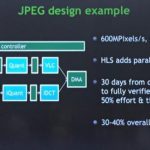
High level synthesis (HLS) seems to have been part of the backdrop of design automation for so long that it seems to be one of those things that nobody notices any more. But it has also crept up on people and gone from interesting technology to keep an eye on to getting genuine adoption. The first commercial product in the space was behavioral… Read More
Why is Intel going inside Altera for Servers?
You should be happy to listen that Intel will buy Altera FPGA challenger, if you expect always more power to be consumed in datacenter! In 2013 the power consumption linked with the Servers and Storage IC activity, plus the electricity consumed in the systems cooling these high performance chips has reached 91 BILLION KWh (or the… Read More
Aldec packs 6 UltraScale parts on HES-7

A few months ago, when the Xilinx UltraScale VU440 FPGA began shipping, one of the immediate claims was a quad-FPGA-based prototyping board touted as “Godzilla’s Butcher on Steroids”. That was a refreshing and creative PR approach, frankly. I’m always careful with less creative terms like “world’s biggest” or “world’s fastest”,… Read More
Will Dark Silicon Dictate Server Blade Architecture?
Does the evil sounding phenomenon known as Dark Silicon create a big opportunity for FPGA vendors as was predicted recently by Pacific Crest Securities? John Vinh posits that using multiple cores as a method of scaling throughput is flattening out, and the use of FPGA’s to perform computation can help off-load and thus overcome… Read More
Taking a Leap Forward to Prototype Billion Gate Designs
It’s very common these days to hear about a billion gates SoC, but not without a huge design and verification effort and investment of resources. A complete verification of such an SoC needs several verification steps including software and hardware based methodologies that often are not sufficient to cover the whole SoC. In order… Read More
Realize the Genius of Your Design!
I think we can all agree that no matter what you are designing, FPGA prototyping can help. The challenge is getting the most out of the leading edge FPGA prototyping solutions and that requires a detailed understanding of how this technology works and what FPGA prototyping solutions match your design and verification requirements.… Read More
Musk’s Orbital Compute Vision: TERAFAB and the End of the Terrestrial Data Center