






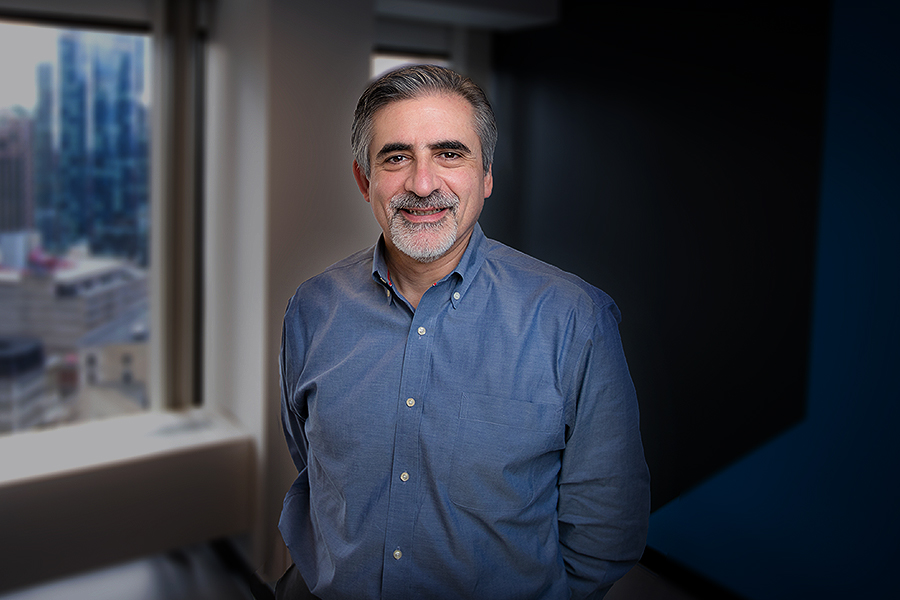
Maurice (Mo) Steinman is Senior Vice President and General Manager, U.S. at Lightelligence. He took a few minutes out of a busy week to answer questions about Lightelligence, its optical solutions, application areas for its optical computing products and how it differentiates itself in this market.
Tell us about Lightelligence.
Lightelligence is an MIT spin-out founded in 2017. Our vision quite simply is to unleash the power of optical computing, fueled by the belief that a new paradigm is required with the computational and data demands of today’s workloads increasingly outpacing the capabilities of purely electronic systems. Since our founding, we have assembled a team of over 250 professionals across six locations worldwide working tirelessly to bring that vision to bear.
What problems is Lightelligence solving?
Our products are focused on two distinct spaces within the optical landscape: optical computing and optical interconnect fabrics.
Our optical computing products are built around an arithmetic processor that exploits the properties of light to perform vector-matrix multiplications at extremely low latency. This type of processor allows us to address single-node performance by accelerating this critical type of arithmetic operation which is prevalent in combinatorial problems and today’s most computationally-demanding workloads.
Our optical interconnect fabric products allow us to scale our customers’ system-wide performance beyond the single-node, by connecting computing elements at multiple different levels. Our solutions range from chip-to-chip, board-to-board, server-to-server, and rack-to-rack, using our optical interconnect fabric products ranging from pluggable modules to co-designed highly integrated optical engine solutions.
What application areas are Lightelligence’s products best suited?
Our optical computing products are best suited for applications that benefit from low-latency computation. In our most recently released optical computing product, PACE2, we have integrated developer-friendly features including a software tool chain to facilitate algorithm exploration. We want to get this product into the hands of researchers who can identify algorithms that exploit the inherent hardware performance for maximum workload benefit.
Our customers are using our fabric products to scale performance across several different use cases. In one scenario, we are enabling our customers to aggregate the performance of many compute nodes with an optical fabric that can span the physical breadth of the system, typically across multiple racks. Optical fabrics are well-suited to build systems that are comprised of tightly coupled elements that are physically distant from each other. Interconnect distances that would be unreachable using purely electronic interconnect are considered “short reach” for optical fabrics.
A related usage scenario involves systems requiring composability. Such systems are disaggregated into distinct server elements and resource pools that can be scaled and assigned flexibly and efficiently. In disaggregating the system, interfaces must be exposed and then connected to permit composing the full system. The ability to manage and share resources across a larger number of servers requires an interconnect fabric that can span a physically large footprint in the data center and connect the exposed interfaces efficiently. Optical interconnects are perfectly suited for the composable disaggregated infrastructure (CDI) market.
What does the competitive landscape look like and how does Lightelligence differentiate?
The landscape is rich with players vying to address one or more areas of optical technology. Rather than taking a component-level view of the market, all our products are developed with a customer use-case mindset and system-level approach. Our cross-functional team has developed a level of insight into the union of hardware and software for customer workloads that sets us apart from other players who employ a component-level approach. This allows us to engage more deeply with our customers and deliver solutions more smoothly and optimally.
What new features/technology is Lightelligence working on?
We continue to invest in future generations of optical processors, scaling matrix processing performance and increasing customer usability and adoption. On the interconnect side, novel features such as Distributed Optical Circuit Switch (dOCS) allow our customers to build topology reconfiguration directly into the performance scale-up network. We are developing Near-Package Optics (NPO) and co-packaged optics (CPO) solutions for deeper levels of optical integration with customer silicon.
What is the biggest growth area for 2026 and why?
In 2026 we are excited about our dOCS (distributed Optical Circuit Switch) technology. This product neatly combines a switching function directly within the scale-up network in a deployment-friendly pluggable form-factor, which eases customer adoption. Built-in switching within the fabric enhances system reliability, fault containment, and uptime by eliminating the single point of failure typically seen with a centralized switch function. We are also looking toward increased adoption in the composable disaggregated infrastructure space with the onset of widely available PCIe 6.0 and CXL 3.0 hardware.
How do customers normally engage with Lightelligence?
Lightelligence utilizes a direct approach to customer engagement. Our business development and sales professionals work to match our technology and product solutions to customer needs. Our engagements range from deep co-development partnerships to customizations of standard products to utilizing products directly from stock. Our field applications engineers (FAEs) work with customers to facilitate trials on their systems and navigate the integration path to deployment.
For more details and updates on Lightelligence, SemiWiki readers should visit www.lightelligence.ai or follow us on Linkedin. Specific questions should be sent to: sales@lightelligence.ai
About Maurice Steinman
Maurice (Mo) Steinman is a Senior Vice President and General Manager, U.S. at Lightelligence. He has enjoyed a 40-year career in the semiconductor industry, working for such companies as Digital, Compaq, HP, Intel and AMD, where he held the title of Senior Fellow before joining Lightelligence. A veteran of many successful tape outs and product introductions, Steinman has expertise in SoC architecture, SoC interconnect, memory subsystems, and energy management. He graduated from Rensselaer Polytechnic Institute (RPI) with a Bachelor of Science degree in Computer and Systems Engineering and is named as an inventor on over 50 U.S. patents.
Also Read:
CEO Interview with Daniel Schall of Black Semiconductor
CEO Interview with Vivek Vishwakarma of ThirdAI Automation
CEO Interview with Vivek Raghunathan of Xscape Photonics
Share this post via:



Why ASML Is Racing to Build 110 EUV Machines