





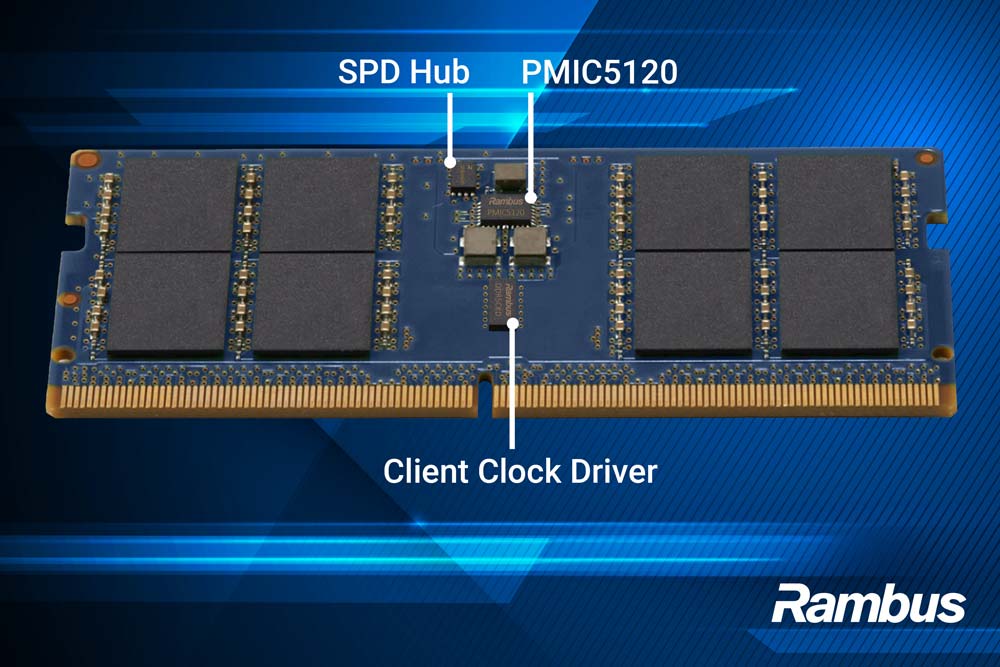
The rapid emergence of AI-enabled personal computers is driving unprecedented demand for higher memory bandwidth, improved signal integrity and greater system reliability. To address these requirements, Rambus has introduced a complete client memory interface chipset for Clocked Unbuffered Dual In-Line Memory Modules (CUDIMMs) and Clocked Small Outline Dual In-Line Memory Modules (CSODIMMs), enabling next-generation AI PCs to fully leverage the performance capabilities of DDR5 memory technology.
As AI workloads become increasingly integrated into mainstream computing platforms, memory subsystems face growing challenges. Large language models, AI assistants, content creation applications and edge inferencing workloads require fast access to large datasets while maintaining low latency and high power efficiency. Traditional memory architectures often encounter signal degradation at higher transfer rates, limiting overall system performance. The new Rambus client chipset addresses these challenges by enhancing signal integrity and enabling higher DDR5 operating speeds.
At the heart of the solution is the Rambus Client Clock Driver (CKD), which serves as a critical timing component for CUDIMM and CSODIMM modules. The CKD re-drives and conditions the clock signal before distribution to the DRAM devices, significantly reducing jitter and timing variations. This architecture improves signal quality across the memory channel, allowing systems to operate reliably at data rates exceeding those achievable with conventional unbuffered memory modules.
The chipset is designed to support the latest JEDEC standards for DDR5 CUDIMM and CSODIMM memory modules. By incorporating clock driver technology directly onto the module, memory manufacturers can overcome electrical limitations associated with increasingly demanding data rates. This capability is particularly important as client systems transition toward DDR5 speeds of 6400 MT/s and beyond, with future generations expected to reach even higher performance levels.
For AI PCs, memory bandwidth plays a crucial role in overall system responsiveness. Modern AI applications frequently move large quantities of data between processors, neural processing units (NPUs), graphics processors and system memory. Bottlenecks in memory throughput can limit the effectiveness of advanced AI accelerators. Rambus’ chipset enables memory modules to sustain higher operating frequencies, helping eliminate these constraints and supporting more efficient AI processing pipelines.
The complete Rambus client chipset includes not only the CKD but also complementary power management and signal conditioning technologies designed to optimize module operation. Together, these components improve timing accuracy, reduce electrical noise and enhance overall memory subsystem reliability. The integrated approach simplifies module design while ensuring compatibility with evolving client platform requirements.
Another important advantage is support for both desktop and mobile form factors. CUDIMMs target desktop and workstation platforms, while CSODIMMs address notebook and compact computing systems. By providing a unified chipset solution across both module types, Rambus enables OEMs and memory manufacturers to standardize development efforts while delivering consistent performance benefits across a broad range of AI PC designs.
Power efficiency remains a key consideration for client computing platforms. AI applications can significantly increase system power consumption, making efficient memory operation essential. The Rambus chipset is engineered to support high-speed operation while minimizing additional power overhead, helping manufacturers balance performance and energy efficiency requirements. This capability is especially valuable in mobile systems where battery life remains a critical design objective.
As the PC industry moves toward widespread deployment of AI-enhanced computing experiences, memory technology will become an increasingly important differentiator. Higher memory speeds, improved reliability and optimized signal integrity are necessary to unlock the full potential of next-generation processors and AI accelerators. Rambus’ complete client chipset provides the foundational technology needed to support these advancements.
Bottom line: By enabling robust DDR5 CUDIMM and CSODIMM implementations, Rambus is helping drive the next wave of AI PC innovation. The company’s expertise in high-speed memory interfaces and signal integrity solutions positions it at the forefront of client memory architecture development, delivering the performance and scalability required for increasingly sophisticated AI workloads.
More information: Scaling to DDR5 9600: Why Clocked Client Memory Modules Matter for AI PCs
Also Read:
WEBINAR: HBM4E Advances Bandwidth Performance for AI Training
How Memory Technology Is Powering the Next Era of Compute
Share this post via:



Comments
There are no comments yet.
You must register or log in to view/post comments.