RVN! 26 Banner revised (800 x 100 px) (600 x 100 px)

Can Samsung Foundry Really Compete with TSMC?

Can Samsung Foundry Really Compete with TSMC?
by Daniel Nenni on 11-20-2020 at 6:00 am

Samsung TSMC 3nm Battle SemiWiki

The semiconductor foundry business has been front page news of late and for good reason, it’s an exciting time in the semiconductor industry and the foundries are where it all begins. Unfortunately, most of the “exciting” news has been overblown but this topic is of great interest, to me at least. Having been intimately involved with the foundries for the last 30 years and covering them for SemiWiki over the last ten years I may have a different view on things so you may want to read on.

Bloomberg recently published an article “Samsung Intensifies Chip Wars With Bet It Can Catch TSMC by 2022”. This is a follow-on article to “Samsung Takes Another Step in $116 Billion Plan to Take on TSMC”. The author of both articles is Sohee Kim who works for Bloomberg out of Korea. She has zero semiconductor education or experience but certainly knows Samsung and has a direct line at the executive levels. So, you can expect these articles are straight from the horse’s mouth so to speak.

According to Sohee Kim Samsung and TSMC will compete for business at 3nm which means high volume manufacturing (HVM) in 2022. A very important point here is that TSMC 3nm and Samsung 3nm will be very different technologies. TSMC is extending their 5nm FinFET based process and Samsung is launching a new process technology (GAA) at 3nm.

Three Challenges for Samsung Foundry at 3nm:

The first challenge is ecosystem! TSMC is using a tried and true technology that is supported by a very large ecosystem of EDA, IP, and services companies. Hundreds of silicon proven IP will be immediately available for TSMC 3nm customers while Samsung must build a new ecosystem for GAA. Not as easy as it sounds, believe me.

The second challenge is trust! Foundry trust comes in different forms: Trust that your IP is safe and sound. Trust that the foundry will not compete unfairly with you. Trust that the foundry will deliver the PPA (power/performance/area) technology that was first described in the early releases of the process design kit (PDK).

The third challenge is yield! GAA is a new process technology and Samsung is well known for brute force yield problems. Being the first company to a new technology is certainly a badge of honor and I have great respect for Samsung’s technological prowess. I do however have direct experience with Samsung’s struggles to get a new process into HVM. Customers must trust that a foundry can deliver on the promise of good die/wafer capacity to meet the agreed upon chip delivery schedule.

In closing Sohee Kim suggests: “If Samsung succeeds, that will be a breakthrough for its ambition to become the chipmaker of choice for the likes of Apple Inc. and Advanced Micro Devices Inc. that now rely on foundries like TSMC.”

To be clear Apple and AMD today are exclusive to TSMC. This exclusivity gets Apple and AMD into the inner TSMC circle where collaboration is at the highest levels. Samsung’s big customers are Nvidia, Qualcomm, and IBM, none of which are in the TSMC inner circle.

From an insiders point of view, QCOM and Nvidia used to be TSMC besties but QCOM competes with Apple and Nvidia competes with AMD so there was dissension in the ranks. IBM used GF 14nm which was licensed from Samsung so they continued on with Samsung 7nm.

Bottom line: Can Samsung Foundry Really Compete with TSMC? Sorry, not today, not at 3nm. The TSMC 3nm PDK is already in use at the top semiconductor companies around the world and have the full support of the ecosystem. The Samsung 3nm PDK on the other hand is still evolving as are the tools and IP that will support it. Just my observation, experience, and opinion of course.

It really is all about trust, absolutely.


Achieving 112Gbps PAM4 Channels with Achronix FPGAs and Samtec Interconnect

Achieving 112Gbps PAM4 Channels with Achronix FPGAs and Samtec Interconnect
by Mike Gianfagna on 11-19-2020 at 10:00 am

Achieving 112Gbps PAM4 Channels with Achronix FPGAs and Samtec Interconnect

They say that getting there is half the fun. On December 1, Achronix and Samtec will present a webinar on this topic in the context of high-performance front panel to midplane and midplane to backplane channel design. Technology, materials and system design will all be discussed with a focus on achieving 112Gbps PAM4 channels with Achronix FPGAs and Samtec interconnect.

Alan Hilton Nickel

The presenters are quite knowledgeable, and I think you will enjoy listening to them.  Presenting for Achronix will be Alan Hilton-Nickel, senior signal integrity engineer. Alan brings 30 years of experience in signal integrity, system development and electronics manufacturing to his role at Achronix, developing high-speed test and measurement boards and reference boards. He holds B.S. in Electrical Engineering from the University of Calgary in Canada.

Matt Burns

Presenting for Samtec is Matt Burns, technical marketing manager. Matt develops go-to-market strategies for Samtec’s Silicon to Silicon solutions, and over the course of the last 20 years he has been a leader in design, technical sales and marketing in the telecommunications, medical and electronic components industries. He holds a B.S. in Electrical Engineering from Penn State University. I know Matt personally, having done several events with him while at eSilicon. Matt really understand how Samtec products help system design.

The webinar will focus on two key enabling technologies to implement high-performance channels. Achronix will discuss the SerDes that is part of their Speedster7t FPGA device and Samtec will discuss the benefits of using their Flyover® interconnect technology.

Accelerating data channels to 112 Gbps PAM4 forces system designers to balance increasing throughput, scalability and density demands with concerns such as signal integrity, system architectures and time-to-market. In this webinar, technical experts from Achronix and Samtec will discuss real-world tools and solutions that optimize the signal path both inside and outside the system design. Achronix and Samtec will provide a real-world case study of implementing 112Gbps PAM4 links using the Achronix Speedster®7t FPGA and Samtec’s portfolio of high-performance interconnect solutions.

You will learn:

  • What some of the emerging applications are that require 112Gbps signals
  • How to optimize the Achronix FPGA SerDes settings for optimal signal integrity
  • What the key design considerations are when designing your board interconnect

I’d say there’s something in this webinar that’s sure to get your attention. Focusing on the unique features of the Samtec Flyover cable, you will see details regarding the substantial improvement this direct connect cable technology provides when compared to traditional PCB traces. The improvements are quite eye-catching. If you think cables and connectors are simple devices, think again.  You’ll learn some of the nuances of using this technology effectively for high-performance systems.  You can learn more about Samtec’s interconnect technology in this post on SemiWiki.

Having worked with Samtec products while I was at eSilicon, I can tell you their technology is very much on the cutting edge. We were able to implement long-reach channels with Samtec cables and eSilcon’s SerDes that could not be done any other way.

If you want to probe more about the Achronix SerDes, you can view an overview of the Acrhonix SerDes design and demonstration of its capabilities here.

You can register for the webinar replay here. I highly recommend you attend if you are contemplating the need for high-performance channels on your next design. You will learn how to implement 112Gbps PAM4 channels with Achronix FPGAs and Samtec interconnect.

Here is a summary of both Samtec and Achronix:

About Samtec, Inc.

Founded in 1976, Samtec is a privately held, $713MM global manufacturer of a broad line of electronic interconnect solutions, including High-Speed Board-to-Board, High-Speed Cables, Mid-Board and Panel Optics, Microelectronics, Flexible Stacking, and Micro/Rugged components and cables. With 33 locations in 18 different countries, Samtec’s global presence enables its unmatched customer service.

About Achronix Semiconductor Corporation

Achronix Semiconductor Corporation is a fabless semiconductor corporation based in Santa Clara, California, offering high-performance FPGA solutions. Achronix is the only supplier to have both high-performance and high-density standalone FPGAs and embedded FPGA (eFPGA) solutions in high-volume production. Achronix FPGA and eFPGA IP offerings are further enhanced by ready-to-use PCIe accelerator cards targeting AI, ML, networking and data center applications. All Achronix products are supported by best-in-class EDA software tools.


The Tell-Tale Entrepreneur, An Easy New Year’s Resolution

The Tell-Tale Entrepreneur, An Easy New Year’s Resolution
by Bernard Murphy on 11-19-2020 at 6:00 am

The Tell-Tale Entrepreneur

Wondering what you might do to up your game this year? What about improving your communication skills? Soothing an angry client, trying to find appeal for a product that’s not exciting customers, or finding the right investor? Working through a growth challenge you under-estimated, or generating excitement in an audience you can’t see? Maybe finding a buyer for your enterprise? Even learning to better communicate on a personal level, with yourself and others? When what we’re doing isn’t working, we tend to think we need more data, or better data, or a magical new imagination of our pitch, or we should work on our speaking style and confidence, to better command our audience. Perhaps. But many times, the better way to communicate is to tell a story.

Why storytelling?

In business and especially in the tech business we’re trained to believe that all persuasion, all decision making is fact and logic based. That whoever has the best facts, features and arguments wins. Every time. We communicate under that assumption, consciously or not. But there’s a problem. We’re emotional animals and we don’t check our emotions at the door when we walk into a business meeting.

Anticipation, excitement, fear, trust, all play a huge role in converting doubters to believers. Emotions that are difficult to excite through slide decks. Aim higher. Don’t just convey information. Trigger your audience’s own flights of fancy around their much bigger goals. Opportunities they hadn’t imagined. Dangers in this path if they don’t take along a worthy mentor. Why should they trust you? Think of the last time you bought a house or a car. Was that a purely logical decision? I doubt it. You bought into your own vision of how that purchase could improve your life. Sure, you carefully checked a bunch of technical boxes, but you ultimately made the decision based on the vision. An emotional decision.

Storytelling works because it engages our emotions. This is self-evident to anyone who enjoys Star Wars, The Lord of the Rings, Romeo and Juliet, The Odyssey. We resonate with a universal story arc, a training wired into our DNA from the dawn of time. Unconsciously engaging in the hero’s quest, the excitement of the adventure. We’re terrified by the big conflict, see ourselves fighting alongside our hero, suffering multiple setbacks. And finally, we share their joy in victory. We are fully emotionally engaged in the story. Long after, we can still vividly recall the highlights and the lowlights. And we remember those who helped us along the way.

Stories in the business world

What does this have to do with your business? The people we want to convince each use the same story-craving brain they use to enjoy big-screen stories. A typical pitch, a dense factual and logical data dump, is a sort of anti-story. Hard work to absorb and definitely not exciting. A story instead directly taps the story arc resonance in our brains, through anticipation, excitement, a climax and ultimate victory. Guiding them to imagine a more exciting quest which you can help them realize.

This isn’t a new idea. Sales professionals intuitively tell stories. Storytelling is the big new trend in marketing. You’ll find no shortage of blogs and white papers to advise you on why you have to jump on board, and how you should tell stories. But there’s something a little off about the advice. Long on explanations and rules and charts, an anecdote or two, but short on real stories. Sort of a technical how-to on storytelling. But technical tutorials aren’t the natural language of storytelling. The right language is stories.

I decided to plug that hole by writing a book on storytelling in business, through real business stories. A couple of introductory chapters, both stories, to lay the groundwork, then a chapter each on a startup story, an investment story, a growth story, a marketing story and an exit story. I close with a story on the stories we tell ourselves, because they greatly influence the stories we tell others.

I know you’ll find this book an easy read, much easier than a typical self-improvement book. I’m certain you’ll also find it stimulates ideas on opportunities and challenges you may face in your own career. Most likely you’ll enjoy both the read and the ideas it stimulates. You can’t help it – that’s the beauty of stories.

The Tell-Tale Entrepreneur is published by Advantage|Forbes Books. You can order it on Amazon. Most New Year’s resolutions are hard work. Do yourself a favor – try a fun resolution and become a better communicator!


Time to Listen to GM’s Mark Reuss

Time to Listen to GM’s Mark Reuss
by Roger C. Lanctot on 11-18-2020 at 10:00 am

Time to Listen to GMs Mark Reuss

General Motors President Mark Reuss told Reuters last week that he is worried about the COVID-19 pandemic currently running rampant in the U.S. and globally. “I’m so worried about it because it’s accelerating and it’s not being contained,” he said during a “fireside chat” at the Reuters Automotive Summit which concludes Monday.

Reuss’ concerns were surprising in light of GM’s recently reported earnings which beat analysts’ estimates and boosted the company’s stock on the back of strong sales of profitable pickup trucks and SUVs. In fact, the atmospherically positive Q3 earnings call paid scant attention to COVID-19 impacts beyond year-over-year comparisons which had evened out since the Q2 lockdown with the possible exception of fleet sales that have been hammered by the severe decline in the rental car sector.

Of course, the earnings call focused mainly on financial issues and Reuss is more of an operational guy with responsibility for GM’s vast regional activities and the complex supply chain required to manufacture those profitable SUVs and pickup trucks. In fact, Reuss is also closer to the thousands of workers exposed to COVID-19 risks on a daily basis across the U.S. and the world – including the strategic markets of China and Brazil.

“I just worry about everybody, I really do,” Reuss was quoted as saying by Reuters. “I think the industry in general and General Motors has done a good job in our plants. But I really worry about people, the death, the suffering and the unemployment that goes along with this pandemic.”

Reuss captured in those words the bizarre bubble world that COVID-19 has bestowed upon all global citizens generally and the automotive industry in particular. For those people so-far unaffected by COVID-19 and able to work from home more or less unmolested, the pandemic is an inconvenience, an annoyance – a bit of mask wearing and hand washing, and a lot less travel.

For millions of others, the pandemic is a struggle to balance remote schooling of young children with the demands of working from home – assuming, of course, the availability of Internet access etc. For millions of others, the pandemic is a reduction in compensation, a lost job, or a loss of health insurance. There is also the care of elderly relatives to be seen to.

For car makers and other factory-centric industries, the pandemic is the daily reality of a potential infection or outbreak or interaction with an infected colleague. Each and every line worker in the automotive industry is suddenly exposed to, interacting with, and dependent upon the personal and social hygiene of each and every other colleague – do they go to church, football games, bars or restaurants?

GM and other auto makers and suppliers have – on their own – developed and implemented comprehensive workplace protocols for in-plant social distancing, testing, and protective equipment, but the sheer size and scope of the automotive industry’s supply chain is precisely what must be worrying GM’s Reuss. Has GM done enough? What about the hundreds of suppliers representing the links in that supply chain? Are they doing enough … every single day?

So here we are in the COVID-19 bubble. Ford Motor Company and GM reported analyst-estimate-smashing profits in the past two weeks and other car companies have reported solid third quarters as well. But can these results be maintained in the face of a pandemic and in the context of a global supply chain being put at risk by a surging pandemic unmatched by globally coordinated mitigation measures?

“I worry that in places that are very different from the United States, Canada or Mexico that a relaxation of some of these (mitigation practices) would hurt the supply chain and have us not be able to run our plants,” Reuss told Reuters. “I know everybody is doing the best they can but we have to keep that up.”

In the U.S., alone, the automotive industry is dependent upon suppliers operating plants in some of the highest infection rate states in the country. People are actively being discouraged from traveling, yet parts and cars must be manufactured and moved across state lines. Those factory workers in the auto industry are suddenly essential workers – essential to creating transportation resources and essential to the health of the economy.

Individual governors have been forced to step forward with increased mitigation measures – in some cases in the face of both legislative and public opposition and approbation. The lack of alignment among political leaders and with the public is yet a further source of concern for someone like Reuss and every other auto executive – or any executive in a factory-centric or even service delivery industry.

Being concerned or even afraid will not solve the problem. It may be time for all industries, not just auto makers, to demand consistent direction and guidelines for maintaining operations during a global pandemic. The world’s economy is skating on a knife’s edge and the slightest disruption could burst the COVID-19 bubble of prosperity – because the rich are getting richer, and those able to continue to work from home are getting complacent.

New car prices are rising as supplies are constrained and demand remains strong – fueled, in part, by consumers leaving public transportation for privately owned vehicles. But if we can’t make the cars we can’t continue to deliver the vehicles and post the impressive profits. The time for collective action is now. The finance folks need to start listening to the Mark Reusses of the world.


The Six Signs That You Need a Yield Management System

The Six Signs That You Need a Yield Management System
by Mike Gianfagna on 11-18-2020 at 6:00 am

The Six Signs That You Need a Yield Management System

If you search on “the six signs” you will find references to a fantasy novel, “The Dark is Rising Sequence” by Susan Cooper. In this fantasy work there are six signs: wood, bronze, iron, water, fire and stone. Their purpose has something to do with driving away the Dark. Here is a quote from the book that puts these six signs in some context:

When the Dark, comes rising, six shall turn it back;
Three from the circle, three from the track,
Wood, bronze, iron; water, fire, stone;
Five will return, and one go alone.

OK, back in the real world the six signs can mean other things. In the case of yield management, yieldHUB recently published a piece called 6 signs you need to invest in a YMS. A lot of companies face this decision. Often, they pull the trigger on more formal yield management capabilities too late, resulting in a lot of growing pains. So, having a way to “read the situation” can be very, very helpful. Here is a summary of the six signs that you need a yield management system. Watch for them. Not heeding the six signs may not cause the end of the world as we know it, but it will certainly cause a lot of missteps as your organization grows.

1) Your team spends more time gathering and converting data than analyzing and solving problems

This is a really easy trap to fall into. Gathering, collating, validating and cleaning data before you analyze it is a natural instinct. Often, product engineers do this work to facilitate analysis and optimization (the important stuff). From a pure resource management point of view, having highly skilled product engineers collecting and organizing data isn’t the best use of their time. A yield management system (YMS) will do this task automatically and never miss a beat.

2) Your teams work in different locations

Given the COVID world we live in right now, it’s almost guaranteed that your team will be working in different locations. This issue goes beyond face-to-face access, however. The key point is communication of timely, relevant and actionable information across the enterprise. Sending spreadsheets via email is bound to propagate out-of-date information and confusion. If your team is located in different countries, language will be a challenge as well. Sending graphical reports often helps to get everyone focused on the right thing but preparing those reports from spreadsheet data is time consuming and it’s hard to keep everyone in sync.

A cloud based YMS will tie everyone together with up-to-date information and easy to generate reports. The “single source of truth” refrain about networked information is very relevant here.

3) Storage issues

This one is easy. Large data logs take a lot of bandwidth and this slows your servers down. If getting your information in the right place is taking too long, you may need that cloud based, single source of truth YMS system.

4) Data archiving

I’ve touched on this one in a prior post. If you have customers with long shelf-life products (any infrastructure gear qualifies), they will expect you to have detailed product information available on a moment’s notice, should a field problem crop up. This will likely wind up in your contract with them. A cloud based YMS is the best way to have this key data be persistent over time.

Maintaining this information can also be a competitive advantage. If you have all the history for the prior designs, you have a better chance of winning new designs.

5) You need to do Characterization or Gage R&R

First a quick definition. I hadn’t heard the term Gage R&R. In case you’re like me, it means:

The terms stand for gage repeatability and reproducibility. It is a statistical tool that measures the amount of variation in the measurement system arising from the measurement device and the people taking the measurement.

Essentially, a way to measure your measurement systems. This kind of work requires assembling and correlating data from many sources. If you’re not careful, you’ll spend more time collecting the data than analyzing it. A good YMS will offer these tools.

6) You should invest in YMS if your team needs to receive alerts

This is really just about everyone. Test results go out of spec, lots get put on hold and sometimes things get a lot worse. You need to be in front of these kind of trends, and automated alerts is the way to do this. A good YMS will allow you to subscribe to the kind of alerts that you need and opt out of the ones you don’t need.

So, there are the six signs that you need a yield management system. Ignore these signs at your own peril. The article from yieldHUB provides more detail and context. You can find the article here.


Third Generation of IP Lifecycle Management Launched

Third Generation of IP Lifecycle Management Launched
by Daniel Payne on 11-17-2020 at 10:00 am

Methodics and Perforce

Back in July I first read the news that Perforce had acquired Methodics, and wasn’t too surprised, because many of the EDA vendors that we blog about do get acquired or merge with similar sized companies in order to be part of a bigger offering. When Methodics announced a webinar introducing IPLM 3.0 (IP Lifecycle Management), I signed up to find out how the acquisition was going, and see what the future roadmap might look like.

Unlike many webinars, this one was a bit different because Methodics had two presenters that alternated during the entire presentation and live demo: Michael Munsey and Vishal Moondhra. I first met Michael Munsey at Viewlogic, and he has over 30 years experience at a variety of companies: Dassault Systemes, Tanner EDA, Cadence, Sente, Silicon Dimensions and IBM. Vishal Moondhra’s experience in design and verification spans some 20 years, with stints at: IgT, Montalvo, Intel, Sun, and Missing Link Tools.

Perforce has been offering software tools for DevOps since 1995, so the addition of Methodics was quite complimentary, and the mood of the speakers was ebullient. Perforce has a solid metadata platform with HelixCore, and Methodics adds the new IPLM piece into that.

With these two companies combined I see very complimentary technologies that are not overlapping, and are not disjointed. Both companies are serving the semiconductor industry with a nice integration between products going back many years now. Stay tuned for the potential of Methodics IP Lifecycle Management tools to be applied in new segments like gaming, animation and video production.

The three generations of Methodics are:

  1. projecic – IP management as a point tool
  2. percipient – enterprise class with 10,000 users
  3. Methodics IPLM – third generation

10 – projecic – first product, IP management, 1st gen, point tool
percipient – 2nd generation, enterprise class, 10,000 users, 100K IP
MethodicsIPLM – 3rd generation

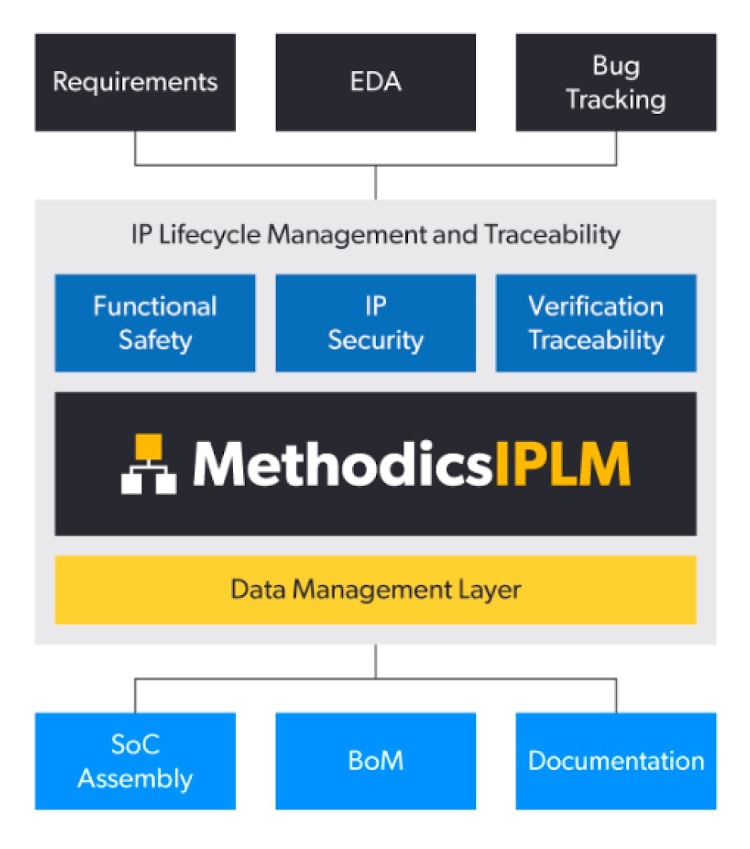
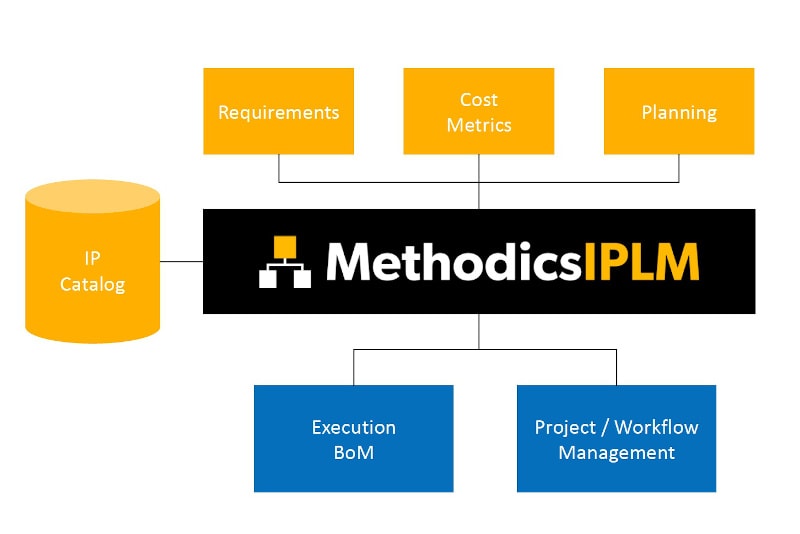
Here’s a diagram showing all of the parts to their IPLM:

With this approach you now have fully traceable IP, starting from requirements through design and documentation. Users now know answers to who/what/when/where/how each piece of IP is being used across all projects in the enterprise. Tracking is a core feature, and it’s integrated with existing IC design flows using rich meta-data, providing a single source of truth so that teams across multiple geographies and projects have a standardized way of working cooperatively.

Maybe 10 years ago an SoC design team could use an Excel spreadsheet to support IP traceability, but with thousands of IP blocks used per design today you need a more sophisticated and capable system in place. Another benefit with this IP Lifecycle Management tool is that your team can continue using their favorite data management tool.

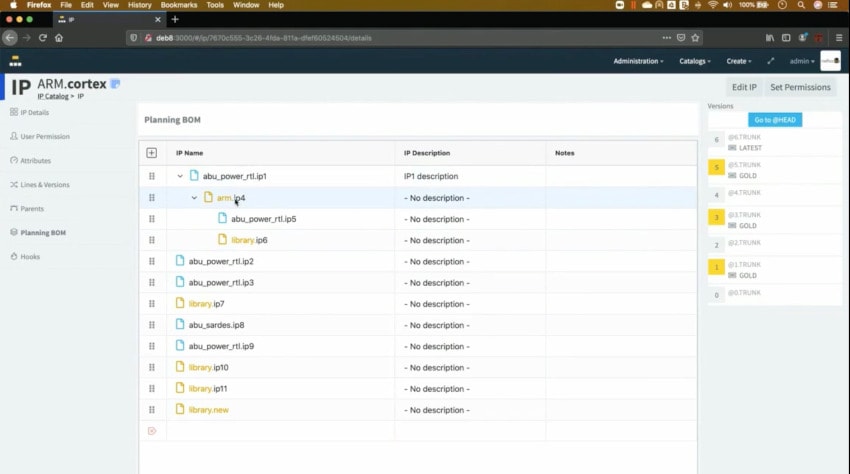
Project planning is now supported with a new Planning BOM, so your plan can evolve as you make early decisions about IP re-use. There’s also an integration with other planning and tracking systems, so this is another open approach.

IP Security challenges are met with three features:

  • IP Portfolio Leakage – Geofencing of IP, and an IPLM permissions hub
  • IP Security Assurance – supporting emerging Accellera IPSA standard
  • IP Provenance – using blockchain to verify IP source, secured metadata

Visualizing your IP is now improved with a refreshed PiWeb look and feel, making it easier to navigate, view the IP library catalog, do advanced searches, and a new analysis tabs that can be customized.

Under the hood one of the biggest enhancements is Custom Defined Objects (CDO), which are used for rapid prototyping and building custom data models without changing the SW from the factory, enabling customer-specific usage.

Performance improvements with PiCache  allow the database to handle even larger designs and more users. The cache is more equitable across multiple projects, and will let you tune resources based on specific project needs.

Demo

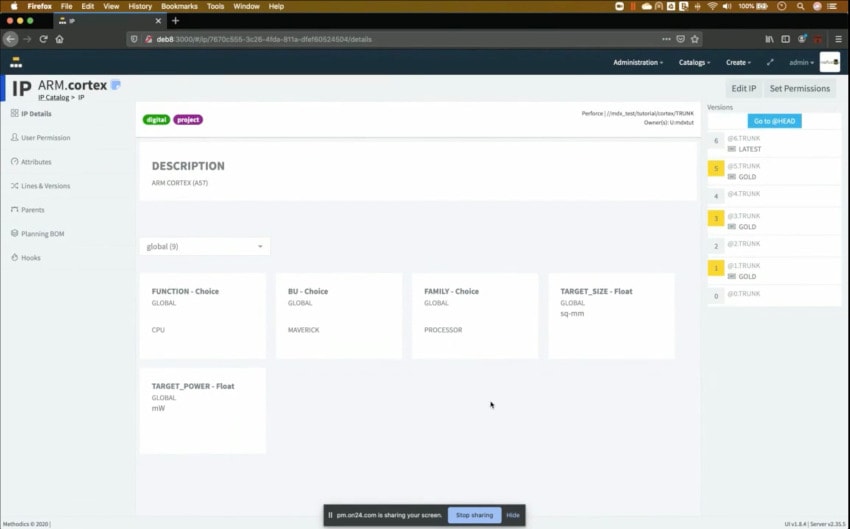
Vishal did a live demo, walking us through the new GUI starting with the IP catalog page, and including the new Planning BOM. The Yellow color shows something that is yet to be fully defined:

Q&A

Q) Will Methodics still support other DM than Helix?

Q) How does VersIC fit into this?

Q) Do you see IPLM extending into system and SW space?

Q) Will the new planning BOM work with other enterprise solutions?

IP Lifecycle Management

IPLM is an important part of SoC design, and as chips get larger, the need just continues to grow. Methodics has been focused on automating this area since 2006, and now as part of Perforce their vision just gets stronger with a third generation offering.

Watch the archived webinar online.

Related Blogs


Better Speech Recognition by Reducing Babble

Better Speech Recognition by Reducing Babble
by Bernard Murphy on 11-17-2020 at 6:00 am

I’ve become a bit of a connoisseur of voice-based control, so when Chris Rowen did a pitch on Babble Labs at Arm Dev Summit last month, I wanted to listen in.  Chris was the CEO of Babble Labs, recently acquired by the Cisco Webex group where he’s now listed as VP Engineering of the Voice Technology Group. You should expect to see this technology appearing at some point on a conference call near you. This acquisition also firmly established Chris as a serial entrepreneur. Will be interesting to see what he tries next. He’s certainly impressed Cisco with better speech recognition.

AI-based transcription

One type of voice-based control is provided in transcription – converting speech to text.  Cloud-hosted transcription services, eg from IBM Watson, need input speech with little background noise. I use such a service to transcribe interviews. It does a good enough job for my purposes, with maybe ~80% accuracy. But what if you want to use voice-based control in a noisy environment? First responders and health-care workers can’t depend on low-noise. If you’re in a restaurant, or shopping, walking through a city, in a busy home or office environment you can’t control noise. You don’t need to transcribe long emails or book chapters in these environments, but basic control through voice commands is highly desirable. Particularly for those emergency responders whose hands are otherwise occupied.

Noise mitigation

Mitigation starts with voice pickup. Audio zoom is becoming popular. Detect where the speaker is and use beamforming to zoom in on that speaker while suppressing audio noise from other sources. Then there’s audio echo cancellation. In a room audio signals can echo off walls and furniture. This will detect and suppress delayed echoes. Adaptive noise cancellation is another trick using inward-facing and outward-facing mics, to guide generating a cancelling waveform. Primarily valuable for headphones and earphones, or in a car cabin. This technique works well for road noise, train noise, fans, equipment rumble, noises which are relatively low frequency and fairly steady. Chris calls this stationary noise. Stationary noise cancellation doesn’t work so well for a baby crying, a dog barking, somebody typing, background speech, as anyone who has used noise-cancelling headphones will know. He calls this dynamic noise.

Mitigating babble noise

This kind of noise is common, much more common than those quiet transcription settings. At an accident, in an emergency room and so on. And these noises fall squarely in the frequency range of human speech. If you filter them out, you’ll also lose the voice of the person giving commands. This takes a different approach.

Chris mentioned a shift in command recognition, once speech is captured, from recognizing phonemes to words to command structure, to instead directly recognizing full commands. My impression is that this is already fairly widely applied at the edge. The probabilistic nature of deep learning recognition gives a higher probability of recognizing a full command directly than in a sequence of recognition steps.

More importantly, Babble has put a lot of work into recognizing “babble”. Those background noises that interfere with commands. This they also do through learning and are able to recognize commands against a much higher background of noise that transcription engines are able to handle. Chris showed several examples. As a reference, at 20 dB signal to noise, the kind of quiet environment recommended for transcription, IBM Watson recognized a set of commands just as well as Babble Labs. At 4 dB, Watson only got one command right and Babble Labs still performed perfectly. At 0 dB, Watson got nothing right and Babble Labs still got all commands right. Only at -3 dB did Babble Labs start to get some commands wrong.

Richard Burton of Arm followed with a discussion of running the Babble Labs capability on a variety of Arm platforms. He demonstrated stats from general purpose Cortex M7 all the way up to Ethos U55, showing a 160X speedup.

Cool stuff. I’d point you to the Babble Labs website, but it’s probably more useful now to point you to the Cisco press release.


Powering the Next Generation of Hearables and Wearables with Chipus

Powering the Next Generation of Hearables and Wearables with Chipus
by Mike Gianfagna on 11-16-2020 at 10:00 am

Powering the Next Generation of Hearables and Wearables with Chipus

Chipus is an interesting company. It’s been around since 2008 and focuses on mixed-signal ASICs, intellectual property blocks and IC design services. They are headquartered on the island of Florianopolis, which is described as the most dense startup ecosystem in Brazil. The company has substantial skills in analog and mixed signal designs, but they’ve also successfully delivered designs in FinFET technologies from RTL to tapeout. Having spent time in analog, mixed signal and FinFET design, I can tell you it’s a rare blend of skills to be able to address all of these disciplines. You can learn more about Chipus from the interview Dan Nenni did with their CEO, Murilo Pilon Pessatti here. Recently, I had an opportunity to preview a webinar that discusses powering the next generation of hearables and wearables with Chipus. IoT is hot, so this one certainly caught my attention.

Murilo Pessatti

The webinar is presented by Murilo Pessatti, CEO of Chipus and Heider Marconi, manager of technical sales at Chipus. Murilo co-founded Chipus. He started working with semiconductor design more than 15 years ago. Between 2003 and 2005, he worked in the power management group of Chipidea Microelectronics, Portugal (acquired by Synopsys). After his experience in Europe, Murilo joined CEITEC (a Brazilian IDM Company) as technical leader and project manager for three years. He holds an MSEE degree in analog IC design from UNICAMP (State University of Campinas) and also has background in project management.

Heider Marconi

Heider was previously CEO of DFchip, a design house and IP provider focused on developing efficient and low power circuits. He joined Chipus three years ago. Both these gentlemen have substantial background in power management and this was the focus of the webinar.

The webinar began with an overview of the hearables and wearables market and Chipus from Murilo. While these kinds of devices have been around for a long time, they are now becoming quite ubiquitous and consumers are demanding smaller, lighter and more comfortable devices. Success in this market will be decided by fashion trends and the devices themselves must accommodate those trends.

Applications include entertainment, health monitoring and augmented reality. Murilo shared some market size data, which is absolutely staggering.  You’ll need to watch the webinar to see the numbers for yourself. Murilo also discussed some work Chipus is doing with GLOBALFOUNDRIES on their 22nm FD-SOI technology, called 22FDX. After a discussion of market dynamics, Murilo handed the presentation over to Heider, who presented a comprehensive power management IP solution from Chipus based on GF 22FDX.

This IP handles a great deal of the power management functions for IoT class devices, including battery charging and battery management as well as overall power management for the chip. Since every design is different, the IP is highly configurable, allowing substantial power management offloading from the main processing portion of the design. Heider goes into a lot of detail, you really need to see the webinar and check it out.

The webinar concludes with a robust Q&A, addressing some very relevant application-level questions. The webinar replay is available HERE. I was amazed at the size of this segment of the IoT market. It’s definitely worth the time to see how Chipus is powering the next generation of hearables and wearables.

About Chipus

Chipus Microelectronics (ISO 9001:2015 certified) is a semiconductor company focused on the development of mixed-signal ASICs, intellectual property (IP) blocks and IC design services.

The company has more than 200 analog IP blocks in process nodes from 22nm to 0.35um of various foundries. Since its foundation in 2008, Chipus has worked with customers worldwide (South and North America, Europe, and Asia) with firm commitment and flexible client support.

Besides analog and mixed-signal expertise, Chipus also offers custom digital IC design services having successfully delivered designs in FINFET technologies from RTL to backend.

Headquartered in Florianópolis, Brazil, Chipus has a US subsidiary in Silicon Valley and sales teams in both USA and Europe.


TSMC to Build first US Fab in Arizona!

TSMC to Build first US Fab in Arizona!
by Daniel Nenni on 11-15-2020 at 10:00 am

TSMC North America SemiWiki

Well, it’s official, the TSMC Board of Directors approved an investment to establish a wholly-owned subsidiary in Arizona with a paid-in capital of $3.5 billion. As history shows the investment may be more than that but $3.5B is a great starting point. This is being discussed in the SemiWiki Forum  and I have been gathering inside intelligence from the ecosystem so let me offer my experience, observation, and opinion.

This is a GREAT political move by TSMC that will help insure the independence of Taiwan, absolutely. It’s only 20,000 wafers per month to start but it can be expanded quite rapidly as TSMC expertly does. Consider this first fab a “toe in the water” test to see how the US Government responds.

In my opinion the target customers would be the US Government and suppliers. Xilinx for example does quite a bit of government business with their FPGAs. Intel is shipping 16nm products today so a US based 5nm fab in 2024 would be perfect timing for Xilinx “made in the USA” customers.

And yes I know that TSMC built a fab (WaferTech) in the United States in 1996 but that was a joint partnership with three other companies. TSMC bought out the partners and now runs it as a wholly owned subsidiary.

Unfortunately, this “toe in water” move is certainly not a guarantee of political success. TSMC did a similar toe in water test in China with Fab 16 in Nanjing (2016) which did not go as planned. Rumor has it the China Government took this olive branch and used it to advance the China semiconductor initiative by “monitoring” construction and recruiting TSMC employees:

China hires over 100 TSMC engineers in push for chip leadership, Emerging chipmakers offer lavish pay packages to snap up talent.

TSMC also has an older 200mm fab in Shanghai but competing against the China Government backed SMIC is now rather challenging for foreign owned manufacturing companies inside of China.

The ultimate goal of course is for TSMC to be an active part of the H.R.7178 – CHIPS for America Act introduced in Congress on June 11th, 2020. Given the importance of semiconductors to modern life let’s hope this bill passes and ushers in a new era of global semiconductor collaboration, absolutely.

Creating Helpful Incentives to Produce Semiconductors for America Act or the CHIPS for America Act

This bill establishes investments and incentives to support U.S. semiconductor manufacturing, research and development, and supply chain security.

Specifically, the bill provides an income tax credit for semiconductor equipment or manufacturing facility investment through 2026. The bill also establishes a trust fund to be allocated upon reaching an agreement with foreign government partners to promote (1) consistency in policies related to microelectronics, (2) transparency in microelectronic supply chains, and (3) alignment in policies towards nonmarket economies.

The Department of Commerce shall, through the National Institute of Standards and Technology (NIST), carry out a program of research and development investment to accelerate the design, development, and manufacturability of next generation microelectronics, including through the creation of a Manufacturing USA institute for semiconductor manufacturing. Commerce shall also establish a program to match state and local government incentives offered to private entities for the purposes of building fabrication facilities relating to semiconductor manufacturing. Further, Commerce shall assess the capabilities of the U.S. industrial base to support the national defense in light of the global nature of supply chains and interdependencies between the industrial bases of the U.S. and foreign countries with respect to the manufacture and design of semiconductors.

The Department of Defense shall prioritize the use of specified available amounts for programs, projects, and activities in connection with semiconductor and related technologies.

The President shall establish within NIST a subcommittee on matters relating to U.S. leadership in semiconductor technology and innovation, which shall develop a national strategy on semiconductor research.

“Semiconductors were invented in America and U.S. companies still lead the world in chip technology today, but as a result of substantial government investments from global competitors, the U.S today accounts for only 12 percent of global semiconductor manufacturing capacity,” said Keith Jackson, President, CEO, and Director of ON Semiconductor and 2020 SIA chair. “The CHIPS for America Act would help our country rise to this challenge, invest in semiconductor manufacturing and research, and remain the world leader in chip technology, which is strategically important to our economy and national security. We applaud the bipartisan group of leaders in Congress for introducing this bill and urge Congress to pass bipartisan legislation that strengthens U.S. semiconductor manufacturing and research.”


2021 will be the year of DRAM!

2021 will be the year of DRAM!
by Robert Maire on 11-15-2020 at 6:00 am

Robert Maire Bloomberg

2020 has been a NAND growth year-2021 will be the year of DRAM. While foundry logic has gotten all the credit in 2020 the reality is that NAND has been up 2X in 2020 for semiconductor equipment provider Applied Materials (AMAT). It is expected that NAND will be flat in 2021 while DRAM will take over the growth slot with foundry/logic remaining the “steady eddie” grower.

Not much Kokusai Komment

Management did say they continue to believe that the Kokusai transaction will close by end of year but we take that with a very large grain of salt as we have seen this movie before with the Applied/TEL merger and the LAM/KLA merger. both of which dragged on before dying a slow death.

As we have previously mentioned , we think one of the ways this deal could get done is as an “olive branch” from China to the new incoming administration.
Given that this is just a “bolt on” acquisition with little synergy, we see little negative from the continued delay.

Applied claiming share gains versus industry

Applied spoke about year on year gains and numbers that implied outgrowing the market. When you dig into the numbers a bit more it would appear that they kept market share roughly flat in the NAND market versus the rest of the industry while taking some share in foundry/logic as that has been more of a core market for the company versus the memory market.

So the reality is that its likely more of a case of who is spending rather than Applied actually taking significant business from competitors.

Service is super solid

As we have seen with most other companies in the industry, the service business has grown to become an outsize portion of the overall business as the installed base becomes huge and the tool complexity with less sophisticated customers increases.

This recurring revenue stream is a great offset to the overall cyclicality of the systems business which gets better and smoother as the percentage continues to increase.

Display is OK

The display business being flat is more or less as expected. It remains a good but certainly not exciting business and perhaps not as attractive nor wildly exciting as the core semi business. There are not a lot of near term technology or capacity drivers expected that will move the needle in this space so we just view it and expect it to be a flattish performer

The Stocks- Is good good enough?

Applied was up a couple of percent in the aftermarket on the very solid results and upbeat commentary. Its hard not to like the results and financials and bullish commentary but it may not be a big enough beat to sustain upward momentum. It was good but the expectation was for it to be good after hearing from ASML, LRCX and KLAC. It also wasn’t significantly better.

The overall chip industry has been very good in 2020 versus the rest of the world as semiconductors have been needed for Covid alternatives and technology that continues to march on.

We are perhaps more optimistic, given the election results, that the China cloud that has hung over the industry will dissipate but it may take a few quarters.

The potential uptick in DRAM is certainly more promising as that spend could be a lot higher than lost SMIC spend.

On a collateral basis we don’t expect as much of a move from sub suppliers as they have already reported good news and the Applied news is not incrementally positive on top of that. ASML, LRCX and KLAC will likely see little additional benefit from the Applied quarter.‌