You are currently viewing SemiWiki as a guest which gives you limited access to the site. To view blog comments and experience other SemiWiki features you must be a registered member. Registration is fast, simple, and absolutely free so please,
join our community today!
WP_Term Object
(
[term_id] => 157
[name] => EDA
[slug] => eda
[term_group] => 0
[term_taxonomy_id] => 157
[taxonomy] => category
[description] => Electronic Design Automation
[parent] => 0
[count] => 4384
[filter] => raw
[cat_ID] => 157
[category_count] => 4384
[category_description] => Electronic Design Automation
[cat_name] => EDA
[category_nicename] => eda
[category_parent] => 0
[is_post] =>
)
“The only sustainable advantage you can have over others is agility, that’s it.” (Jeff Bezos)
The best workflow is the one that has been working until it doesn’t. In their quest to tape-out the next design, SoC teams rely on their proven workflow to meet design constraints and project milestones. As often the case, design … Read More
Predictions and trends create the forces that accelerate innovations and keep the industry moving forward. We are all used to hearing of important issues and challenges, usually in the context of solutions offered by various vendors. The SemiWiki forum plays its role in bringing awareness of all of the above to its audience. For… Read More
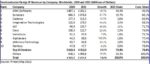
The last year has seen a ton written about the semiconductor industry: chip shortages, the CHIPS Act, our dependence on Taiwan and TSMC, China, etc.
But despite all this talk about chips and semiconductors, few understand how the industry is structured. I’ve found the best way to understand something complicated is to diagram… Read More
Remember when a pair of ethical hackers remotely took over a Jeep Cherokee as it was being driven on a highway near downtown St. Louis back in 2015? The back story is, those “hackers,” security researchers Charlie Miller and Chris Valasek, approached vehicle manufacturers several years before their high-profile feat, warning… Read More
Advanced board designs are fertile ground for misbehavior in time and frequency domains. Relying on intuition, then waiting until near-final product for power integrity (PI) or EMI testing almost guarantees board respins are coming. Lumped-parameter simulations of on-board power delivery networks (PDNs) struggle with … Read More
I’ve been following Neil Johnson on Twitter and LinkedIn for several years now, as he has written and shared so much about the IC design and verification process, both as a consultant and working at EDA vendors. His recent white paper for Siemens EDA caught my eye, so I took the time to read through the 10 page document to learn… Read More
The great thing about architectural solutions to increasing throughput is that they offer big improvements. Multiple CPUs on a chip with (partially) shared cache hierarchies are now commonplace in server processors for this reason. But that big gain comes with significant added complexity in verifying correct behavior. In… Read More
Multi-chip modules are now more important than ever, even though the basic concept has been around for decades. With The effects of Moore’s Law and other factors such as yield, power, and process choices, reasons for dividing what once would have been a single SOC into multiple die and integrating them in a single module have become… Read More
Multi-die design is not a new concept. It has been around for a long time and has evolved from 2D level integration on to 2.5D and then to full 3D level implementations. Multiple driving forces have led to this progression. Whether the forces are driven by market needs, product needs, manufacturing technology availability or EDA… Read More
Automatic adaptive meshing in Ansys HFSS is a critical component of its finite element method (FEM) simulation process. Guided by Maxwell’s Equations, it efficiently refines a mesh to deliver a reliable solution, guaranteed. Engineers around the world count on this technology when designing cutting-edge electronic products.… Read More
AI Bubble?