




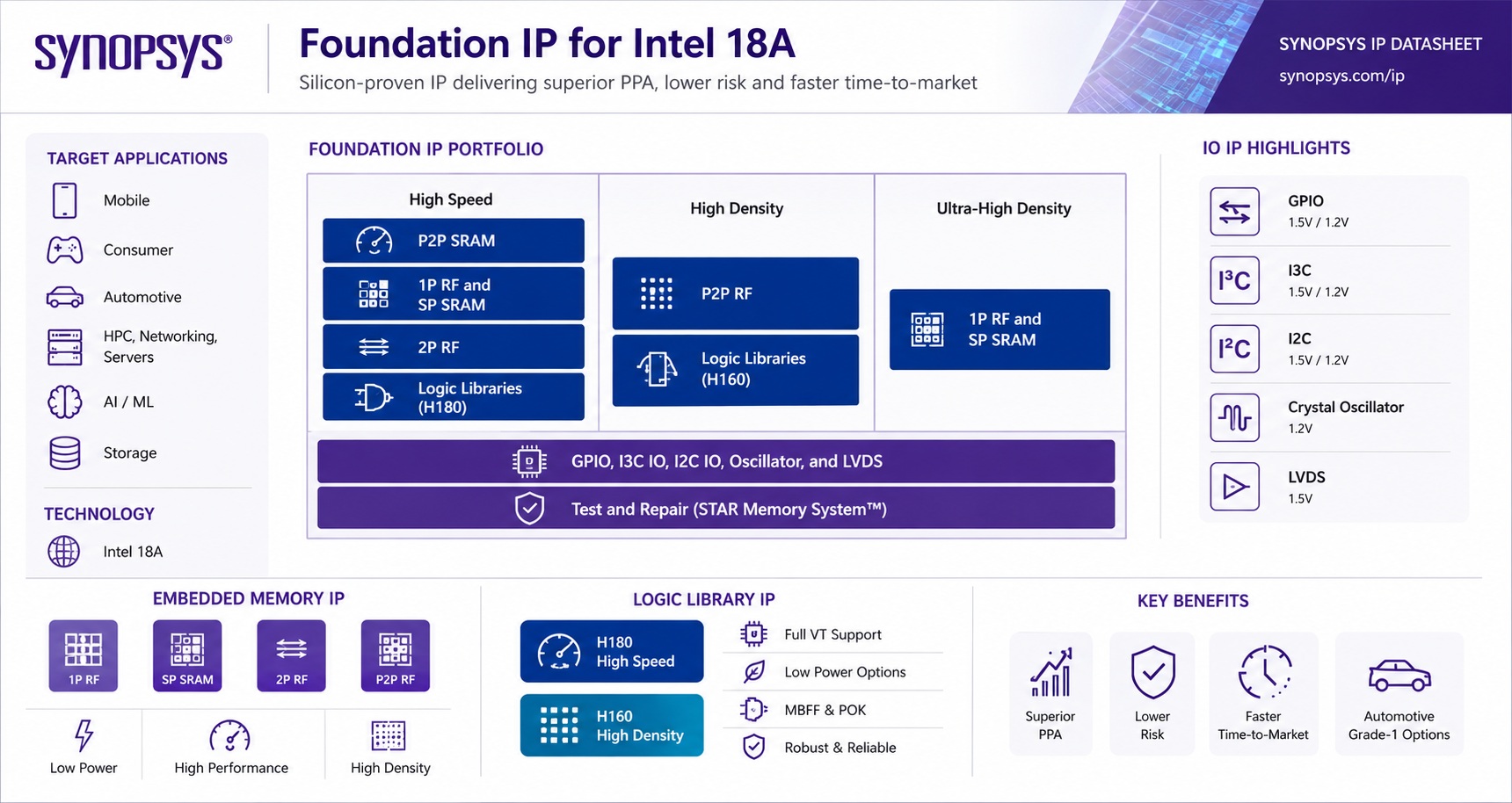

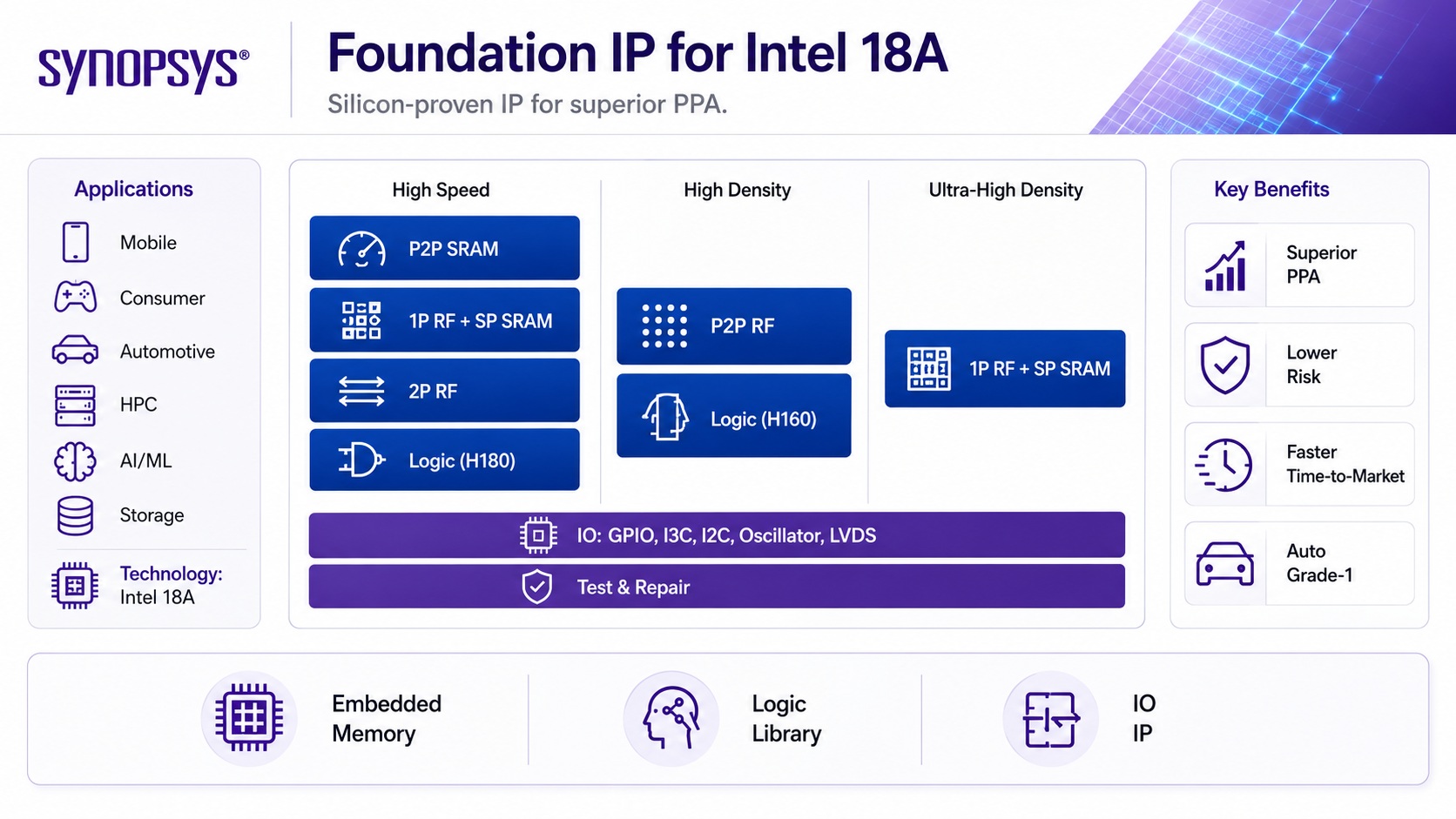
Synopsys Foundation IP for Intel 18A is a portfolio of semiconductor building blocks designed to help system-on-chip developers build advanced chips with better power, performance, and area, often called PPA. The offering includes embedded memory compilers, standard-cell logic libraries, and input/output libraries for Intel’s 18A process technology. In practical terms, this means chip designers do not need to create every low-level circuit block from scratch. Instead, they can use pre-designed, characterized, and silicon-proven IP blocks that are optimized for Intel 18A and integrated into standard design flows.
Having spent a significant portion of my career in Standard Cells, SRAM, I/Os and other IP (Sagantec, Prolific, Virage Logic, Solido Design), I know first hand how important this is. In fact, Synopsys bought Virage Logic and is still the #1 SRAM provider. Siemens EDA bought Solido and they are also #1 in SRAM and Standard Cell characterization. Sagantec ended up at Applied Materials and Arm bought Prolific.
Technically, the memory portion is one of the most important parts of the portfolio. Modern SoCs rely heavily on embedded SRAM and register files because processors, AI accelerators, networking chips, and storage controllers all need fast local memory. Synopsys provides several memory architectures, including single-port SRAM, one-port register files, two-port register files, and pseudo-two-port memory options. These are offered in high-speed, high-density, and ultra-high-density versions, allowing designers to choose whether performance, area, or power efficiency is the priority. The datasheet also highlights advanced power-management modes such as light sleep, deep sleep, shutdown, periphery-off operation, power gating, level shifters, and support for dynamic voltage and frequency scaling. These features matter because memory can consume a large share of chip area and energy, especially in AI and high-performance computing designs.
The logic library portion provides standard cells, which are the basic logic gates and sequential elements used to construct digital circuits. Synopsys offers two major architectures: H180 for high-speed designs and H160 for high-density designs. The high-speed library targets applications such as GHz-class processors, high-speed communications, and high-performance computing, while the high-density library supports compact and power-efficient SoC implementation. The libraries support multiple threshold-voltage options, including high-performance and low-leakage variants, giving designers flexibility to tune timing, leakage, and switching power across different parts of a chip. The inclusion of multi-bit flip-flop kits is especially relevant for AI workloads because blocks with high switching activity can benefit significantly from reduced clock power.
The portfolio also includes power optimization kits, isolation cells, level shifters, retention flip-flops, power switches, and ECO kits. These components are essential for real commercial chip design because modern SoCs are divided into many power domains. Some blocks may be shut down, placed into standby, or run at different voltages depending on workload. Without robust power-management cells, it is difficult to achieve aggressive battery-life, thermal, and reliability targets.
The IO libraries extend the offering beyond internal logic and memory. Synopsys provides GPIO, I3C, I2C, crystal oscillator, and LVDS IP. These blocks allow the SoC to communicate with sensors, peripherals, clocks, boards, and high-speed external interfaces. The datasheet notes support for programmable IO voltages, fail-safe options, Schmitt triggers, spike filtering, power sequencing independence, open-drain modes, and LVDS power-saving features. These details are not glamorous, but they are crucial because many chip failures occur at interfaces, power boundaries, and system-level integration points rather than inside the main compute core.
Why does this matter?
First, foundation IP reduces design risk. At advanced process nodes, creating reliable memories, logic cells, and IO from scratch is expensive, slow, and technically risky.
Second, it accelerates time to market because teams can focus engineering effort on differentiated architecture rather than basic circuit infrastructure.
Third, it improves PPA, which directly affects product competitiveness in mobile, automotive, AI, HPC, networking, servers, and storage. The automotive-grade support, including ISO 26262 ASIL-D random hardware fault analysis and AEC-Q100 reliability qualification, makes the IP relevant for safety-critical SoCs.
Bottom Line: Synopsys Foundation IP for Intel 18A matters because it turns a cutting-edge manufacturing process into a practical design platform that companies can use to build real, reliable, power-efficient chips faster.
Also Read:
Intel 18A vs Intel 18A-P: What Is the Difference and Why Does It Matter?
The Yield Partnership: Intel and PDF Solutions Tackle Advanced Nodes
Share this post via:



Comments
There are no comments yet.
You must register or log in to view/post comments.